



Education Journalist | Study Abroad Lead
Binary compound is one that is made up of exactly two elements. An element is a substance that cannot be further broken down into simpler substances through chemical processes. Any of those boxes on a periodic chart of elements represents an element. Hydrogen, oxygen, and iron are examples of chemical elements. There may be only one of each element in a binary compound.
This can be seen in sodium chloride (salt), which contains one sodium (Na) and one chlorine (Cl). Even yet, certain binary compounds have multiple elements, such as nitrous oxide N2O, which comprises two nitrogen (N) and one oxygen (O). N2O is also known as laughing gas and you'll most likely come across it if you need your wisdom teeth removed at the dentist.
| Table of Content |
Keyterms: Elements, Hydrogen, oxygen, iron, sodium chloride, sodium, chlorine, oxygen, nitrogen, H2O
Binary Compound Definition
[Click Here for Sample Questions]
Binary compounds are those that have two separate elements in them. Elements are compounds that cannot be chemically divided into simpler substances.

Also Read:
Examples of Binary Compounds
[Click Here for Sample Questions]
Let's have a look at some examples of binary compounds in the real world. Let's go for a swim in a nearby river first. H2O can be found almost everywhere. What exactly is H2O? It's just water. Is it possible that it's a binary compound? It does, however, include two chemical elements: hydrogen and oxygen. As a result, it is a binary compound.

We can't swim in the river because it's too cold, but we can pan for gold. In fact, you strike it rich and find gold in your pan! Is gold (Symbol is Au) a binary compound? No, gold is merely a chemical compound (Au). Calcium chloride is also an example of a binary compound.
Binary Compounds Nomenclature
[Click Here for Sample Questions]
- In a binary compound first named the cation followed by the anion.
- Use the periodic table to find the name of a cation with a specified oxidation state.
- The anion names will be derived from the elements name plus the suffix ‘-ide’.
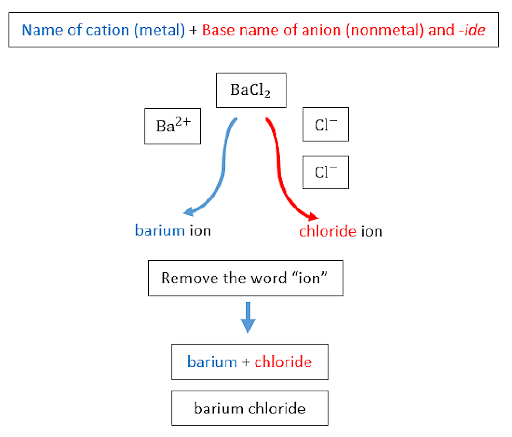
Binary Ionic Compound
[Click Here for Sample Questions]
In a binary ionic compound, the first atom is a metal, while the second atom is a nonmetal. Because of the ionic link binary ionic compounds have relatively high melting and boiling points. Electrolytes are formed when they dissolve in water. Examples of binary compounds are Sodium chloride(NaCl), Sodium fluoride(NaF), Magnesium oxide(Mgo) etc.

Difference Between Binary Compound and Binary Acid
[Click Here for Sample Questions]
The physical state of binary acids and binary compounds is one of the factors that differentiates them. Acids are denoted by the "aqueous" symbol in aqueous molecules since they are also found in aqueous solutions. The characters "1" and "g" denote binary molecules or compound liquids or gases. The cations are named first followed by the anions, in the naming order of binary compounds.
Things to Remember
- Make sure the second name contains the root plus suffix "-ide." BaS could be mistaken for "barium sulfuride" by some students.
- Binary compounds are also found in everyday life such as water and calcium chloride.
- Organic compounds are essential to all species that can be characterised as living on Earth and most likely elsewhere in the universe.
- The seventh group of the periodic table is binary acid which consists of binary hydrogen compounds with one hydrogen atom linked to another atom.
- Binary acid strength is determined by a number of parameters including electronegativity, bond strength and dissociation constant.
- When you utilize a cation with a stable oxidation state then the name can be extracted straight from the periodic table.
Read More:
Sample Questions
Ques: How can you tell if a compound is a binary compound? (2 marks)
Ans: Two distinct components make up a binary compound. A binary compound is a chemical compound made up of exactly two distinct elements in chemistry.
Ques: What is the naming ending of the binary compounds? (2 marks)
Ans: The suffix “-ide” is the naming ending of the binary compound.
Ques: What do you mean a binary covalent? (2 marks)
Ans: Two distinct elements make up a binary covalent compound (specially non-metals). Like a molecule of chlorine trifluoride.
Ques: What makes a binary acid different from an oxyacid? (2 marks)
Ans: A binary acid is made up of two elements like hydrogen and one other. Hydrogen, oxygen and one other element make up oxyacids.
Ques: How can you tell whether a compound is covalent or ionic? (2 marks)
Ans: A metal and a nonmetal form an ionic bond, while two nonmetals form a covalent bond. So you normally just check the periodic table to see if your compound is made up of metals or nonmetals or if it's just two nonmetals.
Ques: What is the world's most strong acid? (2 marks)
Ans: Fluoroantimonic acid is the most strong super-acid ever discovered in the world. It has a pH of 20 quintillion times that of 100 percent sulfuric acid and it may dissolve glass and a variety of other materials.
For Latest Updates on Upcoming Board Exams, Click Here:https://t.me/class_10_12_board_updates
Also Read:



Comments