



Content Curator
Bryophyta is a taxonomic division under Kingdom Plantae comprising three non-vascular land plants: the Liverworts, the Hornworts and the Mosses. They do not possess any differentiated vascular tissue such as xylem and phloem. The plant body is not differentiated into root, stem and leaves like other members of Embryophytes. The members of the group Bryophyta show heteromorphic alternation of generation with a more prominent gametophytic phase. The sporophyte is short-lived and nutritionally dependent on an independent gametophyte.
Keywords: Bryophyta, Alternation of Generation, Life Cycle of Bryophyta
Bryophyta
[Click Here for Sample Questions]
Bryophyta is a taxonomic division under Kingdom Plantae comprising of three non-vascular land plants namely:
- Liverwarts
- Hornwarts
- Mosses
The modern classification system has placed the hornworts and the liverworts are placed in Anthocerotophyta and Marchantiophyta respectively and mosses alone represent Bryophyta. However, the term ‘Bryophyta’ is still used to indicate all three groups. Bryophytes consist of almost 20,000 members. They prefer moist environments but they can grow in drier environments as well. Although Bryophytes are considered thallophytes, sometimes they show a much more differentiated plant body by having stem-like and leaf-like structures.

Bryophyta
The reproductive structures of the Bryophyta members are enclosed gametangia and sporangia as they do not produce any flower or seed. They reproduce by both sexual and asexual means- sexual reproduction through spores and asexual reproduction through gemmae. In terms of evolution, bryophytes provide insights into the migration of plants from an aquatic environment to the land environment as they have a number of physical features that link features of both aquatic and land plants.
Read More:
Characteristics of Bryophyta
[Click Here for Sample Questions]
Bryophyta has several characteristics which are unique to the group. These characteristics are as follows.
- Bryophytes do not possess any vascular tissue having lignin. Although some members may contain specialized tissues to transport water.
- The members of this group do not have any proper root system, stem or leaves. Instead, they have stem-like and leaf-like structures.
- Bryophytes have rhizoids which are used for absorption and anchorage.
- Sexual reproduction takes place by spore formation and is dispersed through water mainly.
Characteristics of Bryophytes
- Water is very essential for members of Bryophyta to grow and spread to different places. Although they can survive in the drier environment as well.
- Their life-cycle is dominated by a multicellular gametophyte stage.
- The gametophyte is haploid and bears multicellular sex organs.
- Their sporophytes are generally differentiated into foot, seta and capsule.
- The sporophyte is nutritionally dependent on the gametophyte. The gametophyte is chlorophyllous and nutritionally dependent.
Read More:
| Difference between Bryophytes and Pteridophytes | Haplontic Life Cycle |
| Heterotrophic Nutrition | Transportation in Plants |
Classification of Bryophyta
[Click Here for Sample Questions]
Although the term ‘Bryophyta’ refers loosely to a group consisting of three groups of plants, the molecular evidence has led to a major revision of the group. In the current classification system, the hornworts and the liverworts are placed in Anthocerotophyta and Marchantiophyta respectively and mosses alone represent Bryophyta. The current classification looks like this-

Classification of Bryophyta
Here, the classification of the liverworts leans on the features of the gametophytic structures with sporophytic features providing additional evidence. However, in the case of hornworts and mosses, the structure of the sporophyte (mainly the sporangium) is the distinguishing feature while the gametophytic characters provide the details for differentiating genera and species. The fundamental classification of the bryophytes is often difficult as a lack of criteria has hampered the process over time. Even the molecular evidence including the comparison of the gene sequences have not yet resolved all the disagreement in the classification of Bryophytes.
Read More:
Life cycle of Bryophyta
[Click Here for Sample Questions]
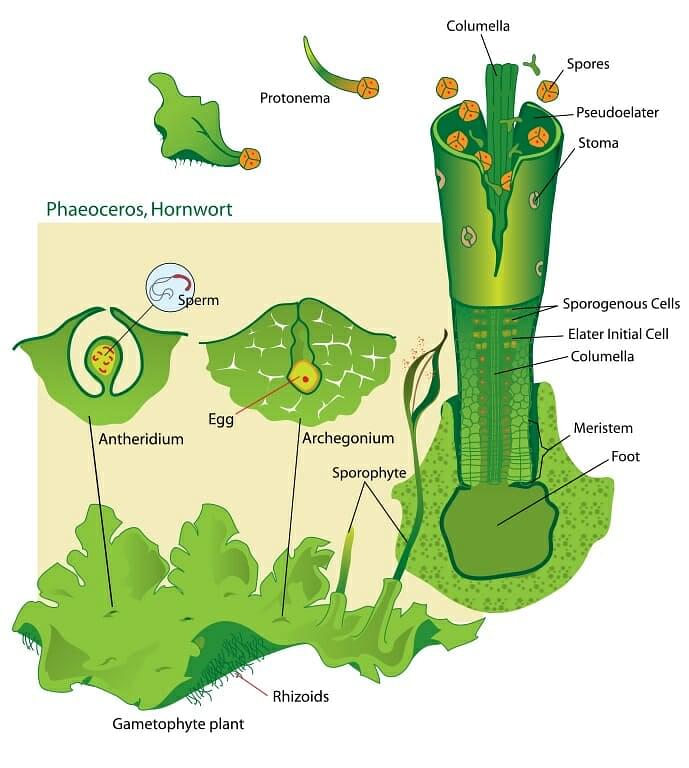
Like other Embryophytes, the bryophytes show life cycles with alternation of generation. In every cycle, a haploid gametophyte having cells with a fixed number of unpaired chromosomes alternates with a diploid sporophyte with cells having paired chromosomes. Here, the gametophyte stage produces sperm(n) and egg(n) which fuse to form a zygote(2n) which grows into a sporophyte(2n). Once mature, the sporophytes produce haploid spores by the process of meiosis which gives rise to a gametophyte.

Life Cycle of Bryophyta
In bryophytes, the gametophytic stage is dominant which means it is a more prominent and longer phase. The sporophytic phase appears occasionally and nutritionally dependent on the gametophytic phase. The gametophytic plant produces gametangia- archegonia and antheridia on the tip of the shoot, in the axil of the leaves or beneath the thallus. The flagellated sperms, developed in antheridium, swim from the antheridia and archegonia for fertilization. The fertilized egg or zygote develops into a sporophyte while enclosed inside the archegonia. Mature sporophytes remain attached to the gametophytes. The sporophyte produces sporangia which are spore-producing capsules. Each gametophyte may give rise to multiple sporophytes.
Read More:
Sexuality
The arrangement of the antheridia and archegonia on an individual bryophytic member is constant although there are considerable differences amongst different groups. Some groups of Bryophytes are monoecious as antheridia and archegonia grow on the same gametophyte. On the other hand, some bryophytes are dioicous where antheridia and archegonia develop on a separate gametophyte.

Moss Sexual Reproduction
In the case of the monoecious species, the archegonia and antheridia grow on the separate shoots of the same gametophyte. It is called autoecious. However, in some cases, they may form on the same shoot but in different structures (paroecious) or in the same structure (synoecious).
Read More:
Evolution of Bryophyta
[Click Here for Sample Questions]
It is thought that about 510 - 630 million years ago, after several processes of terrestrialization, the land plants evolved from aquatic plants such as green algae. The molecular evidence has shown that Bryophyta members are the earliest diverging lineages of the extant land plant groups. Bryophytes show linking features with both land plants and aquatic plants.

Evolution of Bryophyta
Bryophytes show embryonic development which is observed in vascular plants but not in algae. Again, although they lack vascularized tissue they possess specialized organs for specific functions, analogous to that of leaves and stems of the vascular plants.
Read More:
Things to Remember
[Click Here for Sample Questions]
- Bryophyta is a taxonomic division under Kingdom Plantae comprising three non-vascular land plant groups – Anthocerotophyta, Bryophyta and Marchantiophyta.
- The members do not possess any vascular tissue although the specialized leaf-like structures and stem-like structures may be present.
- Bryophytes have rhizoids instead of roots for anchorage and absorption.
- Bryophytes show alternation of generation which means the life cycle consists of gametophytic and sporophytic stages.
- The gametophyte stage is more prominent and longer than the sporophyte stage.
- The gametophytic plant produces gametangia- archegonia and antheridia. The male gametes are flagellated and develop inside antheridium while the female gamete or egg develops in an archegonium.
- The Bryophytes essentially require water for their fertilization process to occur.
- According to the modern classification system, the hornworts and the liverworts are placed in Anthocerotophyta and Marchantiophyta respectively and mosses are placed under Bryophyta.
Read More:
Sample Questions
Ques: Which one of the following is a non-vascular embryophyte? (1 mark)
(A) Thallophytes
(B) Bryophyta
(C) Angiosperms
(D) Gymnosperms
Ans: B. Bryophyta
In the members of the Bryophyta, the vascular bundle i.e. xylem and phloem are completely absent. That is why they are considered non-vascular plants.
Ques: Which of the following shows heteromorphic alternation of generation? (1 mark)
(A) Fungi
(B) Bryophytes
(C) Algae
(D) None of the above
Ans: B. Bryophytes
Heteromorphic alternation of generation refers to a type of alternation of generation in which the gametophytic and sporophytic plant bodies are morphologically and genetically different. The members of Bryophyta show such heteromorphic alternation of generation.
Ques: What are elaters? (2 marks)
Ans: The sporogonium of Marchantia is differentiated into foot, seta and capsule. The capsule contains specialized spindle-shaped, elongated, hygroscopic structures with two spiral bands. These specialized structures are called elaters.
Ques: State some medicinal uses of Bryophytes. (any three) (2 marks)
Ans: Bryophytes have numerous medicinal usages. Some of them are given below-
- Sphagnum –used in surgical dressing due to its high absorptive power and some antiseptic property
- Marchantia- used to cure pulmonary tuberculosis and affliction of the liver.
- Polytrichium- it has been shown to dissolve stones in the kidney and gall bladder.
Ques: Why are Bryophytes called amphibians? (2 marks)
Ans: Although Bryophytes grow in dry environments water is absolutely necessary for the fertilization process. The male gametes swim to reach the archegonia which contain the female gametes. Thus, Bryophytes are called plant amphibians.
Ques: what kind of lifecycle is observed in Bryophytes? (2 marks)
Ans: The members of Bryophytes show a heteromorphic alternation of generation where the gametophyte is morphologically and genetically different from the sporophyte. Here, the sporophyte is nutritionally dependent on a much prominent gametophyte.
Ques: What is a gemma cup? (2 marks)
Ans: The Gemma cups are cup-like structures containing gemmae. These bilaterally symmetrical gemmae are small discs of haploid (n) that give rise to gametophytes directly.
Ques: In which of the following jacketless archegonia develops? (2 marks)
(A) Riccia
(B) Anthoceros
(C) Funaria
(D) Marchantia
(E) None of the above
Ans: The jacketless archegonia occurs in Anthoceros. Here the archegonia are sunken in the thallus. There is no jacket covering archegonium; the vegetative cells of the thallus protect the archegonium while a tip is found on the top.
Ques: What are the types of mature seeds? (3 marks)
Ans: The mature seeds are of two types-
Albuminous- here the endosperm is present to supply nutrients to the embryo in the seed.
Non- albuminous- Here, the seed does not contain any endosperm or other storage food.
Ques: classify plants based on their habitat. (3 marks)
Ans: On the basis of the habitat the plants can be of four types-
Hydrophytes- They are the plants that grow in the aquatic habitat.
Mesophytes- They grow under moderate moisture and temperature conditions.
Xerophytes- These plants grow in extreme conditions of deserts i.e. in the acute dearth of water.
Halophytes: These plants grow in the extreme saline habitats such as salt estuaries, saline ponds, alkaline soil, etc.
Epiphytes: These are the plants that grow on other plants.
Read More:



Comments