



Education Content Expert
Cactus is a flowering plant in the family Cactaceae. Cactaceae family is comprised of thousands of species that are characterized by thick, fleshy stems. Cactus are found thriving in hot, dry, and semi-desert habitats. Cactus can survive in such arid places due to the morphological and physiological adaptations that allow them to conserve water. Most cacti have succulent plant parts, especially their stem where water is conserved. Cactus have modified leaves that appear as spines on their stem. These features help the cactus against water loss and herbivory. Cactus has no true leaves, but green stems. Thus, the process of photosynthesis occurs mostly in their stems.
Read More: NCERT Solutions for Class 6 Science The Living Organisms Characteristics and Habitats
| Table of Content |
Key Terms: Cactus, Stem, Leaves, Photosynthesis, Desert, Adaptation, Spines, Cacti, Plants, Stomata, Water, Transpiration
What is Cactus?
[Click Here for Sample Questions]
Cactus, or cacti, are succulent desert plants that are often covered in sharp spines.
- There are around 1,650 different kinds or species of cactus.
- The habitat of cactus includes dry and rocky areas such as deserts.
- Cactus thrive in arid environments whereas the other plants struggle to survive.
- Cactus are able to survive in desert or arid areas because of their capacity to hold water.
- A sharp spine is an adaptation of a cactus plant that offers it additional protection as animals are less likely to eat them.
- Cactus can grow in all kinds of environments due to their adaptive features.
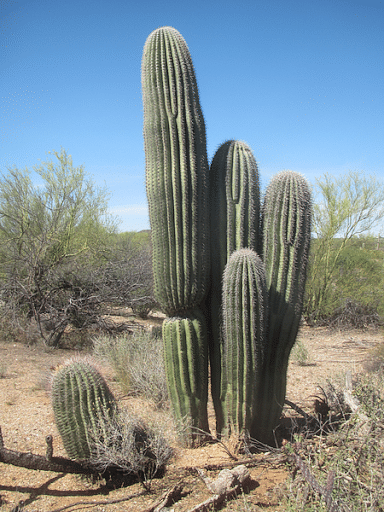
Cactus
Read More:
How are Cactus Adapted to Survive in a Desert?
[Click Here for Sample Questions]
Cactus have special adaptations in their roots, leaves as well as stems which enable them to survive in hot and dry environments. The adaptations of cactus to survive in a desert are:
Spines
- Cactus does not have any structures resembling leaves.
- The leaves of a cactus are modified into spines that emerge from small bumps on the plant known as an areole.
- Photosynthesis is thus not carried out by the leaves and is performed by the stems.
- Cacti have easy access to sunlight as they are predominantly found in deserts.
- The spines on cacti prevent excess evaporation since water is very hard to be found in deserts. Spines also help to trap air that restricts airflow and prevents evaporation.
- Spines collect dew from the early morning fog and when it is liquified into the water, it drips to the ground below.
- In such a manner the water is again absorbed by the plant.
- Spines on the Cactus also prevent herbivores to feed on the succulent flesh of the cactus.
Roots
- Cactus plant has shallow and wide fibrous roots that are very close to the surface to quickly absorb rainwater.
- Since rainfall is not frequent in deserts, thus, cactus have shallow roots that usually cover a large area to absorb the water quickly.
- The roots of the cactus also show temporary growth spurts during the rains which are often growing within a span of two hours.
- These temporary roots wither away after the rainfall.
- Root hairs grow quickly during rainfall to increase the surface area of absorption and die once the ground dries up.
- A few cacti have a taproot system in addition to fibrous roots, that grow deep underground and are of several times the length of the plant height above the ground.
- These taproots absorb water present deep underground.
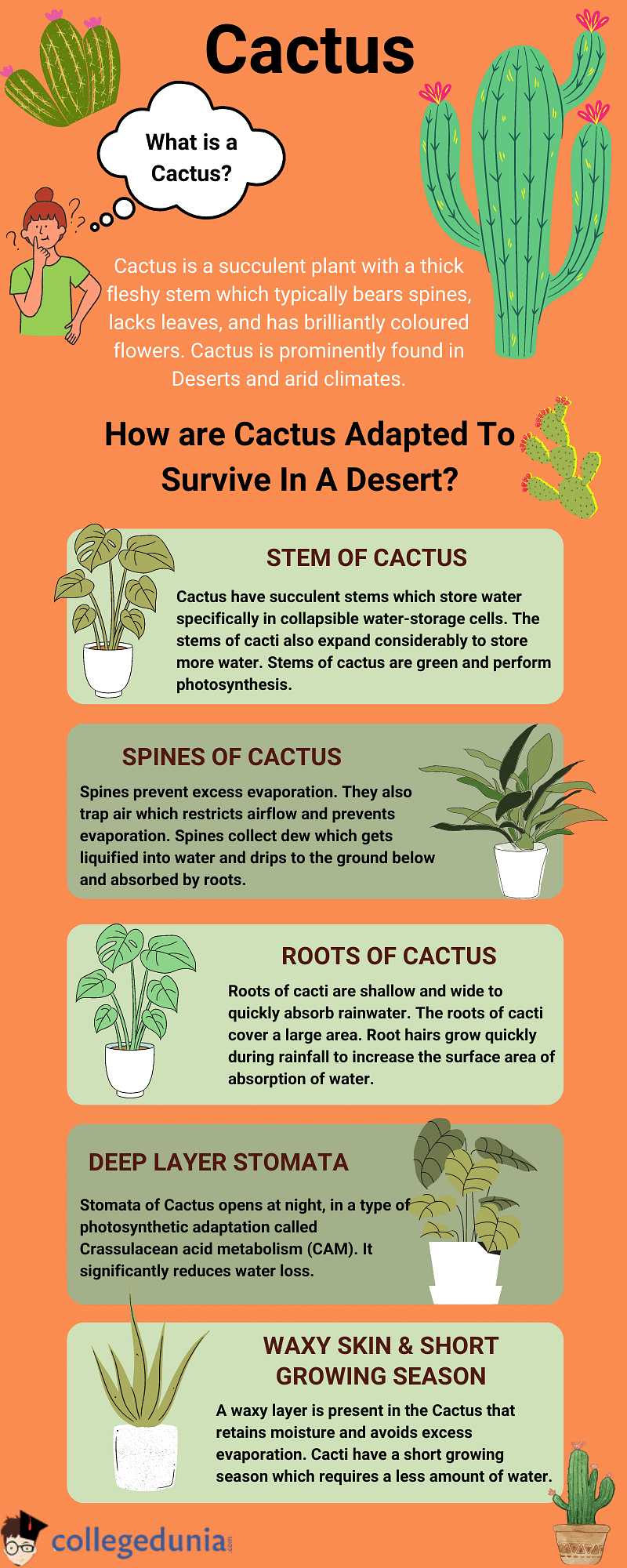
Cactus
Deep-Layer Stomata
- Stomata in cactus is found deep in the tissue as opposed to the surface.
- The stomata open at night in Catus which is a type of photosynthetic adaptation called Crassulacean acid metabolism (CAM).
- This process along with the deep-layer stomata significantly reduces water loss.
Thick and Expandable Stem
- Stems in cacti are succulent and comparatively thicker than other plants.
- Stems are the part where photosynthesis is performed in cacti.
- It is due to this feature that they store water in stems specifically in collapsible water-storage cells.
- The stems of cacti can also expand considerably to store more water.
Read More: Modifications of Stem
Waxy Skin
- A waxy layer covers most of the surface (except for the stomata) of the cactus.
- This waxy layer on the plant helps to avoid excess evaporation as well as retain moisture.
Short Growing Season
- Cactus has a very short growing season in comparison to other plants.
- It is because constant growth requires a large amount of water and water is very scarce in environments like deserts.
- The cactus plants grow for one season and stop before resuming growth in the next season.
- Cacti grow slower than other plants, however, they do live longer.
Read More: The Living Organisms Characteristics and Habitats Notes
Facts about Cactus
[Click Here for Sample Questions]
Here are a few interesting facts about Cactus:
- Cactus grows in extremely hot and dry climates. Thus, it is commonly found in Mexico and many parts of the southwestern United States in North America.
- In India, cacti are mostly found in dry regions such as Gujarat and Rajasthan's Thar desert.
- Cactus stores a lot of water when it rains to meet the demands of the dry and hot conditions of the desert.
- Cactus have excellent adaptation to conserve water, one of which is only opening their stomata at night.
- Spines of cacti that are blown around by strong desert winds or that pierce animals frequently end up in new places which then develop into cacti plants. This ensures the plants' survival after the older ones die of old age.
Also Check:
| Related Topics | ||
|---|---|---|
| Plant and Tree | Transportation in Plants | Vegetative Propagation in Plants |
| Difference Between Natural Selection and Adaptation | Predation | Difference Between Adaptation & Mitigation |
Things to Remember
- Cactus are angiosperms present in deserts or arid climates.
- Cactus is one of the few plants that are able to thrive in deserts.
- Cactus have different parts that help them to adapt to the adverse conditions of a desert.
- There are special adaptations in the roots, leaves as well as stems of a cactus that enables it to survive in deserts.
- Spines, Deep-Layer Stomata, Thick Stems, Waxy Skin, and Short Growing season are some of the factors that allow cactus to survive in a desert.
Sample Questions
Ques. How are cactus adapted to survive in a desert? (5 Marks)
Ans. Cactus have various sorts of adaptations in their roots, leaves as well as stems which allows them to thrive in arid climates, especially deserts. Some of the adaptations are
- The leaves of a cactus are reduced to spines to reduce water loss through transpiration.
- The wide and deep roots of the cactus absorb rainwater on the surface and reach the underground deep water.
- It has sunken stomata to reduce water loss.
- There are fleshy and thick stems to store water and perform photosynthesis.
- A waxy coating is present on the stem to retain water.
- Cactus have a short growing season due to which they do not need much water to grow.
Ques. What adaptations are showcased by cactus to attract pollinators? (3 Marks)
Ans. Cacti generate different types of flowers depending on the type of pollinator they want to attract. The most frequent pollinators of cacti are bees, along with other insects such as butterflies, moths, hummingbirds, and bats. Cactus produce flowers that often bloom at dusk and in the evening, are less vividly colored than conventional cactus flowers, have a musty odor, and yield a lot of sugary nectar.
Ques. How do spines help cactus to adapt to the desert? (3 Marks)
Ans. The spine of a cactus performs various functions that help it to survive in deserts:
- Spines of the cactus defend the plant against predators.
- Spines control the airflow around the plant, thus, reducing transpiration or loss of water.
- When it rains, fogs, mists, or dews, the moisture in the air condenses on the spines and then drips to the ground for absorption.
Ques. How does a cactus save energy? (3 Marks)
Ans. A desert cactus do not have leaves that serve as the growth factories of the plant. Thus, one of the most crucial adaptations of cactus for surviving in the desert is a slow metabolism. Cacti focus on maintaining the structures and behaviours that aid in their survival rather than focusing their energy on producing the foliage that other plants require, to maintain their more rapid development.
Ques. How do spines save cactus from predators? (2 Marks)
Ans. The stem of the cactus has spines that protect it from predators or herbivores who might feed on it. The spines on the cactus may be long or short, thick and spiky or thin and hairlike, bristly, woolly, needle-like, barbed, hooked, straight, or curved. The colors of the spines may also vary.
Ques. Do cactus need leaves for photosynthesis? (2 Marks)
Ans. No, cactus do not need leaves primarily for the process of photosynthesis. One of the most notable adaptations of cactus is the absence of leaves. They do not require leaves because the process of photosynthesis takes place in stems.
Ques. Why do cactus develop temporary hair during rainfall? (2 Marks)
Ans. During rainfall, cactus roots develop temporary root hairs, which is an intriguing way for them to conserve water and avoid water loss. The surface area of the root system of a cactus is in touch with the soil and increases as a result of the rapid growth of these root hairs.
Ques. What function is performed by the roots of a Cactus? (2 Marks)
Ans. Cactus has a complex network of shallow roots that extend broadly along the surface of the soil. This complex network allows them to access any surface moisture caused by fog, mist, or morning dew as well as to soak up as much water as possible when it rains.
Ques. What is the waxy coating on the stem of the cactus? (2 Marks)
Ans. Cactus has a waxy coating on their stems called the cuticle. This waxy coating helps in keeping moisture inside the plant. The cuticle covering in cacti is impervious and extremely thick in comparison to the outer skin of most plants.
Ques. Where is Cactus found in India? (1 Mark)
Ans. Cactus are majorly found in the dry regions of India such as Gujarat and the Thar desert of Rajasthan.
Check-Out:



Comments