



Content Curator
Capillaries are defined as the blood vessels which are very minute in size and connect the arteries and veins. They help in transporting deoxygenated blood back into the veins and also transport oxygenated blood from the arteries to the body's tissues.
- The capillaries play a crucial role in the circulatory system, essentially between the arteries and veins.
- Capillaries are the smallest blood vessels in the vascular system.
- Capillaries are about 8 to 10 micrometers in size.
- When the skin gets scratched or pierced, blood is forced out of the capillaries which causes blanching.
- Blood is a physiological fluid that contains red blood cells (erythrocytes), which carry oxygen and give blood its red color.
| Table of Content |
Key Terms: Veins, Arteries, Heart, Tissues, Diffusion, Capillaries, Nutrients, Blanching, Branching, Vanuels
What are Capillaries?
[Click Here for Sample Questions]
Capillaries are tiny blood vessels that connect arteries and veins. Blood travels through the vessels as liquid connective tissue. It moves throughout the entire body, distributing nutrition, oxygen, and waste materials.
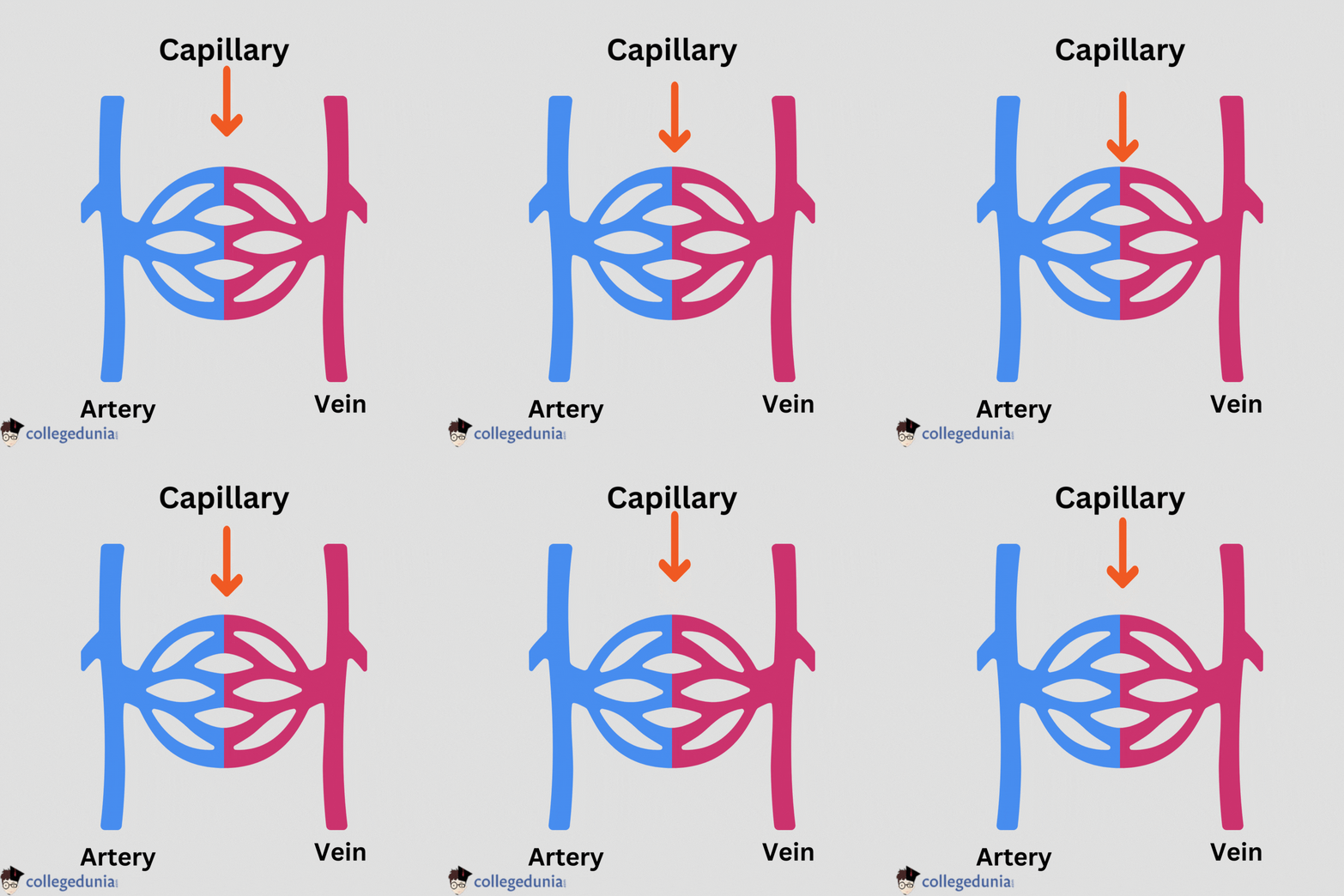
Capillary Diagram
- Veins, arteries, and capillaries are three different types of blood vessels, and each has a unique function in blood circulation.
- This integrated arterial system, which consists of the blood arteries that bring blood to and from the heart and the venous system, is connected by capillaries.
- The capillaries that connect the tissues and blood carry out the exchange of oxygen, waste, and nutrients.
These two exchanges take place:
- Passive diffusion is the process by which a specific material moves from an area of higher concentration to lower concentration.
- Pinocytosis is the procedure by which tiny molecules like proteins and lipids are taken up by bodily cells.
The endothelium is a thin layer that covers the capillary walls. The basement membrane is another layer that surrounds the endothelial layer. Various kinds of capillaries have various endothelial layer compositions.
Read More:
Capillaries System Structure
[Click Here for Previous Year Questions]
The arteries, which narrowly branch into the arterioles, which then branch into capillaries, carry blood out from the heart.
- Nutrient and waste exchange takes place in the capillaries.
- These capillaries subsequently converge to form venules.
- Blood returns to the heart through the vena cavae when these venules enlarge and converge to become veins.
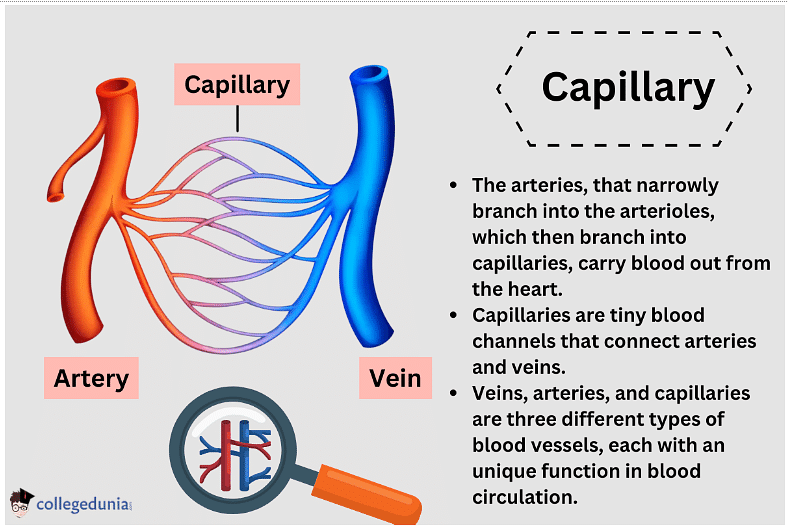
What are Capillaries Infograph?
- The blood capillaries have a diameter of three to four micrometers.
- They are composed of a thin layer of epithelial cells and a tunica intima-named basal lamina or basement membrane.
- An imperfect layer of cells called pericytes surrounds the epithelial cells in part.
The capillary bed functions as a component of each capillary and is an interconnected network of capillaries that serve tissues and organs. More capillaries are necessary to provide nutrients and eliminate metabolic waste when the tissue is more metabolically active.
Types of Capillaries
[Click Here for Sample Questions]
There are three different capillary kinds, and each one serves a different purpose:
Continuous Capillary
This form is thought to be the most prevalent. The endothelial cells have little space in between them.
- Gasses, water, sugar, and hormones can travel via these openings.
- However, the blood-brain barrier includes the continuous capillaries that are seen in the brain.
- By permitting the needed nutrients to pass through the capillary, this barrier aids in protecting the brain.
- As a result, there are no endothelial cell gaps in these brain capillaries, and the basement membrane that surrounds them is also thick and each one serves a different purpose.
Fenestrated Capillary
They leak more than continuous capillaries do. In addition to the tiny spaces between the cells, these also have tiny pores known as fenestrae or fenestra. These pores, which are situated on the walls, help in the interchange of molecules of greater sizes.
- The fenestra has a diaphragm-like, non-membranous structure.
- These fenestrated capillaries are present in the regions where the exchange of big molecules is necessary.
- Examples include the small intestine, which depends on the food's nutrients being absorbed where the filtering of blood occurs, in the kidneys.
Sinusoid Capillary
The most uncommon and leakiest capillary is the sinusoid capillary. The interchange of bigger molecules, including cells, occurs through these wide pores in the capillary walls.
- These can be discovered in organs such as the bone marrow, spleen, and liver.
- These capillaries are situated between the hepatocytes and the epithelial cells.
Lymphatic Capillaries
These minuscule capillaries are found between the gaps that exist in cells. It aids in draining the extra fluid.
- These capillaries are larger and have closed ends than blood capillaries.
- These capillaries carry lymph throughout the body.
- The cells therein separate when the pressure in interstitial fluid exceeds that in the lymph.
Systemic Capillaries
Systemic capillaries are located at the intersection of the arteries and veins. Internal respiration, in which oxygenated blood circulates throughout the body, is made easier by it.
- Carbon dioxide and oxygen from the alveoli are exchanged in the pulmonary capillary.
- The heart sends the blood, which has a high oxygen content, to the tissues.
- Deoxygenated blood is conveyed through the pulmonary arteries, whereas oxygenated blood travels through the pulmonary veins.
- The arteries via which the deoxygenated blood travels throughout the body are called pulmonary arteries.
Capillary Diseases
[Click Here for Previous Year Questions]
Due to the capillaries small size, any abnormal functioning might result in serious medical conditions:
- Birthmarks known as "port-wine stains" are brought on by the expansion of capillaries beneath the skin.
- Petechiae: The roughly pinhead-sized, spherical, tiny patches that are present on the skin. Purple to crimson are all possible hues.
- Petechiae can develop as a result of other illnesses such as leukemia, low platelet counts, or scurvy.
- Systemic Capillary Leak Syndrome:It’s a rare condition that happens randomly. The presence of specific compounds in the blood that damage the capillary walls.
- SCLS may cause some attacks that call for emergency medical attention.
- Arteriovenous Malformation Syndrome: Where capillaries are missing, an aberrant network of veins and arteries connects.
- The brain and spinal cord have tangles.
- A few of the signs include discomfort, a headache, difficulty speaking, seeing, or moving, and weakness. It is an uncommon disorder that is discovered at birth.
- Microcephaly-Capillary Malformation Syndrome is identified before birth. Capillaries are discovered to enlarge close to the skin's surface.
- It is brought on by a mutation in the STAMBP gene.
Read Also:
Things to Remember
- The smallest and most abundant blood vessels are called capillaries serve the purpose of exchanging materials between the blood and tissue cells.
- Platelets, plasma, white blood cells, red blood cells, and other components make up blood.
- Lymph is made up of lymphocytes. Gasses, hormones, and nourishment are carried by the lymph.
- Either through internal cavities or tightly closed tubes like arteries, blood circulates through the circulatory system.
Previous Year Questions
- Blood capillaries are made of...[NEET 1993]
- Blood group AB has...[NEET 1991]
- An adult human with average health has systolic and diastolic pressures as… [NEET 1998]
- Blood pressure in the mammalian aorta is maximum during...[NEET 2015]
- Blood pressure in the pulmonary artery is...[NEET 2016]
- Breakdown product of haemoglobin is...[NEET 1988]
- Bundle of His is a network of...[NEET 2003]
- Arteries are best defined as vessels which....[NEET 2018]
- Arteries carry oxygenated blood except...[NEET 1989]
- Cells formed in bone marrow include...[NEET 1992]
Sample Questions
Ques: Why is our heart referred to as myogenic? (2 marks)
Ans: "Mayo" means "muscular," and "genic" means "originating from." We refer to the cardiac impulse as myogenic since it originates in the heart muscles. An impulse that spreads over the heart walls can be produced by modified cardiac muscles or the nodal tissue of the heart, the SA node. The heart begins to beat as a result of this.
Ques: Define the cardiac cycle? (2 marks)
Ans: The contraction and relaxation of the atria and ventricles are just two of the processes the heart performs throughout the cardiac cycle. Systole is the event of contraction, and diastole is the event of relaxation.
Ques: Define the cardiac output? (2 marks)
Ans: Cardiac output is the term used to describe how much blood the heart can pump in a minute. It is the result of the heart rate and stroke volume (amount pumped each beat) (measured in beats per minute).cardiac output is calculated as heart rate times stroke volume.
Ques: Why do we consider blood as a connective tissue? (3 marks)
Ans: For the following grounds, blood can be classified as connective tissue:
- They are the most prevalent and widely dispersed tissue in the body.
- They bind, link, or support the other organs of the body.
- Gasses, nutrients, and hormones are transported by the blood from one human organ to the next. It permeates the entire body.
Ques: Describe cardiac noises. (3 marks)
Ans: Each heartbeat produces a different heart sound.
- During each cardiac cycle, lubb and dubb are audible.
- The bicuspid and tricuspid valves closing together causes causeirst sound, or lubb. It has a low pitch.
- Semilunar valves closing results in the second sound dub. It has a high pitch.
- In the clinical diagnosis of any heart-related illness, both sounds are crucial.
Ques: Difference between blood and lymph? (4 marks)
Ans: The difference between blood and lymph are as follows:
| Blood | Lumps |
|---|---|
| Blood is a red connective tissue | Lymph is a colorless viscous fluid. |
| Blood flows through blood vessel that is arteries, veins, and capillaries | It flows in the lymph vessels. |
| It also contains hemoglobin, red blood cells, white blood cells, and platelets. | It also contains white blood cells called lymphocytes. |
| It transports gasses and other nutrients in the body. | Exchange of gasses and nutrients between the blood and the cells occurs through the lymph. |
Ques: What is the lymphatic system's functional purpose? (3 marks)
Ans: Before being released to systemic circulation, it transports blood from the colon to the liver. It is crucial in the following ways:
- Glucose, amino acids, and other nutrients can be found in abundance in the blood from the alimentary canal.
- Blood passing through the liver during famine uses extra glucose and lipids.
- Poisonous ammonia is transformed into urea and then excreted by the kidney.
- The liver produces fibrinogen and other proteins that are transported throughout the bloodstream.
Ques: Why do thrombocytes need to be present for blood to coagulate? (2 marks)
Ans: Blood contains platelets, also known as thrombocytes, which are generated in the bone marrow and have a week-long lifespan. Every time we sustain an injury, blood leaks from our bodies and platelets are released to create thromboplastin, a clotting factor.
Pro-thrombokinase is induced when it is present and when calcium ions are present. A series of events lead to the formation of a blood clot, which plugs the damaged blood vessel and stops further blood loss.
Ques: Why do thrombocytes need to be present for blood to coagulate? (3 marks)
Ans: Blood contains platelets, also known as thrombocytes, which are created in the bone marrow and have a week-long lifespan.
- Every time we sustain an injury, blood leaks from our bodies and platelets are released to create thromboplastin, a clotting factor.
- Pro-thrombokinase is induced when it is present and when calcium ions are present.
- A series of events lead to the formation of a blood clot, which plugs the damaged blood vessel and stops further blood loss.
Ques: What does "double circulation" mean? What does it signify? (5 marks)
Ans: In a single complete cycle when the heart beats twice then that mechanism is known as double circulation. This type of circulation is found in frogs, reptiles, birds, and mammals, among other creatures.
However, it manifests more pronouncedly in birds and mammals whose hearts are completely segmented into four chambers: the right atrium, the right ventricle, the left atrium, and the left ventricle.
There are two distinct phases to the movement of blood in an organism:
- The circulatory system
- Pulmonary blood flow
The transfer of oxygenated blood from the left ventricle of the heart to the aorta is referred to as systemic circulation. The blood then transports to the tissues via a system of capillaries, arteries, and arterioles.
The venules, veins, and vena cava draw deoxygenated blood from the tissues and release it into the left auricle.
Deoxygenated blood is sent from the right ventricle to the pulmonary artery, which subsequently transports blood to the lungs for oxygenation, as part of the pulmonary circulation.
Ques: Explain: (3 marks)
(a) Hypertension
(b) Coronary artery Disease
Ans: Hypertension: The most prevalent ailment that affects the heart, blood vessels, brain, kidneys, and eyes are hypertension (high blood pressure).
120/80 is the normal blood pressure. It is considered to be high blood pressure or hypertension if it exceeds 140 mm Hg and 90 mm Hg. Causes include:
- Blockages occur in coronary heart arteries.
- Smoking tobacco increases the heart rate process. Blood arteries are constricted, and blood pressure is raised.
Coronary Artery Disease (CAD): This condition develops when fatty substances are deposited on the artery walls, leading to atherosclerotic plaques. This causes the artery's lumen to narrow, obstructing blood flow and, in severe cases, totally closing off the arteries, resulting in a heart attack.
Ques: What is the function of blood vessels and capillaries? (5 marks)
Ans: Blood vessels have a flexible tube that allows them to transport blood throughout the body along with oxygen, nutrition, water, and hormones.Arteries carry blood away from the heart because they are strong and flexible. Furthermore, it causes high blood pressure. The arteries constrict when the heart is relaxing because they are flexible.
Atherosclerosis keeps the body's blood pressure in check in this way. They both have a muscular wall, thus they keep their size (diameter) to change the blood flow to a specific bodily region.
Small capillaries that join veins and arteries (which transport blood out from the heart) are called capillaries (which carry blood again back to the heart). The capillaries transport waste materials from tissues to the blood as well as oxygen and nutrients from the blood into the tissues.
Read More:



Comments