



Education Journalist | Study Abroad Lead
Carbon nanotubes are a kind of carbon allotrope that resembles a tube of carbon atoms. Carbon nanotubes are extremely strong and are tough to break, but they are still light. Due to the presence of their phenomenal electrical, thermal and mechanical properties, carbon nanotubes are one of the most researched nanomaterials. They are mainly categorised into two different types, namely, Single Wall and Multiwall Carbon nanotubes. Multiwall carbon nanotubes have many concentric cylindrical lattices of carbon atoms, whereas one wall carbon nanotubes have just one cylinder of carbon atoms. Another name for carbon nanotubes is Buckytube. Two-dimensional graphite is rounded or folded into a cylindrical shape structure and is used to produce nanotubes that are concave inside. It has a diameter of 1-3 nanometers. Carbon nanotubes can be used for device modelling, energy storage, automotive parts, sporting goods, boat hulls, water filters, coatings, electromagnetic shields. thin-film electronics and actuators.
| Table of Content |
Key Words: Carbon, Nanotube, Single, Multi, Walled, Diameter, Transistors
Properties of Carbon Nanotubes
[Click Here for Sample Questions]
Some of the properties of carbon nanotubes are:
- Carbon nanotubes tend to be tough. They are found to be as tough as a diamond (diamond is the hardest natural material).
- The weight of the carbon nanotube is found to be very low.
- A carbon nanotube’s density is one-fourth of that of steel.
- Carbon nanotubes are much tougher than steel. They have great mechanical properties, and hence can be ten times stronger than steel.
- Carbon nanotubes tend to have a high thermal capacity. Normally, it is found to be twenty times more heat resistant than steel. Thus, unlike steel, it does not expand on heating. Hence, carbon nanotubes are used in making bridges and materials for aircraft.
- In carbon nanotubes, each carbon atom is attached with the other three carbon atoms by using covalent bonds. These covalent bonds of carbons form lattices with a hexagonal shape.
- A carbon nanotube’s crystalline structure exists in the form of regular hexagons.
- Carbon nanotubes are found to be elastic.
- Carbon nanotubes are good conductors of heat.
- Carbon nanotubes have good electrical conductivity.
- The young's modulus of a carbon nanotube is high, being around 1 terra pascal for each carbon nanotube, which makes it ten times stronger than steel.
- Carbon nanotubes are found to be chemically neutral. So, they have chemical stability. Thus, carbon nanotubes do not corrode.
Carbon Nanotubes
Read More:
Applications of Carbon Nanotubes
[Click Here for Sample Questions]
Carbon nanotubes have applications in various fields such as:
For the destruction of Breast cancer tumours
Carbon Nanotubes are utilised to end breast cancer tumours. The antibody along with the help of nanotubes is attached to the proteins by the cancer cells in the body and then the nanotubes absorb the laser beam used for killing the tumour’s bacteria.
Windmill Blades
Carbon Nanotubes are also used in windmill blades as they have low weight. This increases the windmill’s efficiency and helps to produce large electricity at a faster rate.
Filtration
Carbon nanotubes are used to separate particles from carbon nanotubes if the particle’s size is greater than the diameter of carbon nanotubes by filtering the particles through it. They can also be utilised to trap ions of smaller size from a solution.
Carbon Nanotubes as Nano Cylinders
Gas like H2 can be used as energy for the battery of vehicles, As it can be stored safely inside the carbon nanotubes and thus the H2 storage problem can be solved. Carbon nanotubes are also able to absorb infrared light and can be used in the IR optics industry.
Aircraft stress reduction
Carbon Nanotubes can also be used in aircraft and spacecraft to reduce the overall weight and stress of all the different components working together.
Types of Carbon Nanotubes
[Click Here for Sample Questions]
There are mainly two types of Carbon Nanotubes.
- Single-walled Carbon nanotubes
- Multi-walled Carbon nanotubes
Single-Walled Nanotubes
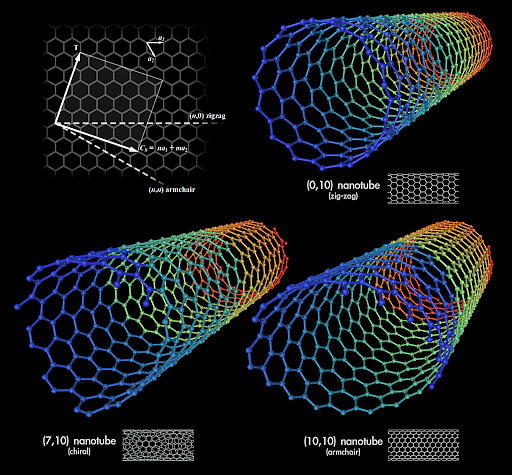
Single-walled Carbon Nanotubes is represented as SWCNT. They exist in a one-dimensional structure. Some of the examples for a Single-walled CNT are zig-zag and armchair Single-walled Carbon nanotubes
The properties of Single-walled Carbon Nanotubes are:
- A Single-walled Carbon nanotube’s diameter is around 2nm.
- They are also known as a nanowire as they exist in just one dimension.
- A single-walled Carbon nanotube can be used to miniaturize Electronics.
- They have a bandgap that varies from 0 to 2 electron volts (eV).
- They have conductive properties like that of a semiconductor. Therefore, they show both semiconductive and metallic behaviour.

Types of Carbon Nanotubes
Multi-walled Carbon Nanotubes
They are represented as MWCNT. They are made up of various nested carbon nanotubes. This kind of nanotubes has two different diameters, one is called the outer diameter while the other is called the inner diameter. Chiral Multi-walled Carbon nanotubes is a fine example of Multi-walled Carbon nanotubes.
The Properties of Multi-walled Carbon Nanotubes are as follows:
- The outer diameter of Multi-walled Carbon nanotubes is around 2 to 20 nanometres.
- The inner diameter of Multi-walled Carbon nanotubes is around 1 to 3 nm.
- The length of Multi-walled Carbon nanotubes is around 5 to 6 micrometres.

Multi-walled Carbon Nanotubes
Difference between Carbon Nanotubes and Carbon Nanofibres
[Click Here for Sample Questions]
Carbon nanofibres are shown as CNFs. Carbon nanofibres have a diameter of 200 nm. They are not hollow from the inside. The lattice structures of the carbon nanofibres and carbon nanotubes are completely different. In Multi-walled Carbon nanotubes, the nanotubes are hollow from inside but are arranged concentrically. So, Multi-walled Carbon nanotubes differ from carbon nanofibres. Carbon nanofibers have been used for several decades to strengthen compounds.
Miscellaneous Uses of Carbon Nanotubes
[Click Here for Sample Questions]
Other uses of carbon nanotubes are:
- Composite materials that consist of carbon nanotubes are used in sports goods.
- Carbon nanotubes have been used to produce bullet-proof jackets.
- Carbon nanotubes are used to make spacecraft and aircraft bodies.
- Carbon nanotubes are used to build high-performance nanoscaled thin-film transistors that will replace silicon-based transistors because of the excellent semiconducting properties of carbon nanotubes.
- Carbon nanotubes are used to make electrochemical sensors and biosensors.
- Carbon nanotubes are used to make electrodes to research electrochemical reactions as they have excellent electrical properties.
- They are also used as catalysts in some reactions.
- They are used in drug delivery systems and in some uses of electronics.
Things to Remember
- Carbon nanotubes are a kind of carbon allotrope that resembles a tube of carbon atoms.
- Carbon nanotubes are extremely strong and are tough to break, but they are still light.
- Due to the presence of their phenomenal electrical, thermal and mechanical properties, carbon nanotubes are one of the most researched nanomaterials.
- They are mainly categorised into two different types, namely, Single Wall and Multiwall Carbon nanotubes.
- Multiwall carbon nanotubes have many concentric cylindrical lattices of carbon atoms, whereas one wall carbon nanotubes have just one cylinder of carbon atoms.
- Carbon Nanotubes are utilised to end breast cancer tumours.
Read More:
Sample Questions
Ques: How do you purify carbon nanotubes? (3 marks)
Ans: Carbon nanotubes are cleaned by a treatment with concentrated nitric corrosive, then oxidized in air. Electrochemical pretreatments are done to expand the selectivity of carbon nanotube terminals.
Ques: What are the benefits of nanotubes over ordinary materials? (3 marks)
Ans: CNTs have been demonstrated to be an amazing added substance to grant electrical conductivity in plastics. Their high perspective proportion (around 1000:1) bestows electrical conductivity at lower loadings, contrasted with ordinary added substance materials, for example, carbon dark, slashed carbon fibre, or treated steel fibre.
Ques: What are the two different ways of production of carbon nanotubes? (3 marks)
Ans: The development of carbon nanotubes is possible by:
- Plasma-based combination technique or curve release dissipation strategy,
- Laser removal strategy,
- Warm blend process,
- Compound fume testimony
- Plasma-upgraded synthetic fume statement.
Ques: How strong are carbon nanotubes? (2 marks)
Ans: Rigidity is a proportion of how much power a substance can endure without destroying. The rigidity of carbon nanotubes is roughly multiple times more prominent than that of steel of a similar distance across.
Ques: Are carbon nanotubes biodegradable? (3 marks)
Ans: CNTs can be biodegraded by macrophages through enzymatic oxidation. Neither CNTs going through biodegradation nor the results of their corruption have been accounted for to be cytotoxic in vitro and in vivo.
Ques: Who uses carbon nanotubes? (3 marks)
Ans: One of the promising utilization of single-walled carbon nanotubes (SWNTs) is their utilization in sunlight powered chargers, because of their solid UV/Vis-NIR retention qualities. Research has shown that they can give a sizable expansion in productivity, even at their momentum unoptimized state.
Ques: Who invented carbon nanotubes? (2 marks)
Ans: In 1991, Iijima found carbon nanotubes (CNTs). From that point forward, another part of the information in materials science has arisen - Nanoscience.
Ques: What type of materials are carbon nanotubes? (3 marks)
Ans: Carbon nanotubes (CNTs) are carbon-based materials made of flimsy graphite sheets with dense benzene rings into a consistent rounded empty chamber. CNTs are ready from sp2 hybridised three-layered nanoscale tubes.
Ques: How do carbon nanotubes work? (3 marks)
Ans: Nanotubes go about as impetuses when an electric flow is gone through them. This allows them to give electrons to particles that interact with the response destinations. The response like occurs in power devices, so further examination might help in improving energy units.
For Latest Updates on Upcoming Board Exams, Click Here: https://t.me/class_10_12_board_updates
Check-Out:



Comments