



Education Journalist | Study Abroad Lead
Cartilaginous joint, often referred to as an amphiarthrose, is a joint formed by the skeletal system in which cartilage connects the bones. The joint cavity of cartilaginous joints is absent, in contrast to that of synovial joints, which are filled with fluid.
- In place of this, they have cartilage between the articulating bones, which offers support and permits just a small amount of movement.
- In parts of the body that need stability and restricted motion, cartilaginous joints are present.
Read More: Fibrous Joints
| Table of Content |
Key Terms: Cartilaginous Joints, Types of Cartilaginous Joints, Examples of Cartilaginous Joints, Cartilaginous Joints Function.
Types of Cartilaginous Joints
[Click Here for Sample Questions]
There are two types of cartilaginous joints: synchondroses and symphyses. Here are more details about each type:
- Synchondroses: These joints are characterized by the presence of hyaline cartilage between the bones. Synchondroses are typically temporary and are present during development and growth.
- They play a crucial role in the growth and development of long bones in children.
- As the bones mature, the hyaline cartilage in synchondroses is gradually replaced by bone tissue, resulting in a fusion of the bones.
- One well-known example of synchondrosis is the growth plate, also called the epiphyseal plate, located at the ends of long bones.
- The growth plate allows for longitudinal bone growth until it eventually closes during adolescence.
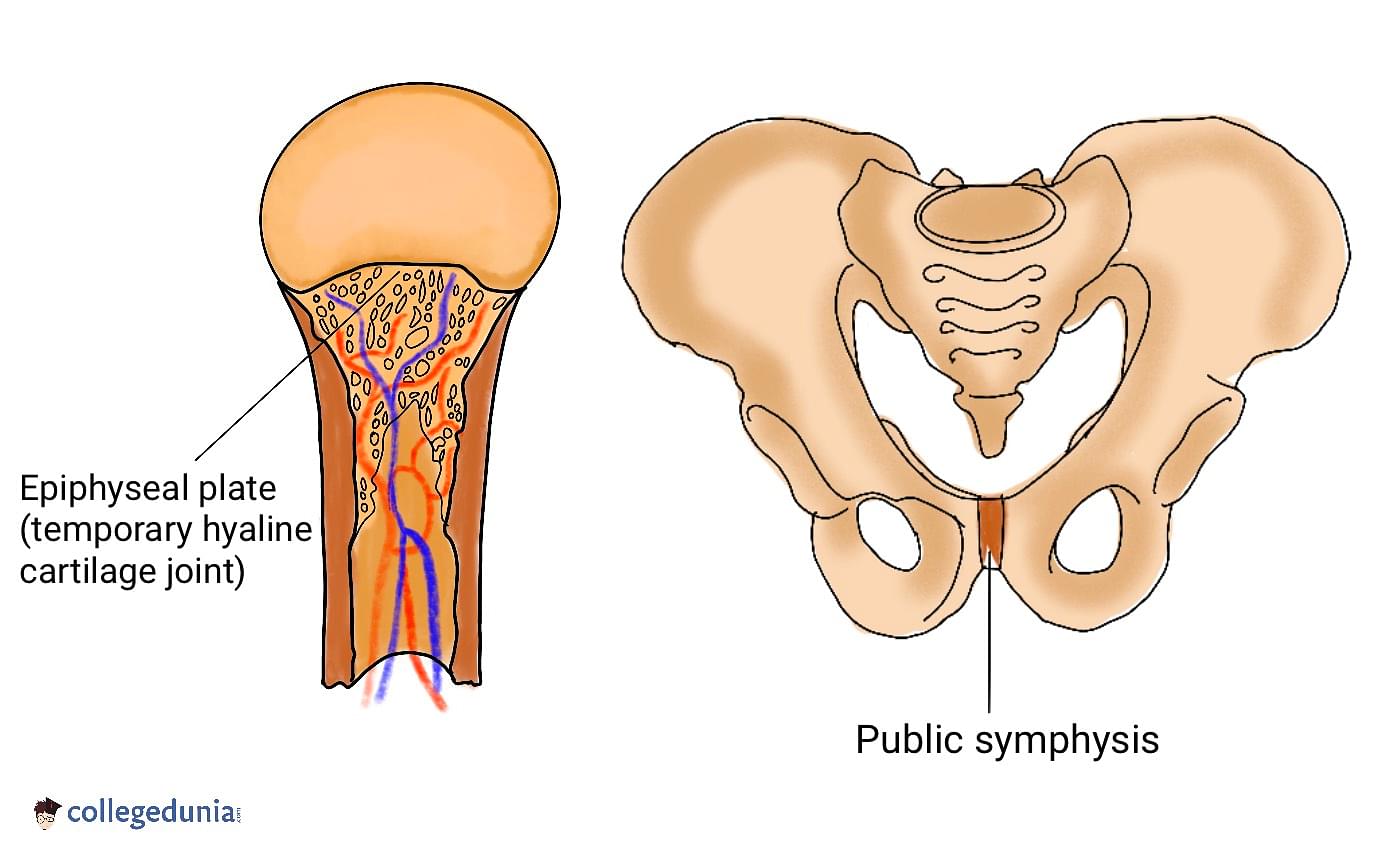
Types of Cartilaginous Joints
- Symphyses: In these joints, the articulating bones are separated by fibrocartilage. Hyaline cartilage is softer and less resilient than fibrocartilage, which gives the joint more stability and stress absorption. Symphyses allow for limited movement and are found in areas that require both stability and flexibility.
- The primary function of symphyses is to provide support and withstand the forces applied to the joint.
- One well-known example of a symphysis is the pubic symphysis in the pelvis, which connects the two pubic bones anteriorly.
- This joint helps to stabilize the pelvis during activities such as walking and childbirth.
- Another example is the intervertebral discs between the vertebrae of the spine.
- These symphyses allow for slight movement and act as shock absorbers between the vertebral bodies.
Both synchondroses and symphyses play important roles in maintaining skeletal structure and function. While synchondroses are primarily involved in growth and development, symphyses provide stability and shock absorption in weight-bearing areas of the body.
Read More: What are the 22 Bones of the Skull?
Structure of Cartilaginous Joints
[Click Here for Sample Questions]
The structure of cartilaginous joints involves the arrangement and composition of the tissues that connect the articulating bones. There are two main components that contribute to the structure of cartilaginous joints:
- Articular Cartilage: Articular cartilage is a smooth, shiny, and elastic type of connective tissue that covers the ends of the articulating bones in a joint. It is made up of specialized cells called chondrocytes that are encased in a collagen-, proteoglycan-, and water-based matrix.
- Articular cartilage acts as a protective layer, reducing friction and facilitating smooth movement between the bones.
- Its smooth surface allows the bones to glide against each other with minimal resistance.
- The articular cartilage also helps to distribute loads evenly across the joint, thereby reducing stress on the underlying bone.
- Fibrocartilage: Fibrocartilage is a tough and dense type of cartilage that contains both collagen fibers and cartilage cells. It provides additional support and stability to cartilaginous joints.
- Fibrocartilage acts as a shock absorber, reducing the impact on the joint during weight-bearing activities.
- It also helps to distribute forces evenly across the joint, preventing excessive stress on the bones.
- Fibrocartilage is found in areas where more stability and strength are required, such as the intervertebral discs of the spine and the pubic symphysis in the pelvis.
Read More: Ball and Socket Joint
Other Structures of Cartilaginous Joints
[Click Here for Sample Questions]
Few Additional structures of Cartilaginous Joints are mentioned below–
- The perichondrium is a layer of connective tissue that surrounds the cartilage in cartilaginous joints.
- It consists of fibrous tissue and contains blood vessels that supply nutrients to the cartilage.
- The perichondrium also plays a role in cartilage growth, maintenance, and repair.
- While cartilaginous joints do not have a synovial cavity like synovial joints, some cartilaginous joints may have a synovial membrane.
- The fluid produced by this synovial membrane, which borders the joint space, lubricates the joint, and feeds the cartilage.
- Overall, the structure of cartilaginous joints involves the presence of articular cartilage, fibrocartilage (in some cases), the perichondrium, and, occasionally, a synovial membrane.
- These structures work together to provide stability, shock absorption, and smooth movement within the joint.
Read More: Skeletal System
Functions of Cartilaginous Joints
[Click Here for Sample Questions]
Important functions of such joints are described below–
- Provide Stability: Cartilaginous joints play a crucial role in stabilizing the skeletal system.
- The dense and tough nature of cartilage and fibrocartilage helps maintain the alignment and structural integrity of the bones.
- Cartilaginous joints allow for limited movement while preventing excessive or undesirable movements that could lead to injury or instability.
- Absorb Shock: The presence of cartilage and fibrocartilage in cartilaginous joints allows them to absorb and distribute forces, thus reducing the impact on the bones.
- In weight-bearing joints like the spine, pelvis, and knees, where the joints are subjected to large stresses during motions like walking, jogging, or leaping, this is particularly crucial.
- The cartilage and fibrocartilage act as cushions, protecting the bones from excessive wear and tear.
- Facilitate Limited Movement: While cartilaginous joints have restricted mobility compared to synovial joints, they still allow some movement.
- This slight movement is essential for various physiological processes and activities.
- For example, cartilaginous joints in the spine enable slight flexion, extension, lateral bending, and rotation, contributing to the overall flexibility and mobility of the vertebral column.
- Similarly, When walking or giving birth, the pubic symphysis' cartilaginous joints allow for minimal mobility.
- Transmit Forces: Cartilaginous joints assist in transmitting forces from one bone to another.
- This helps maintain the continuity of force distribution within the skeletal system, allowing coordinated movement and effective load-bearing.
- The fibrocartilage in symphyses is especially adept at transmitting forces due to its toughness and ability to withstand compression.
- Support Growth and Development: Synchondroses, a type of cartilaginous joint, is vital during growth and development in children.
- They provide the necessary flexibility and support for longitudinal bone growth.
- The growth plates, which are synchondroses located at the ends of long bones, allow for the elongation of bones until they close during adolescence.
- By providing a site for new bone growth, cartilaginous joints contribute to the overall development and maturation of the skeletal system.
It's important to note that while cartilaginous joints serve these functions, their specific range of motion and stability vary depending on the type of cartilaginous joint and its location in the body. Each cartilaginous joint is uniquely adapted to fulfill its specific role in maintaining skeletal function and supporting bodily movements.
Read More: Bones of Legs
Diseases and Conditions
[Click Here for Sample Questions]
Diseases and conditions associated with cartilaginous joints include–
- Osteoarthritis: Over time, the cartilage in cartilaginous joints can wear down, leading to osteoarthritis.
- This degenerative joint disease causes pain, stiffness, and reduced mobility.
- Osteoarthritis commonly affects weight-bearing joints such as the spine, hips, and knees.
- Intervertebral Disc Herniation: The intervertebral discs between the vertebrae can experience herniation, where the gel-like center of the disc protrudes and puts pressure on nearby nerves.
- This condition can cause back pain, numbness, and weakness in the affected area.
- Pubic Symphysis Dysfunction: During pregnancy, hormonal changes can lead to loosening of the pubic symphysis, causing pain and instability in the pelvic region.
- This condition, called pubic symphysis dysfunction or pelvic girdle pain, can affect a woman's mobility and quality of life.
- Growth Plate Injuries: In children and adolescents, the growth plates in synchondroses can be susceptible to injuries.
- Fractures or trauma to these areas can disrupt bone growth and potentially lead to deformities or growth disturbances.
Things to Remember
- Cartilaginous joints are a type of joint in the skeletal system where bones are connected by cartilage.
- There are two main types of cartilaginous joints: synchondroses and symphyses.
- Synchondroses have hyaline cartilage between the bones and are temporary joints during growth and development.
- Symphyses have fibrocartilage between the bones and allow limited movement. They are found in areas that require stability and support.
- The structure of cartilaginous joints includes articular cartilage, fibrous cartilage, and a surrounding perichondrium.
- The functions of cartilaginous joints include providing stability, absorbing shock, allowing limited movement, and supporting growth and development.
- Diseases and conditions associated with cartilaginous joints include osteoarthritis, intervertebral disc herniation, pubic symphysis dysfunction, and growth plate injuries.
Sample Questions
Ques: What are the two main types of cartilaginous joints, and how do they differ in terms of the type of cartilage present? (2 Marks)
Ans: The two main types of cartilaginous joints are synchondroses and symphyses. Synchondroses are characterized by hyaline cartilage between the bones, while symphyses have fibrocartilage between the articulating bones.
Ques: What is the role of synchondroses in the skeletal system? (2 Marks)
Ans: Synchondroses play a crucial role in the growth and development of long bones in children. They provide flexibility and support for longitudinal bone growth. As the bones mature, the hyaline cartilage in synchondroses is gradually replaced by bone tissue, resulting in the fusion of the bones.
Ques: How do symphyses contribute to joint stability? (2 Marks)
Ans: Symphyses provide stability to the joints by having fibrocartilage between the articulating bones. Fibrocartilage is tough and flexible, offering additional support and shock absorption. This feature helps withstand the forces applied to the joint and maintain joint stability.
Ques: What are the main functions of cartilaginous joints? (2 Marks)
Ans: The main functions of cartilaginous joints include providing stability to the skeletal system, absorbing shock, facilitating limited movement, transmitting forces, and supporting growth and development.
Ques: How does articular cartilage contribute to joint function? (2 Marks)
Ans: Articular cartilage, which covers the ends of the articulating bones, acts as a protective layer. It lessens friction and enables easy bone-to-bone movement. As a result of the articular cartilage's smooth surface, the bones may move past each other with no resistance, distributing weight more uniformly and putting less strain on the underlying bone.
Ques: What is the role of fibrocartilage in cartilaginous joints? (2 Marks)
Ans: Fibrocartilage provides additional support, stability, and shock absorption in cartilaginous joints. Its tough and dense composition allows it to act as a cushion, reducing the impact on the joint during weight-bearing activities. Fibrocartilage also helps distribute forces evenly across the joint, preventing excessive bone stress.
Ques: Which joint in the pelvis is an example of a symphysis, and what is its function? (2 Marks)
Ans: The pubic symphysis in the pelvis is an example of a symphysis. Its primary function is to stabilize the pelvis during activities such as walking and childbirth. The symphysis allows for limited movement while providing support and withstanding the forces applied to the joint.
Ques: What are some diseases and conditions associated with cartilaginous joints? (2 Marks)
Ans: Diseases and conditions associated with cartilaginous joints include osteoarthritis, intervertebral disc herniation, pubic symphysis dysfunction, and growth plate injuries. These conditions can cause pain, reduced mobility, and, in some cases, deformities or growth disturbances.
For Latest Updates on Upcoming Board Exams, Click Here: https://t.me/class_10_12_board_updates
Check-Out:



Comments