



Education Content Expert
Fibrous Joints are a type of joint in which the bones are connected by strong fibrous tissue rich in collagen.
- Joints are defined as the point or locations within the body where two or more bones are connected together.
- They are primarily responsible for connecting bones throughout the human body.
- Arthrology is the study of joints that deals with the types, structures, functions, problems, and treatment of various joint disorders.
- Fibrous joints allow for very little or no movement.
- They are further divided into Sutures, Gomphoses, and Syndesmoses.
Read More: NCERT Solutions For Class 11 Biology Locomotion and Movement
Key Terms: Fibrous Joints, Arthrology, Sutures, Gomphoses, Syndesmoses, Tissues, Squamous Suture, Bones, Joints
What are Joints?
[Click Here for Sample Questions]
Joints are the site or locations in the body where two or more bones are connected together to allow movement. There are different types of joints based on the degree, type of movement, structure, and function.
Joints can be categorized into three major types which are:
- Fibrous Joints: These joints are immovable joints and are found where bones are not flexible such as in the Skull.
- Cartilaginous Joints: These joints are partly movable joints comprising symphysis or synchondrosis joints.
- Synovial Joints: Synovial joints are the most common type of joint and are flexible, movable, rotatable, and can slide over one another.
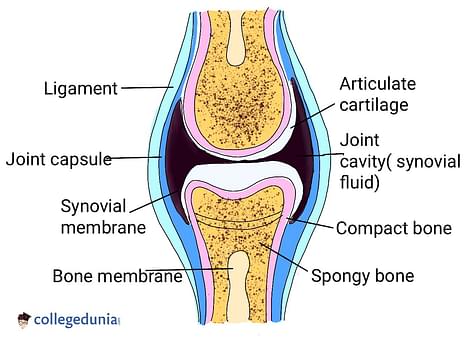
What are Joints?
Read More: What are the 22 Bones of the Skull?
What are Fibrous Joints?
[Click Here for Previous Year Questions]
Fibrous Joints are rigid or immovable joints that are restricted to only a few parts of the human body. Fibrous connective tissues, such as collagen fibers, join bones and hold them together.
- Skull is the best example of a fibrous joint.
- Bones are fused together so that they are fixed to that area and frame a structure as an immovable joint.
- Some other examples of fibrous joints are the backbone, pelvic bone, rib cage, and upper jaw.
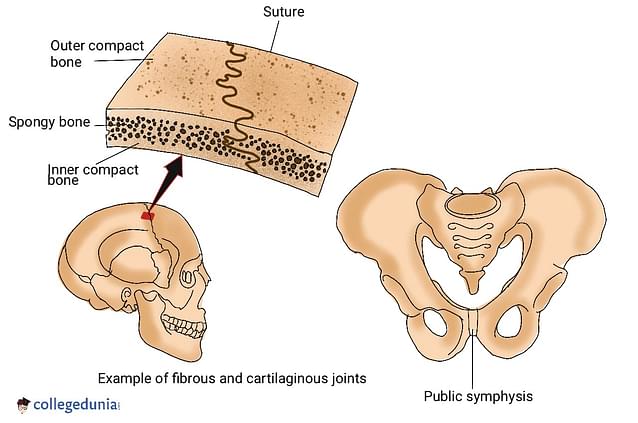
Fibrous Joints
Read More:
| Relevant Concepts | ||
|---|---|---|
| Skeletal System | Hinge Joints | Arthritis |
| Saddle Joints | Ball and Socket Joint | Bones of Legs |
Types of Fibrous Joints
[Click Here for Sample Questions]
Fibrous Joints are categorized into three categories based on their location:
- Sutures
- Gomphosis
- Syndesmoses
Sutures
Suture Joints are immovable or permanent joints made up of a thin layer of dense fibrous connective tissue linked to certain skull bones. By connecting the uneven interlocking edges of cranial bone, these joints also offer strength to the joint. Sutures are active bone development sites.
They are further classified based on the shape of the articulating surfaces and the manner of fusion of the articulating bones.
- Serrate Sutures: These joints are found between the parietal bones.
- Denticulate Sutures: These joints are found between the parietal and occipital bones.
- Squamous Sutures: These sutures are sutures found between the temporal and parietal bones.
- Limbous Sutures: They are slightly modified squamous sutures. Modified Tempro parietal suture is an example.
- Plane Sutures: They are found between the horizontal plates of two palatine bones.
- Wedge and Groove Sutures: They are the joints present vomer bone and rostrum of the sphenoid bone.
Read More: Locomotion and Movement Important Questions
Gomphosis
- Gomphosis is a unique fibrous joint that gives each tooth an independent and robust suspension.
- It secures the teeth in their sockets located in the maxilla and mandible.
- Peg and socket joints are other names for gomphosis fibrous joints.
Syndesmosis
- Syndesmosis is a form of fibrous joint in which interosseous ligaments connect two parallel bones.
- These types of joints are present in the forearm and leg.
- Examples of these joints include vertebrate joints, coracoclavicular joints, and old sacroiliac joints.
Check More:
Things to Remember
- Fibrous joints are joints in which the bones are linked together by strong fibrous tissue rich in collagen.
- Backbone, pelvic bone, rib cage, and upper jaw are some examples of fibrous joints.
- These joints are also called fixed or immovable joints because they do not move.
- Fibrous joints have no cavity and are connected via fibrous connective tissue.
- There are basically three types of fibrous joints namely Sutures, Gomphoses and Syndesmoses.
- Fibrous joints play an important role in connecting the adjoining bones as well as protecting the internal organs.
Previous Years’ Questions
- Fibrous joints play a significant role in locomotion. Fibrous joints have…
- Which of the following joints would allow no movements… (NEET - 2015)
- Which one of the following is not a synovial joint… (COMEDK UGET - 2014)
- The ball and socket joint is found in… (OJEE - 2011)
- ectoral girdle consists of…
- What is the name of joint between ribs and sternum… (NEET - 2000)
- Three of the following pairs of the human skeletal parts are… (NEET - 2011)
- Which of the following statements regarding locomotion…
- Total number of bones in the hind limb of a man is… (JIPMER - 2003)
- Which of the following is made up of a single bone… (AIIMS 1994)
Sample Questions
Ques. What are Fibrous Joints? (2 Marks)
Ans. Fibrous Joints are joints that connect the bones together by fibrous tissue, which is primarily composed of collagen. These are permanent joints formed by a layer of white fibrous tissue varying in thickness that connects bones. These joints lack a joint cavity. One of the most prominent examples of fibrous joints is the skull.
Ques. What is the function of Fibrous Joints in the human body? (1 Mark)
Ans. Fibrous joints in our bodies play an important role in strongly connecting the adjoining bones and protecting the internal organs. They also provide the body with weight-bearing stability and strength.
Ques. What is Scurvy? (2 Marks)
Ans. Scurvy is a connective tissue disease that affects the gomphosis joints, causing teeth to loosen due to joint instability. It is caused by the breakdown of the connective tissues around the teeth, which induces pain and inflammation. A doctor’s consultation is required if much damage has been done. It is a curable and non-communicable disease.
Ques. What are the types of Joints? (3 Marks)
Ans. Joints can be classified into three types based on their movement:
- Fibrous Joints: Bones in these joints are connected through fibrous tissues like collagen.
- Synovial Joints: In these joints, the ends of the bones are protected by the synovial membrane and synovial fluid.
- Cartilaginous Joints: The bones in these joints are connected through cartilage.
Ques. What is a Gomphosis, and what type of fibrous joint is it? (3 Marks)
Ans. A gomphosis is a fibrous peg-and-socket joint that moves. The only examples of this type of joint are the roots of teeth (pegs) that fit into the mandible and maxilla sockets. It is a unique fibrous joint that gives each tooth an independent and robust suspension. It secures the teeth in their sockets located in the maxilla and mandible. Peg and socket joints are other names for gomphosis fibrous joints.
Ques. Which joint has the greatest range of motion? (1 Mark)
Ans. The most prevalent and mobile form of joint found in a mammal's body is the synovial joint, often known as diarthrosis. Synovial joints provide movement at the place where the articulating bones meet.
Ques. What holds the bones together in a fibrous joint? (2 Marks)
Ans. Fibrous joints are held together by dense connective tissue made mostly of collagen. Since fibrous joints do not move, these joints are often known as fixed or immovable joints. Fibrous joints are joined by fibrous connective tissue and lack a joint cavity.
Ques. What is Syndesmosis? (2 Marks)
Ans. Syndesmosis is a fibrous joint in which interosseous ligaments connect two separate bones. Syndesmosis fibrous joints include vertebrate joints, coracoclavicular joints, and old Sacroiliac joints. Fibrous joints are rigid or immovable joints that are mostly restricted to a few parts of the human body. Fibrous connective tissues, such as collagen fibers, join bones and hold them together.
Ques. Do the hip and knee have Fibrous Joint? (2 Marks)
Ans. Fibrous joints are found within the joints of the hip bone. The three bones of the pelvis fuse together to form the fibrous joint. The knee, on the other hand, is not a fibrous joint. It is a synovial joint- the only joint that has a space or synovial cavity.
Ques. Where are Gomphoses found? (2 Marks)
Ans. Gomphoses are a type of fibrous joint that is also known as peg and socket joints. These joints line the upper and lower jaws in each tooth socket. These joints have a relatively limited range of motion and thus they keep the teeth tightly locked in place.
Check-Out:



Comments