



Content Writer
Ball and Socket Joints are type of synovial joints in which the rounded surface of bones moves into the cup-like depression of another bone. It can be divided into various parts, such as the hip joint, shoulder joint, knee joint and elbow joint.
- The ball and socket joints are also known as the spheroid joint.
- A joint is a connector of two bones that connects the skeleton.
- It keeps the body functioning as a whole.
- Arthrology is a branch of science that study about different types of joints.
- There are many different types of joints in the human body, and ball and socket joints are one of them.
- Ball and Socket Joints help in greater movement of any other kind of joint.
- It helps move three axes; hence, it is also termed polyaxial.
Read More: Types of joints
Key Terms: Ball and Socket Joints, Synovial Joint, Femur Bones, Joints, Bones, Spheroid Joint, Skeleton, Arthrology, Pelvic Bone, Femur Bone, Tendons
What are Ball and Socket Joints?
[Click Here for Sample Questions]
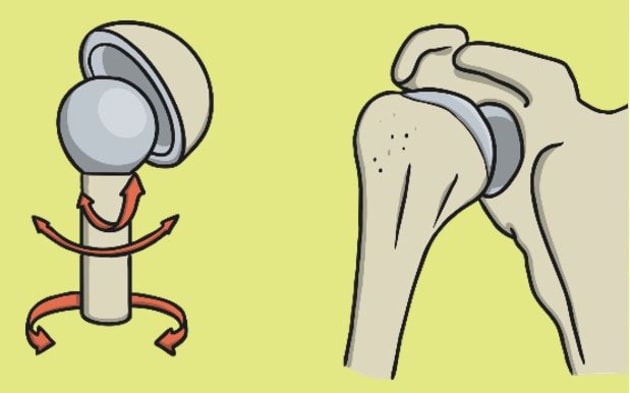
Ball and socket joints are freely moveable synovial joints. It is made up of one bone's ball-shaped surface that fits into another bone.
These types of joints have a ball-shaped surface.- The ball and socket joints have smooth freedom of movement.
- It has the ability to travel along infinite number of different axes while maintaining the same centre of motion.
- The bones responsible for movement along different axes are called distal bones.
- Ball and Socket Joints help in the movement of arms and legs in various directions.
- It helps in the spinning of limbs across stationary bones.
Read More:
Types of Ball and Socket Joints
[Click Here for Sample Questions]
The various types of ball and socket joints are as follows:
Condyloidal Joints
Condyloidal Joints are also known as biaxial joints. It is a type of ovoid articular surface or condyle that is placed on an elliptical cavity. It helps in the movement along two planes and allows for the flexion movement of joints. It helps in abduction, adduction and circumduction of joints.
Enarthrodial Joints
Enarthrodial Joints are also known as Multiaxial joints. These types of bones are located in the shoulders and hips. In these types of joint spheres, the head of one of the joints fits into a rounded cavity in the other bone. These types of joints move along different axes.
Ball and Socket Joints
Read More: Arthritis
Functions of Ball and Socket Joints
[Click Here for Sample Questions]
The various functions of ball and socket joints are as follows:
- One of the functional properties of ball and socket joints is mobility.
- It provides flexibility in indeterminate directions.
- Due to the cup-like depression and lock-and-key fit of the ball-shaped surface, one bone fits into the socket of the other, allowing movement.
- Ball and socket joints allow the hip to move in different directions for activities such as sitting, standing, and running.
- It helps in the lateral rotation of joints.
- They are responsible for maintaining the stable position of the body.
- Ball and socket joints help in forming a connection between arms and steering knuckles.

Ball and Socket Joints
Read More: Difference Between Bone and Cartilage
Features of Ball and Socket joints
[Click Here for Sample Questions]
The various features of ball and socket joints are as follows:
- The ball and socket joints are found in the shoulder and hip joints.
- It is a thick, irregular connective tissue that links two bones together in a synovial joint.
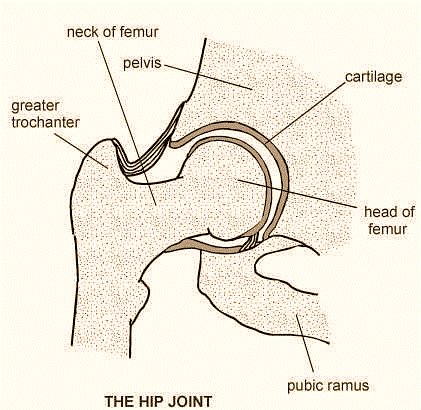
- The ball-shaped surface of the femur bone fits into the cup-shaped surface of the pelvic bone, or the acetabulum.
- Due to the thick, irregular connective tissue, the ball and socket joint are anatomically categorized as synovial.
- It provides optimum flexibility for bone mobility.
- It also helps to maintain the structural integrity of the body without destabilizing the freedom of movement.
Read More:
Things to Remember
[Click Here for Sample Questions]
- Ball and socket joint is a form of joint in which one bone's ball-shaped surface fits into the hollow cavity of another bone.
- Another bone that fits into the other bone is commonly known as a socket.
- This sort of joint allows for movement in all directions.
- There is a presence of fluid in joints which helps in the free movement of the bones.
- It is also known as synovial joints.
- The ball and socket joints are supported by tendons and ligaments.
Read More: Difference between Locomotion and Movement
Sample Questions
Ques: Why is Ball and Socket Joint important? (2 marks)
Ans: Ball and Socket joints are important because they provide both swinging and rotating movements. The distal bone can move about three major axes with a common center once the articulating bone is received into the cavity of another bone. Stabilizing ligaments restrict the directions and extent to which the bones can move in the joint.
Ques: What are the Synovial Joints and state its types. (5 marks)
Ans: Joints in the human body are categorized into several distinct kinds based on structural, functional, clinical, and biomechanical features. A form of joint renowned for unrestricted mobility and no direct connecting of the bones is the synovial joint, which is classified according to structural and functional features.
Various types of synovial joints are:
- Ball and socket joint: Ball and socket joints is in the shape of ball that is kept in the pocket.
- Hinge joint: It is a type of junction joint that bend along single axis.
- Pivot joint: It is a type of joint that rotate along single axis.
- Condyloid joint: These are biaxial joints that consists of movement across two axes.
- Saddle joint: It is a type of joint that move long different dimensions of the body.
Ques: How many Ball and Socket Joints are found in the human body? (1 mark)
Ans: In a human body there are six ball and socket joints. It is evenly distributed in a pair form. Two of the ball and socket joints are present in the ear, two in the shoulders, and two in the hip.
Ques: Do animals have Ball and Socket Joint? (2 marks)
Ans: Yes, animals do have ball and socket joints. The enormous shoulder and hip joints of animals have the most developed ball and socket joints, which enable swing for the arms and legs in various directions as well as spin of those limbs onto the more stationary bones.
Ques: What are Acetabular Fractures? (2 marks)
Ans: A break in the socket component of the "ball-and-socket" hip joint is known as an acetabular fracture. Hip socket fractures are uncommon, occurring far less commonly than upper femur or femoral head fractures (the "ball" portion of the joint). A high-energy incident, such as a vehicle accident, is responsible for the majority of acetabular fractures.
Ques: What is a ball and socket joint? Give examples. (3 marks)
Ans: A ball and socket joint is known as a joint in which one of the bones has a round head that fits within a hollow cavity of another bone allowing optimum flexibility in humans and animals. It is also known as spheroid joint.
- The fluids present within the bones of the capsules help in free movements of joints.
- It is made up of membrane found inside a capsule. Ball and socket joints help in rotational and circular movements.
- Example: Hip joint, elbow joint, shoulder joint.
Ques: Which of the skull bones is movable? Why do our elbow bones not move backward? (2 marks)
Ans: Lower jaw bone, also known as the mandible bone, is the only movable skull bone. Due to the presence of the hinge joint our elbow cannot move backwards and can only move in one direction.
Ques: What are the various types of movements that take place in ball and socket joints? (5 marks)
Ans: The various types of movements that take place in ball and socket joints are as follows:
- Abduction helps in the movement that takes place away from the body.
- Ball and socket joints provide greater flexibility to the bones and joints of the body.
- With the help of extension joints, bones can easily move in reverse direction.
- Circumduction helps in completing the circle of the joints.
- Adduction helps in the movement of joints that take place in the direction of the body.
Ques: What is the difference between abduction and adduction? (3 marks)
Ans: The difference between abduction and adduction are as follows:
| Abduction | Adduction |
|---|---|
| Abduction helps in the movement of limbs away from the midline of the body. | Adduction helps in the movement of limbs towards the midline of the body. |
| The muscle creating this type of motion are called abductor. | The muscle creating this type of motion are called adductor. |
| Moving your fingers away from each other is example of abduction. | Bringing your fingers together is example of adduction. |
| In case of hips, it moves legs to the sides of the body. | In case of hips, it fall toward the midline of the body. |
Ques: Give some examples of ball and socket joints? (3 marks)
Ans: Some common examples of ball and socket joints are as follows:
- Hip, which is located at the femur bone that rests in the socket of the pelvis.
- The shoulder joint is located at the upper extremity of the humerus joint.
- It rests in the cup-like glenoid fossa socket of the shoulder blade.
- The wrist joint is another example of ball and socket joints.
Ques: Explain the hip joint? (4 marks)
Ans: The hip joint is a type of joint that provides a connection between the thigh bone, known as the femur, and the bone of the pelvis. It is one of the largest bones. The femur bone has a round top that fits into the cup of the pelvis.
- It provides balance and support to the upper part of the body.
- The hip joint helps in the movement of the upper leg of the body.
- It is responsible for holding the weight of the body.
- Ligaments are responsible for connecting bones to bones.
Ques: What is the difference between tendons and ligaments? (5 marks)
Ans: The difference between tendons and ligaments are as follows:
| Tendons | Ligaments |
|---|---|
| In tendons, fibroblasts are present in a row. | In ligaments, fibroblasts are scattered. |
| They are in white colour. | They are in yellow colour. |
| Tendons are tough and elastic in nature. | Ligaments are elastic in nature. |
| They connect skeletal muscles to bones. | They are responsible for connecting bones to bones. |
| The proteoglycan content is low. | The proteoglycan content is high. |
Read Also:



Comments