



Content Curator
Bones of legs provide the body framework, attach the muscles and tendons, and protect the soft organs. The legs are one of the most important parts of the body which helps in its movement and locomotion. They are one of the most crucial parts of the entire skeletal system. The leg comprises three crucial bones.
| Table of Content |
Keyterms: Bones, legs, skeletal system, tendons, muscles, organs, crucial bones, knee joint, hip joint
Bones of Legs: Introduction
[Click Here for Sample Questions]
Legs provide support to the body while standing, and are modified to ensure the walking of the animals. The lower limb of the body is divided into three major regions. The thigh is foremost and is that portion of the lower limb which is located between the hip joint and knee joint.
The leg is the region between the knee joint and the ankle joint. Below the ankle is the foot. The lower limb contains 30 bones. These bones are the femur, patella, tibia, fibula, tarsal bones, metatarsal bones, and phalanges.
The femur is the single bone of the thigh. The patella is the kneecap and articulates with the femur. The tibia is the larger, weight-bearing bone located on the side of the leg, and the fibula is the thin bone of the lateral leg beside the tibia.
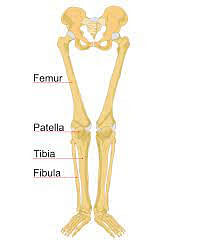
Bones of Legs
The three bones present in the leg are:
- Femur
- Tibia, and
- Fibula
Femur Bone (Thigh Bone)
[Click Here for Previous Year Questions]
Femur or thigh bone is present in between the hip joint and the knee joint. It is the longest and the heaviest bone in the human body. The head of the femur bone is spherical in shape and fits into the socket of the hip bone, forming the ball and socket joint of the hip.
This round area of the femur is termed as acetabulum. The neck of the bone extends outwards and slightly downwards thus forming an elongated structure. The femur bone easily dominates the entire leg region by giving an individual one-fourth of their height.
At the basal area, femurs form a triangular surface which then forms a joint with the tibia and the patella, the knee joint.
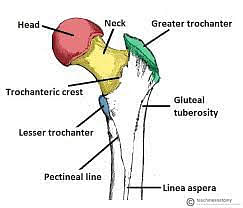
Femur Bone (Thigh Bone)
Tibia Bone (Shin Bone)
[Click Here for Sample Questions]
The tibia or the shin bone is present in the middle of, and acts as a bridge in between the two bones of the lower leg, below the knee joint. The upper end of the bone is broad and flat, forming two areas for joining with the femur bone at the knee joint.
The head of the fibula joins with the lower end of femur bone and forms the tibiofibular joint. The other end, distal end forms the ankle joint with the talus bone and the fibula bone.
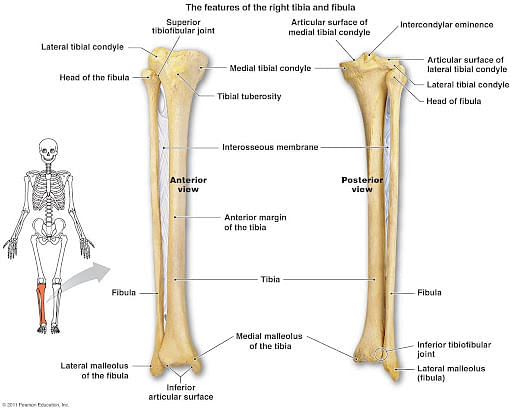
Tibia Bone (Shin Bone)
Fibula Bone
[Click Here for Previous Year Questions]
The fibula bone is a long slender bone present with the tibia in the lower part of the leg, below the knee joint. The head of the fibula bone is joined to the head of the tibia bone.
Forming a joint, termed as tibiofibular joint, and the lower end of the bone is projected beyond the end of tibia, forming the lateral malleolus. This part stabilises the ankle joint.
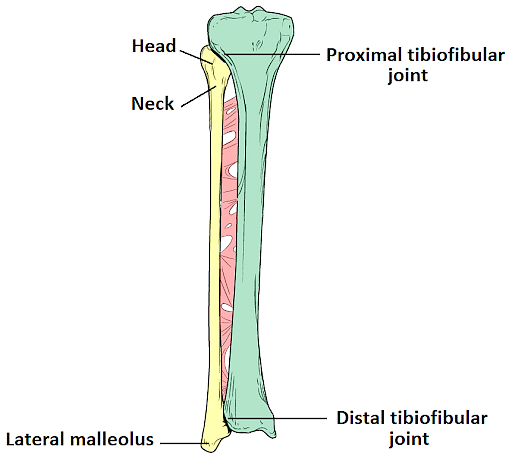
Fibula Bone
Also Read:
| Related Articles | ||
|---|---|---|
| Sliding Filament Theory | Deltoid Muscles | Tissue Culture |
| Central nervous system | Types of Joints | Pelvic Bones |
| Control and coordination | Blood vessels | Blood |
Patella (Knee cap)
[Click Here for Sample Questions]
The patella (kneecap) is the largest sesamoid bone of the body. A sesamoid bone is a type of short bone. The patella is found in the tendon of the quadriceps femoris muscle, the large muscle of the thigh that passes across the knee to attach to the tibia.
The patella joins with the patellar surface of the femur. The patella does not join with the tibia bone.
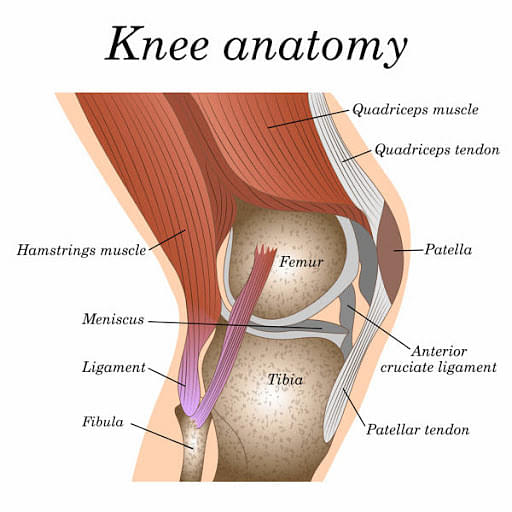
Patella (Knee cap)
Things to Remember
- The bones of the legs originate below the hip joint. The entire leg region comprises two joints, the knee joint, and the ankle joint.
- The region between the hip joint and the knee joint is termed as the thigh area. And the leg is specifically located between the knee joint and the ankle joint. And the foot is present below the ankle joint.
- There are 30 different bones present in our lower limb, i.e., legs. The 30 different bones are, patella, femur, fibula, tibia, metatarsal, tarsal bones, and the phalanges bones. The leg bone comprises long bones and short bones, especially sesamoid bones.
- The long bones are femur, tibia, and fibula and the sesamoid bones are the kneecaps, i.e., patella, short bones are the phalanges, tarsals, and metatarsals.
Previous Year Questions
- During muscle contraction in humans, the….[NEET 2013]
- Elbow joint is an example of...[NEET 1980]
- Sternum is connected to ribs by...[NEET 1980]
- Which cartilage is present on the end of long bones -...[NEET 1989]
- H-zone in skeletal muscle fibre is due to...[NEET 2003]
- Three of the following pairs of the human skeletal parts are correctly matched with their respective inclusive skeletal category...[NEET 2011]
- Lack of relaxation between successive stimuli in sustained muscle contraction is known as….[NEET 2016]
- Glenoid cavity articulates….[NEET 2015]
- A deltoid ridge occurs in...[NEET 1990]
- Number of cervical vertebrae in camel is...[NEET 1990]
- Stimulation of a muscle fiber by a motor neuron occurs at….[NEET 2014]
- In human body which one of the following is an atomically correct ?...[NEET 2007]
- Which one of the following items gives its correct total number?...[NEET 2008]
- ATPase enzyme needed for muscle contraction is located in -[NEET 2004]
- Calcium is important in skeletal muscle contraction because it...[NEET 2018]
- Colle's fracture is associated with...[BHU UET 2009]
- Inter-articulated disc is found in...[BHU UET 2005]
- During strenuous exercise glucose is converted into...[BHU UET 2005]
- Human vertebral column consists of 33 vertebrae and ________ bones...[BHU UET 2012]
- Which of the following is correct for the pairs of cervical nerves and number of cervical vertebrae respectively ?...[GUJCET 2009]
Sample Questions
Ques. What are the bones present in the foot? (1 Mark)
Ans. The bones of the foot are divided into three main categories. The posterior (Front part) foot is formed by the seven tarsal bones. The mid-foot has the five metatarsal bones. The toes contain the phalanges.
Ques. What is bone marrow? Give its main function. (1 Mark)
Ans. The long bones such as the thigh bone, upper arm bones have hollow spaces inside which contain bone marrow. The bone marrow produces red blood cells. They also form some kinds of white blood cells.
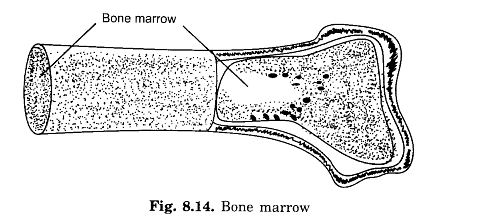
Bone Marrow
Ques. How many bones are present in the lower limbs? (2 Marks)
Ans. There are 30 bones present in total in the lower limbs of the human body. The leg comprises several long and short bones. The leg has three major bones, femur, tibia, and fibula, joined together by the patella bone. The foot comprises three categories of bone too, tarsals, metatarsals, and phalanges.
Ques. Write a short note on the thigh bone. (3 Marks)
Ans. The femur, thigh bone is present in between the hip joint and the knee joint. It is the longest and the heaviest bone in the human body. The head of the femur bone is spherical in shape and fits into the socket of the hip bone, forming the ball and socket joint of the hip. This round area of the femur is termed as acetabulum. It is the longest bone and contributes to one- fourth of the human height.
Ques. Write a note on all the bones of the leg. (3 Marks)
Ans. The leg comprises three major bones, Femur, Tibia, and Fibula joined together with the patella bone forming the knee joint. The femur, thigh bone is present in between the hip joint and the knee joint. It is the longest and the heaviest bone in the human body.
The tibia or the shin bone is present in the middle of, and acts as a bridge in between the two bones of the lower leg, below the knee joint. The fibula bone is a long slender bone present with the tibia in the lower part of the leg, below the knee joint. The head of the fibula bone is joined to the head of the tibia bone.
Do Check Out:



Comments