



Content Curator
Chyme can be defined as a half-digested food in the stomach that contains digestive juices. It is simply a semi-liquid form of food. Chyme is acidic in nature.
- The digestion of food begins in the mouth.
- The food then travels to the stomach, where different enzymes break it down into a pulp.
- The food we eat is digested by our bodies through a process called digestion.
- Various enzymes play an important role in the process of digestion.
- These enzymes break food into simpler forms so that it can be easily absorbed by the body.
These simpler forms of food are fats, carbohydrates, protein, and starch. These elements provide energy for the body to perform various tasks.
| Table of Contents |
Key Terms: Chyme, Digestion, Absorption, Digestive Enzymes, Enzymes, Protein, Starch, Gastric Glands
What is Chyme?
[Click Here for Sample Questions]
Chyme is a half-digested food in the stomach that contains digestive juices. It is a semi-liquid form of food that has been eaten. Chyme is acidic.
- The digestion of food starts in the mouth.
- It goes to the stomach, where different enzymes break it down into a pulp.
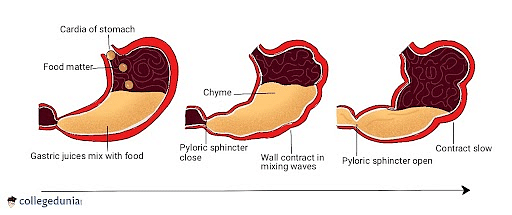
- The stomach muscles contract and expand to mix the food.
- The muscle walls of the stomach move back and forth to mix food with gastric juice.
- This mixture is called chyme.
- When the chyme is present in the stomach, it is called stomach chyme.
Read More:
| Topic Related Concepts | ||
|---|---|---|
| Nutrition in Human Beings | Digestive Enzymes | Heterotrophic Nutrition |
| Excretion | Peristalsis | Egestion |
| Gastrointestinal Tract | Stomach | Digestion in Ruminant |
Composition of Chyme
[Click Here for Previous Year Questions]
Chyme is composed of half-digested food, salivary enzymes, carbohydrates, gastric juice, and half-digested food.
- Some cells from the mouth and food pipe also get mixed with chyme while swallowing the food.
- Stomach secretion contains hydrochloric acid, which makes the chyme acidic.
- The low pH of chyme destroys pathogens and other microbes present in the food.
- Pepsin is another enzyme secreted by the stomach cells that gets mixed with the chyme and makes it acidic. Pepsin helps in the digestion of protein.
- The presence of electrolytes and water in the chyme maintains the food's natural state.
- Whether spicy, sweet, or any kind of food is consumed, it will make them neutral in nature.
- The nature of chyme depends on the nature of the food you eat.
- If a low-carb food with a high content of protein and fat is consumed, then the chyme will be frothy and oily.
- High carb diet will make chunky chyme with chunks of undigested foods.
- In case it is whole grains, the chyme will stay in the stomach for a longer time.
Chyme
Functions of Chyme
[Click Here for Sample Questions]
When you eat any food, a large amount is ingested that cannot be directly absorbed by the body. It is first broken into small portions by chewing. When chewed food enters the stomach, it is further broken down to form chyme.
Food's surface area must be increased to allow digestive juices and enzymes more access. For food to be broken down into simpler forms, digestive enzymes must bind directly to food particles. Chyme increases the surface area of the food.
The main functions of chyme are:
- To stimulate the secretion of digestive contents from digestive glands.
- Break down the food into smaller forms to increase its surface area.
- To make the food more slippery and liquefy food.
Thus, some of the functions of chyme are:
Digestion of Food
Food digestion involves both physical and mechanical breakdown. Breaking the food into smaller fragments is called physical digestion, and breaking foods with enzymatic action is called chemical digestion.
Digestion in Mouth
The process of digestion starts in the mouth.
- Teeth grind and mix the food with the help of the tongue.
- Salivary amylase mixes with food to break it down chemically. Mucus mixes with the food to lubricate it. This stage of food is called “bolus.”
- This bolus then travels through the esophagus (food pipe) during the swallowing process and reaches the stomach.
Gastric Glands
The gastric glands are one of the most important components in the formation of chyme. The gastric glands are present in the mucosa part of the stomach. It contains three types of cells -
- Mucus is secreted by the mucous neck.
- Pepsinogren is secreted by the chief cells or peptic cells.
- Intrinsic factors and hydrochloric acid are secreted by oxyntic or parietal cells.
Digestion in Stomach
When a bolus enters the stomach, it is mixed with gastric enzymes and other contents to form chyme.
- Hydrochloric acid activates the pepsinogen and converts it into the active pepsin enzyme. Pepsin breaks down the protein into peptones and proteases.
- Since HCl is naturally acidic, mucus protects the stomach walls from it.
- Therefore, the mixing of food particles with gastric secretions is known as "chyme."
Digestion in Small Intestine
The juice from the pancreas has many enzymes, some of which are inactive and become active at a later time. Intestinal mucosa secretes various enzymes:
- Lipase
- Nuclease
- Trypsinogen
- Chymotrypsinogen
- Amylase
- Procarboxypeptidase
Bile pigments and bile salts are found in bile secreted from the duodenum. Bile emulsifies the fat. Intestinal secretion contains various enzymes:
- Maltase
- Lipase
- Dipeptidase
- Nucleosidase
- disaccharides
All these enzymes work together in the small intestine to break down the food chemically.
Read More:
Generation of Chyme
[Click Here for Previous Year Questions]
Bolus from the mouth generates the chyme. The mouth breaks down the food and mixes it with the saliva to form a bolus. This bolus travels through the oesophagus and reaches the stomach.
- The smooth muscles of the stomach are arranged in diagonal, circular and longitudinal arrangements.
- These muscles start contracting to churn the food and mixes it with mucin, HCl, water, ion, and enzymes.
- HCl allows the optimal function of pepsin and influences the hydrolysis of various bonds.
- The stomach has a thick lining of mucus to protect it from these acidic components. Parietal cells derive energy from the ATP by using proton pumps.
- Secretion of acid is an important process of chyme digestion.
- Various molecules control acid secretion. The nervous system is an important part that regulates all the secretions.
- After the digestion of food in the stomach, the pyloric sphincter remains closed and chyme moves out of the stomach reaching the small intestine.
- The intestinal walls’ muscles mix all the secretion of chyme and absorb essential nutrients such as fatty acid, monosaccharides, amino acid, and glycerol.
- The remaining excretory wastes move to the large intestine and are excreted through faeces.
Things to Remember
- Chyme is a half-digested food in the stomach comprising of digestive juices.
- The food which is consumed is digested by our bodies through a process called digestion.
- Bolus from the mouth helps in the production of chyme. The mouth breaks down the food and mixes it with the saliva to form a bolus.
- One of the main function of Chyme is to stimulate the secretion of digestive contents from digestive glands.
- When the chyme is present in the stomach, it is known as stomach chyme.
Previous Year Questions
- A baby boy aged two years is admitted to play school and passes through a dental … [NEET 2017]
- The characteristic that is shared by urea... [KCET 2009]
- The primary dentition in humans differs from... [NEET 2015]
- Stool of a person contain whitish grey colour due to... [NEET 2002]
- Food is moved along the alimentary canal by the contraction known as... [JIPMER 2003]
- Which of the following statements is not correct? [NEET 2015]
- If for some reason the parietal cells of the gut epithelium become partially non-functional, what is likely to happen? [NEET 2010]
- Jaundice is a disorder of... [NEET 2010]
- Which cells of "Crypts of Lieberkuhn" secrete antibacterial lysozyme? [NEET 2017]
- Secretin and cholecystokinin are digestive hormones. They are secreted in… [NEET 2005]
Sample Questions
Ques: Chyme is produced in which part of the stomach? (1 mark)
Ans: Chyme is produced in the antrum part of the stomach.
Ques: What is Digestion? (1 mark)
Ans: Digestion can be defined as a process of breakdown of large insoluble food molecules into smaller water-soluble food molecules in order for them to be easily absorbed into the watery blood plasma.
Ques: Where does chyme go after traveling from the small intestine? (2 marks)
Ans: Various enzymes work on the chyme present in the small intestine, where it gets digested. The intestinal walls take in important vitamins, minerals, and nutrients like proteins, carbs, and fats. Wastes that need to be thrown out move to the large intestine. From there, they leave the body through the rectum and anus. further chyme
Ques: What is the pH level of chyme? (2 marks)
Ans: Chyme has a very low pH of approximately 2, which makes it more acidic in nature. The acidic nature of chyme aids in the removal of pathogens from food and aids in the digestion of food. The presence of hydrochloric acid makes the chyme acidic in nature. This pH level changes when chyme leaves the stomach and enters the small intestine. It becomes neutral in the stomach with a pH of approximately 7.
Ques: What is the role of the liver in the formation of chyme? (2 marks)
Ans: The liver secretes bile, which is stored in the gall bladder. Bile is released in the small intestine, where it becomes a part of chyme to help it break down even more. The main role of bile in the digestion of chyme is to turn its acidic nature into an alkaline one.
Ques: What is the process by which chyme is formed? (2 marks)
Ans: Food is ingested through the mouth, and digestion starts in the mouth. Teeth break down food, and food and salivary amylase mix with it to partially break down the food to turn it into a bolus. This bolus passes to the stomach through the food pipe. With a little help from the muscles in the stomach, enzymes and other digestive factors mix with the bolus to turn it into chyme.
Ques: What is the difference between chyme and chyle? (2 marks)
Ans: Chyme is a partially digested food with some other contents present in the stomach. Chyle is formed in the small intestine when the fats in food start getting digested. The main differences between chyme and chyle are -
- Chyme is present in the stomach, while chyle is digested in the intestine.
- Chyme is made up of enzymes from saliva, hydrochloric acid, water, and enzymes from the stomach. Chyle, on the other hand, is made up of fatty acids, proteins, and carbohydrates.
Ques: Where does chyme go after traveling from the stomach? (3 marks)
Ans: Part of the digestion of chyme takes place in the stomach, and then it moves to the small intestine.
- The process of digestion continues in the small intestine.
- Chyme stays in the stomach for about 2–6 hours, depending on the nature of the food, and then the stomach empties all the chyme into the duodenum of the small intestine.
- Various enzymes work on the chyme in the small intestine to break it down into simpler forms.
Ques: What is the difference between bolus and chyme? (5 marks)
Ans: When you eat food and it is chewed and mashed up in the mouth, it is called a "bolus." When the food is partly digested in the stomach, it is called “chyme.” Bolus is more alkaline in nature than chyme.
Teeth and saliva break down eaten food into a bolus, and stomach contents break down the bolus into chyme. The main differences between bolus and chyme are as follows -
| Bolus | Chyme |
|---|---|
| Bolus is alkaline in nature. | Chyme is acidic in nature. |
| Bolus is present in the mouth. | Chyme is present in the stomach. |
| Bolus represents ball-shaped food. | Chyme represents the fluidity and creamy texture of food. |
| Bolus is a soft food. | Chyme is almost a liquid food. |
| A bolus is a combination of food and saliva. | Chyme is a mixture of different stomach contents, such as hydrochloric acid, pepsin, water, and stomach contents. |
Also Check-out:



Comments