



Content Curator
When an object moves in a circular path then the motion of an object is said to be a circular motion. An object is said to be in a circular motion if it travels in a circular path such that the distance of an object from a fixed point remains constant.
- An object can be either in uniform or non-uniform circular motion depending on acceleration and angular speed.
- In a uniform circular motion, acceleration and angular speed remain constant throughout the motion, while in a non-uniform motion, acceleration keeps changing.
- A body undergoes circular motion if a force acts upon it directed towards the centre of the circular path.
- This force is called centripetal force. Without centripetal force, a body cannot undergo circular motion.
Read More: Uniform and Non-Uniform Motion
Key Terms: Circular Motion, Banking of Roads, Kinematics, Motion, Distance, Speed, Velocity, Centripetal Force
What is Circular Motion?
[Click Here for Sample Questions]
The motion of an object in a circular path along the circumference of a circle or rotation along a circular path is called circular motion. For example: The motion of earth around the sun is an example of circular motion.

Circular Motion
Variables in Circular Motion
[Click Here for Sample Questions]
Angular variables define the motion of a body in a circular path. Angular variables are:
Angular Displacement
Angular displacement is defined as the angle subtended by a moving body at the centre of the circular path per unit of time. It is represented by Δθ. The figure shows the angular displacement.

Angular Displacement
In the figure, Δθ is measured between position vectors rÌ and r’Ì.
Angular displacement is given by
Δθ = ΔS/ r
Here, ΔS is the linear displacement and ‘r’ is the radius. It is measured in radians.
Angular Velocity
Angular velocity is defined as the rate of change of angular displacement (Δθ) in a circular motion. It is represented by ω.
ω = Lim t → 0 (Δθ/Δt) = dθ/dt
It is measured in rad/s. It is important to note here, a body undergoing circular motion also has linear velocity. This linear velocity is given by
v = ds/dt
v = |ds/dt|
where s is the displacement of a body.
| The linear acceleration (a) of a body undergoing circulation motion has two components:
ar = v2/r = ω2r
at = |dv|/dt |
Angular Acceleration
It is defined as the rate of change of angular velocity (ω) of a rotating body in a circular motion. It is denoted by ðand measured in rad/s2.
ð = dω/dt
Also, ω = dθ/dt,
So
ð= d2θ/dt2
Angular acceleration (ð) and linear acceleration (a) are related to each other as
| a = rð |
where ‘r’ is the radius of a circular path
The angular acceleration decides the nature of circular motion. If a body moves in a circular path with constant angular acceleration then, the motion is called uniform circular motion.
We know in a circular motion, the velocity vector keeps changing its direction at every point in a circle. This signifies that the radial component (ar) of acceleration is always non-zero. But a tangential acceleration (at) component can either have a positive or negative value in a non-uniform circular motion. A tangential component is zero in a uniform circular motion.
Read Also:
Centripetal Acceleration
The acceleration act on a body undergoing circular motion whose direction is towards the centre of the circular path is called centripetal acceleration. It is also called radial acceleration because it acts along a radius of a circular path. It is given by
ð= v2/r = rω2
Centripetal Force
A body moving with a uniform velocity (v) on a circular path with radius r possesses radial acceleration v2/r. According to Newton’s second law, acceleration is induced by the force in the same direction as that of force.

Centripetal force acting towards the centre
Thus, we can say a body undergoes circular motion if a force acts upon it and in the direction towards the centre of the circle or circular path of motion. This force is called centripetal force. If no centripetal force is applied to the body it does not undergo circular motion.
Read Also: Centrifugal Force
For a body of mass ‘m’ undergoing circular motion, the centripetal force is given
Fcen = mass x acceleration
| Fcen = mv2/r |
We know, v = rω
| Fcen = mrω2 |
Forces like gravitational force, electrostatic force, frictional force, and the tension in the string is all centripetal forces.
Read Also: Calculating Centripetal and Centrifugal Force
Note: Work done by the centripetal force is always zero as the centripetal force and displacement are perpendicular (at 90°) throughout the circular motion.
Uniform Circular Motion
[Click Here for Sample Questions]
If a body travels in a circular path with constant angular speed and acceleration then the body is to undergo uniform circular motion. The velocity varies but the speed remains constant in a uniform circular motion.
When a body rotates around an axis (negligibly small when compared to the radius of a circular path) each particle of a body undergoes uniform circular motion with the same angular velocity. But the linear velocity and acceleration vary with axis location.
Read Also:
| Uniform Circular Motion - Related Topics | ||
|---|---|---|
| Displacement Vector | Resolution of Vectors | Newton’s Laws of Motion |
In the case of uniform circular motion;
ar = v2/r = rω2
If the mass of a body is ‘m’ then force is given by
F = ma
mv2/r = mrω2
If any particle is undergoing uniform acceleration then;
- The speed of motion will be constant.
- The velocity of a particle is constantly varying at each instant, v = R.
- No tangential acceleration component is present i.e. at = 0.
- The radial acceleration (centripetal) is ω2R.
- v = rω.
In the case of non-uniform circular motion, there is some tangential acceleration that varies the particle’s speed. In non-uniform motion, acceleration is given as the vector sum of radial and tangential accelerations.
a = ar + at
Examples of Uniform Circular Motion
- The motion of satellites around the planets is an example of uniform circular motion.
- Electrons revolving around the nucleus of an atom are an example of uniform circular motion.
- Windmill blade rotation is an example of uniform circular motion.
Kinematics in Circular Motion
[Click Here for Sample Questions]
A body executing circular motion will have angular acceleration, angular speed and angular displacement. These circular variables are related to each other and give kinematics equations as:
- ω = ωo + αt
- θ = ωot + 1/2αt2
- ω2 = ωo2 + 2αθ
where ωo is the initial angular velocity, ω is the final angular velocity, α is angular acceleration, θ is angular displacement, and t is the time taken.
Read Also:
Motion Of A Car On A Level Road
[Click Here for Sample Questions]
When a car moves on a level road, three primary forces are acting on the car. These forces are:
- The weight of a car
- Normal Reaction from the road
- Frictional force (f)
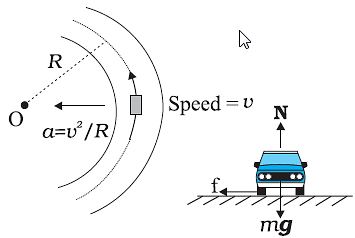
Motion Of A Car On A Level Road
From the figure, it is clear that there is no acceleration in a vertical direction. Hence, the net force acting in the vertical direction will be zero.
Fy = N - mg = 0
∴ N = mg
Thus, the centripetal force required for circular motion is present along the surface of the road. This force is induced by the contact force between the surface of a road and the car tyres. This force is the frictional force (f), which is static and provides centripetal acceleration.
This friction force opposes the motion of the car that is moving away from the circular path. Using the law of static friction equations (fs ≤ μsN) and Fcen = mv2/R. We get
f ≤ μsN = mv2/R
v2 ≤ μsRN/m [N = mg]
∴ v2 ≤ μsRg (μs = static frictional coefficient)
From the above expression, it is clear velocity does not depend on the mass of a car. Hence, at any value of μs and R, a maximum speed of a car can be achieved.
Special Case: When a car takes a circular turn on a horizontal surface road, the frictional force acts as a centripetal force. The equation can be written as
μsN = mv2/R [N = mg]
| vmax = √(μsRg) |
Also check: Derivation of Centripetal Acceleration
Circular Motion on a Banked Road (Turning at Roads)
[Click Here for Sample Questions]
The frictional effect on a motion of a vehicle can be reduced if the road is slightly banked (inclined) on the outer end. As shown in the figure below

Circular Motion on a Banked Road
This is called banking of the road. The forces acting on the vehicle are shown above. It is similar to the case when a vehicle turns.
We know, there is no acceleration in the vertical direction of motion. Hence, the net vertical force (Fy) will be zero. So, from the figure
Fy = Ncosθ - mg - f sinθ = 0
Ncosθ = mg + f sinθ …(i)
The centripetal force is induced due to the horizontal component of friction force (f) and normal force (N). Thus, from the figure we have
Nsinθ + f cosθ = mv2/R …(ii)
For a safe turn, the coefficient of friction (μs) between the tyres and the road is given by
μs ≥ v2/Rg
∴ v ≤ √(μsRg)
To find vmax, we use the equation f = usN
Thus substituting f = usN in eq (i) and (ii) we get,
Ncosθ = mg + usNsinθ …(iii)
Nsinθ + usNcosθ = mv2/R …(iv)
Solving (iii) and (iv) we get,
vmax = [Rg (μs + tanθ/ 1 - μstanθ)]½ …(v)
For μs = 0
| vmax = √(Rgtanθ) |
Or
vmax = (Rgtanθ)1/2 …(vi)
The above equation of speed suggests that no friction force is required for centripetal force. If compared with maximum speed on a flat road we observe (vmax)flat < (vmax)banked. Hence, frictional force will be present in the banked road and the car can be parked if tanθ ≤ us.
Things to Remember
- For uniform circular motion, the speed of motion will be constant v = rω, and the radial acceleration is ω2R.
- In a circular motion, velocity keeps changing its direction, thus the radial acceleration is always non-zero.
- In a uniform circular motion, tangential acceleration is zero. While in a non-uniform circular motion, tangential acceleration can take either a ‘+ve’ or ‘-ve’ value. The resulting acceleration in non-uniform circular motion is given by: a = ar + at
- Work done is zero by the centripetal force as the centripetal force is perpendicular to displacement throughout the circular motion.
- For a safe turn, the coefficient of friction (μs) between tyres and road is given by μs ≥ v2/Rg and maximum velocity is vmax = (Rgtanθ)½
Also check:
Sample Questions
Ques 1: A wheel is rotating about its axis at a rate of 1200 rotations per minute. It comes to rest in 2 minutes. Determine the angular acceleration of a wheel. (3 Marks)
Ans: From the kinematics of circular motion, we know,
ω = ωo + αt …(i) (ωo is initial angular velocity and ω is final angular velocity)
⇒ ωo = 1200 rpm = (1200 x 2ð/60) rad/s
⇒ ωo = 40ð
ω = 0 and
t = 2 min = 120 s
Putting value in eq (i)
0 = 40ð- 120α
α = ð/3 rad/s2
Ques 2: Two bodies with masses m1 and m2 travel in a circle with radii r1 and r2 respectively. If they complete rotation in equal time, find the ratio of their angular speeds. (4 Marks)
Ans: The time required to complete one rotation of a circle is known as the period (T). Thus angular speed is given by,
ω = 2ð/T
For a body of mass m1
ω1 = 2π/T1 …(i)
For a body of mass m2
ω2 = 2π/T2 …(ii)
The angular speed is independent of the mass of the body, thus the ratio of angular speed is ω1/ω2
ω1/ω2 = T2/T1
Since the period is the same for both bodies
∴ ω1/ω2 = 1
Ques 3: A car is moving on a road at a constant speed of 36km/h. If the friction coefficient between car tyres and the road is 0.5. Find the minimum turning radius of a car. Take g = 10 m/s2. (3 Marks)
Ans: We know, for a safe turn on a road
v2 ≤ μRg …(1) (μ is friction coefficient)
Given,
μ = 0.5 and g = 10 m/s2
Velocity (v) of a car = 36km/h = 10 m/s
Substituting these values in eq (1)
R ≥ v2/μg
⇒ R ≥ (10)2/(0.5 x 10)
⇒ R ≥ 20 m
Hence, the minimum value of the turning radius of a car is 20 m.
Ques 4: Earth takes 365 days to complete one revolution around the sun. Determine its
a. Angular velocity and linear speed
b. Centripetal acceleration
Take R = 1.5 x 10¹¹ m. (4 Marks)
Ans: Given,
T = 365 days
⇒ T = 365 x 24 x 60 x 60 = 31536000 s
- Angular velocity (ω)
ω = 2ð/T
⇒ ω = (2 x 3.14)/ 3.1536 x 10⁷ rad/s
ω = 2 x 10⁻⁷ rad/s
Linear speed (v) is given by
v = Rω
⇒ (2 x 10-7) x (1.5 x 1011 m)
v = 3 x 10⁴ m/s
- Centripetal acceleration is given by
ac = v2/R
⇒ (3 x 10⁴)2 / (1.5 x 10¹¹)
ac = 6 x 10⁻³ m/s2
Ques 5: A man standing on an L.P. of a disc rotating on a table at the rate of 33·1/2 rpm. The distance of a man from the centre of the disc is 20 cm. Prove that the friction coefficient between the man and the disc is greater than π2/81. (Take g= 10m/s2). (3 Marks)
Ans: A man standing on an L.P. of a disc rotating on a table at the rate of 33·1/2 rpm.
Here,
n = 33·1/2 rpm = 100/ (3 x 60) rps
∴ ω = 2πn = 2π x 100/180 = 10π/9 rad/sec
Radius (r) = 10 cm = 0.1 m and g = 10m/s2
We know, for proper rotation
μsN ≥ mRω2 [N = mg]
μsmg ≥ mRω2 [N = mg]
μs ≥ Rω2/g = [0.1 x (10π/9)2]/ 10
On solving we get,
μs ≥ π2/ 81
Ques 6: A fly is trapped in a circular canal of radius 10 cm. It moves along the canal and completes 8 revolutions in 100s. Determine
a. the angular and linear speed of the motion
b. Is the acceleration vector (aÌ) a constant vector? Find its magnitude. (4 Marks)
Ans: The motion of a fly is a uniform circular motion. Here,
R = 10 cm Thus,
- Angular speed is given by
ω = 2ð/T
T is the time required in covering 8 revolutions in 100s. So,
T = 100/8
ω = 2ð x (8/100)
ω = 0.5 rad/s
The linear speed (v) for uniform circular motion is
v = Rω = (10 cm) x (0.5 s-1)
v = 5 cms-1
- The direction of the acceleration vector (a) is always directed towards the centre of the groove. Since this direction varies continuously with time, acceleration is not a constant vector.
The magnitude of the acceleration is given by
a = ω2R = (0.5 s-1)2 x (10 cm)
a = 2.5 cm s-2
Ques 7: A biker is riding at a speed of 27 km/h. As a bike approaches a circular turn on the road of radius 80 m, the biker applies brakes and reduces the speed at the rate of 0.50 m/s every second. Find the magnitude and direction of the net acceleration of the biker on the circular turn. (5 Marks)
Ans: Net acceleration is produced due to centripetal acceleration and braking.
Acceleration due to braking (at)
at = 0.5 m/s2
Speed of bike = 27 km/h = 7.5 m/s [1 km/h = 5/18 m/s]
The radius of a turn, R = 80 m
Centripetal acceleration is
ac = v2/R = (7.5 m/s)2/(80 m)
ac = 0.7 m/s2
The angle between at and ac is 90°. Hence resultant acceleration is
a = (ac2 + at2)½
a = (0.72 + 0.52)½
a = 0.86 m/s2
Now, the angle of net acceleration with the direction of velocity is given by
tanθ = ac/at
tanθ = 0.7/0.5 = 1.4
θ = tan-1(1.4) = 54.56°
Ques 8: A particle of mass 10 kg is attached to a string and rotates in a horizontal circle of radius 4m. If the speed of a particle is 5m/s, find tension in the string and angle with vertical θ. Take g = 10 m/s2 (5 Marks)
Ans: The circular motion of the particle can be described through the figure as
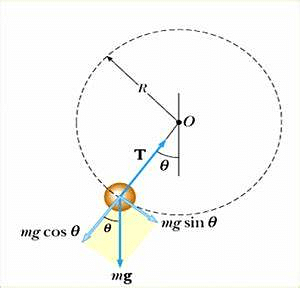
Given,
Mass of particle = 10 kg
The radius of a horizontal circle, R = 4m
Net horizontal force (Fx) is
Fx = T sinθ - mv2/R = 0
T sinθ = mv2/R …(i)
Observing Vertical motion we have,
T cosθ = mg …(ii)
Dividing (i) by (ii) we get,
tan θ = v2/Rg
θ = tan-1(v2/Rg) = tan-1(52/4*10)
θ = 32°
So, from equation (ii) we get,
T = mg/cosθ = 10*10/cos (32°) [cos 32° = 0.85]
⇒ 100/0.85
T = 118 N
Ques 9: A ball of mass 0.5 kg is attached to a string moving in a horizontal circle. If the tension in the string exceeds 25 N, the string will break. Find the maximum angular velocity of a ball with which it can rotate. The length of a string is 1.96 m. (3 Marks)
Ans: The centripetal force of the ball is provided by the tension in the string.
We know, Fcen = mrω2
So in this case,
T = mrω2
Where ‘m’ is the mass of the ball and ‘r’ is the string length.
The max. Angular velocity (ω) is attained at the maximum tension (termed as breaking tension). So,
ωmax = √(Tmax/mr)
⇒ √[25/ (0.5)(1.96)]
ωmax = 5.05 rad/s
Ques 10: A cyclist is travelling at a speed of 10m/s around a circular path of radius 50 m. Given the combined mass of man and cycle is 120kg. Determine
a. Cyclist’s rate of acceleration.
b. The net force acting on them. (3 Marks)
Ans.
- Since the cyclist is travelling at a constant speed, the centripetal acceleration is directed towards the centre of the circular path. It is given by
ac = v2/R …(i)
Given,
v = 10 m/s and R = 50m
⇒ ac = (10)2/50
ac = 2 m/s2
- Centripetal force is the net force exerted on a combined man and bicycle system. This centripetal force is given by
Fcen = mac
⇒ Fcen = (120 Kg)(2 m/s2)
Fcen = 240 N
Also check:



Comments