



Content Curator
In a chemical reaction, a displacement reaction occurs where an atom or a group of atoms is replaced by another atom. It can be seen in both metals as well as non-metals. As iron is applied to a copper sulphate solution, for example, the copper metal is displaced.
| Table of Content |
Read Also: Class 10 Chemical Reactions
A + B-C → A-C + B
When A is more receptive than B, the above equation remains.
A and B must be one of the following:
- Halogens in which the letter C denotes a cation.
- Different metals, with C denoting an anion.
This chapter is a part of CBSE class 10 Chemical Substances, Nature and Behaviour and carries a total of 25 marks and 55 periods.
Explanation
[Click Here for Sample Questions]
Why does the copper sulphate solution's blue colour disappear and the iron nail become brownish?
The following chemical reaction takes place in this Activity:
Fe(s) + CuSO4(aq) → FeSO4(aq) + Cu(s)
(Copper sulphate) (Iron sulphate)
In this reaction, Iron has displaced or replaced another element, copper, from the copper sulphate solution. This reaction is known as displacement reaction
Other examples of displacement reactions are
Zn(s) + CuSO4(aq) → ZnSO4(aq) + Cu(s)
(Copper sulphate) (Zinc sulphate)
Pb(s) + CuCl2(aq) → PbCl2(aq) + Cu(s)
(Copper chloride) (Lead chloride)
Zinc and lead have a higher reactivity than copper. They deplete copper by removing it from its compounds.
Single Displacement Reaction
[Click Here for Sample Questions]
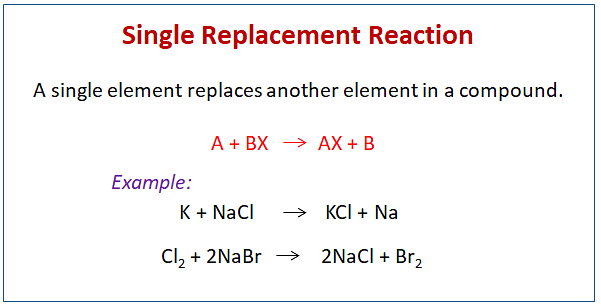
A single displacement reaction, also known as a single substitution reaction, is a form of oxidation-reduction chemical reaction in which an ion or atom falls out of a compound and is substituted by another. As chlorine is applied to a solution of sodium bromide in its gaseous state (or as a vapour dissolved in water), it takes the place of bromine. Since chlorine is more reactive than bromine, it displaces bromine from sodium bromide, resulting in blue solutions. The displaced bromine gives the brown colour.
Let's look at a different chemical reaction.
In a test tube, dissolve 0.5 gm Silver nitrate in 10 ml water. After that, a copper wire is dipped in it and left undisturbed for a while. On the Copper wire, the gleaming silver crystals can be seen. If any copper is formed, the solution becomes bluish. Copper metal displaces silver from Silver Nitrate solution in the reaction below.
Cu(s) + 2AgNo3(aq) → 2Ag(s) + Cu(NO3)2(aq)
Double Displace?ment Reaction
You'll see that a white powder forms that is insoluble in water. A precipitate is the insoluble material that forms. A precipitation reaction is any reaction that results in a precipitate.
Na2SO4 (aq) + BaCl2(aq) → BaSO4 (s) + 2NaCl(aq)
(Sodium Sulphate) (Barium Chloride) (Barium sulphate) (Sodium chloride)
What is the origin of this? The reaction of 2– SO4 and Ba2+ produces the white BaSO4 precipitate. Sodium chloride is the other chemical made, and it persists in the solution. Double displacement reactions are described as reactions in which ions are exchanged between the reactants.
Read more: Balanced Chemical Equations
Sample Questions
Ques1:A Reddish Brown Coloured Metal, Used In Electrical Wires, When Powdered And Heated Strongly In An Open China Dish Its Colour Turns Blacks. When Hydrogen Gas Is Passed Over This Black Substance, It Regains Its Original Colour. Based On Above Information Answer The Following Question.
(i) Name the Metal And The Black Coloured Substance Formed.(ii) Write Balanced Chemical Equation For Both The Equation.
Ans. (i) The name of the metal is Copper and the copper (II) oxide is the black substance.
(ii)
Ques2 : What Is Redox Reaction? Identifying The Substance Oxidised And The Substance Reduced In The Following Reactions:
(i) 2PbO + C → Pb + Co2
(ii) MnO2 + 4HCL → MnCl2 + H2O + Cl2.
Ans. Redox reactions refer to the oidization or reduction reactions. In this reaction one of the reactant gets oxidised and the other reduces.
(i) In case of the first reaction the lead reduces and the carbon gets oxidised.
(ii) In case of the second reaction MnO2 reduces and HCL gets oxidised.
Ques3: What is rancidity? Mention any two ways by which rancidity can be prevented.
Ans. Rancidity refers to the oxidisation of the oild or fats present in the food which results in a bad smell and bad taste. The two ways in which it can be prevented are:
- Refrigeration of the left-over food items.
- Flushing the food with the nitrogen gas.
Ques4: Write balanced chemical equation for the reaction that take place during respiration. Identifying the type of combination reaction that take place during this process and justifying the name. Give one more example of this type of reaction.(2 marks)
Ans. C6H12O6 + 6O2 → 6CO2 + 6H2O + Energy
This is called an exothermic reaction because of the large amunt of heat being released.
Example: The vegetable being decomposed into compost.
Ques5: What is meant by: (a) Displacement reaction (b) Reduction reaction (c) Combination reaction. (2 marks)
Ans. (a) Displacement reaction: In this kind of reaction one of the element takes place with another element in a particular compound. C + DE → CE + D
(b) Reduction reaction: In this kind of reaction a reactent acquires one or more electrons in a chemical reaction. Reduction reaction always takes place along with oxidisation reaction.
(c) Combination reaction: In this kind of reaction two or more than two compounds merge to produce one compound. C + D → CD
Ques6: (a) Why is respiration considered Exothermic reaction?
(b) Define the terms Oxidation and Reduction?
(c) Identify the substance that is oxidised and reduced in the reaction: CuO + Zn → Cu + ZnO?(2 marks)
Ans. (a) Respiration is considered to be an Exothermic reaction because in this process energy is released. Glucose merges with the oxygen available in our cells to produce CO2 and H2O along with energy. Energy gets produced in this process.
(b) Oxidisation refers to the losing of the electrons during the process of reactionby an atom, ion or molecules. The opposite process of oxidisation is known as reduction. It takes place when an electron is acquired at the oxidisation state and an ion, atom or molecule reduces.
(c) Zink gets oxidised to zink oxide and copper oxide gets reduced to copper.
Ques7: 2g of Lid Nitrate Powder is taken in a boiling tube. The boiling tube is heated over a flame. Now answer the following: (a) State the colour of the fumes evolved and the residue left. (b) Name the type of chemical reaction that has taken place stating its balanced chemical equation.(2 marks)
Ans. (a) The colour of the fumes evolved is brown and the residue left behind is also brown.
(b) The type of chemical reaction stated over here is decomposition. Chemical equation:

Ques8: (i) Classify the following reaction into different type: (a) AgNO3(aq) + NaCl(aq) → AgCl(s) + NaNO3 (aq) (b) CaO(s) + H2O(l) → Ca(OH)2(aq) (c) 2KClO3(s) → 2KCl(s) + 3O2(g).
(ii) Which of the above reactions are precipitation reactions? Why is a reaction called precipitation reaction?(2 marks)
Ans. (i) (a) AgNO3 + NaCl → AgCl + NaNO3 - Double Displacement Reaction
(b) CaO + H2O → Ca(OH) - Combination Reaction
(c) 2KClO3 → 2KCl (aq) + 3O2 (g) - Thermal Decomposition Reaction
(ii) Reaction (a) is a presipitation reaction as a result of this reaction silver chloride precipitate is formed. When the product of chemical reaction is acquired in the precipitate form then that particular reaction is called a precipitation reaction.
Ques9: Distinguish between a displacement and a double displacement reaction.(2 marks)
Ans.
| Single Displacement Reaction | Double Displacement Reaction |
|---|---|
| A less reactive reaction is replaced by a more reactive reaction in a compound. | Two or more atoms change places to give rise to a new compound. |
| Single displacement takes place. | Two displacements takes place. |
| The colour change takes place without precipitate. | Formation of precipitation takes place. |
| Metals tends to react with a different metal’s salt solution. | The salt solution of two distinguished metals react with one another. |
| Ex: 2Kl + CL2 → 2KCl + I2 | Ex: 2KBr + BaCl2 → 2KCl + BaBr2 |
Ques10: Identify the type of reaction in the following: (a) Fe + CuSO4(aq) = FeSO4(aq) + Cu(s) (b) 2H2 + O2 = 2H2O(1 mark)
Ans. (a) Displacement reaction
(b) Synthesis reaction
Ques11: When iron nails are dipped in the copper sulphate solution the colour of the solution changes. Why?(1 mark)
Ans. When iron nails are dipped in the copper sulphate solution the colour of the solution changes to blue to pale green because the iron replaces copper from the copper sulphate solution due to the reason that iron is more reactive than copper.
Ques12: What is the cause for displacement reaction?(1 mark)
Ans. The cause of displaclement reaction aking place is that a metal from the electrochemical series is merged with the ions belonging to a metal laying lower in the electrochemical series. The atoms belonging to the more reactive metal helps in pushing their electrons to the ions belonging to the less reactive metal.
Ques13: Can you name the metal that deposits reddish brown substance on the iron nails when dipped in CuSO4?(1 mark)
Ans. The metal that deposits reddish brown substance on the iron nails when dipped in CuSO4 is Copper.
Ques14: What do you mean by the reactivity series of metals?(1 mark)
Ans. The reactivity series of metal refers to a chart which list metals in a sequence of reducing reactivity. Generally the metal which is more reactive tends to react more vigorously with other elements.
Ques15: What is called displacement reaction?(1 mark)
Ans. A displacement reaction refers to the one where an atom or group of atoms is replaced by a different atom in a particular molecule.
Ques16: What is double displacement?(1 mark)
Ans. The reactions where two of the compounds react through the exchanging of ions to produce two new type of compounds are known as double displacement reactions.
Ques17: What is a Neutralisation reaction?(1 mark)
Ans. The type reaction that takes place between an acid and a base which leads to the formation of an ionic compound, most probably water is called the neutralisation reaction.



Comments