



Content Curator
Solute is a material that is dissolved in another substance, known as a solvent, in such a mixture. Solution is a form of homogenous mixture made up of two or more components in chemistry. The mixing of a solution takes place at a scale where the effects of chemical polarity are present, resulting in solvation-specific interactions. When the solvent makes up the majority of the combination, as is often the case, the solution takes on the state of the solvent.
Keyterms: Solute, solvent, mixture, Solution, homogenous mixture, components, combination, concentration
Read More: Combustion and Flames
Meaning of Solute
[Click Here for Sample Questions]
A solute is a material that dissolves in another substance, which is referred to as a solvent in a solution. For example, dissolving table salt (NaCl) in water to make a saline water solution. The solute is salt, while the solvent is water.
A solute's concentration in a solution is a measure of how much of that solute is dissolved in the solvent in relation to the amount of solvent present, such as salt.
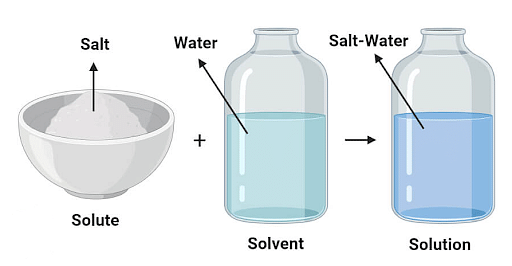
What is a Solute?
Characteristics of Solute
[Click Here for Sample Questions]
- A solution is a mixture of two or more components that is homogenous.
- A solution's solute particles are invisible to the naked eye.
- Light rays are not scattered by a solution.
- A solution is one that is stable.
- Filtration will not be able to separate the solute from the solution (or mechanically).
- It is made up of only one phase.
Also Read:
Types of Solute
[Click Here for Sample Questions]
The term "homogeneous" refers to a mixture's components forming a single phase. The term “heterogeneous” refers to the fact that the components of a combination are of different phases.
Concentration, temperature, and density of the mixture can be equally distributed throughout the volume, but only in the absence of diffusion processes or after they have occurred. The following are the most common types of solutes:
- Gaseous
- Liquid
- Solid
Read More: Mechanical Properties of Solids
Gaseous
When a solvent is a gas, only gases are dissolved when certain conditions are met. Air, such as oxygen and other gases dissolved in nitrogen, is an example of a gaseous solution.
Liquid
Almost all liquids and solids can be dissolved if the solvent is a liquid. Some instances are as follows:
- The presence of gas in a liquid
- Water with oxygen
- Water with carbon dioxide
- A liquid within a liquid
To create a constant, two or more chemicals with the same chemistry but varied concentrations are mixed together.
- Alcoholic beverages are just ethanol solutions in water.
Solid within liquid
- Sugar (sucrose) in water
- In water, sodium chloride (NaCl) (salt).
Read More: Acids, Bases and Salts
Solid
Gases, liquids, and solids can all be dissolved if the solvent is solid.
Solids with gas
- Hydrogen dissolves readily in metals, particularly palladium.
Liquid within solid
- Mercury reacts with gold to generate an amalgam.
- Moist solids are formed when water is dissolved in solid salt or sugar.
- Hexane dissolved in paraffin wax
Solid within solid
- Steel is essentially a carbon atom solution in a crystalline matrix of iron atoms.
- Alloys such as bronze and a variety of others.
- Plasticizer-containing polymers.
Read More: Dioxygen
Difference Between Solute and Solvent
[Click Here for Sample Questions]
| Specific | Solute | Solvent |
|---|---|---|
| Meaning | A soluble material. | It's a medium for dissolving. |
| Physical State | Could be liquid, gas or solid. | Mostly liquid, but could be gaseous and solid too. |
| Dependability | Solubility depends on characteristics of solute. | Solubility depends on the characteristics of the solvent. |
| Boiling point | Boiling point is high in comparison to solvent. | Boiling point low in comparison to the solute. |
| Example- Saline water | salt | water |
Examples of Solute
[Click Here for Sample Questions]
| Solution | Solute |
|---|---|
| Alcoholic drinks | Alcohol dissolved in water |
| Air in atmosphere | Many gases in nitrogen |
| Antifreeze in radiator | Ethylene glycol in water |
| Amalgam | Mercury in silver |
| Brass alloy | Zinc in copper |
| Bronze | Tin dissolved in copper |
| Carbonated beverages | CO2 in water |
| Saltwater | Salt dissolved in water |
| Sugar water | Sugar dissolved in water |
Things to Remember
- A solution is a form of the homogenous mixture made up of two or more components in chemistry.
- A solute is a material that is dissolved in another substance, known as a solvent, in such a mixture.
- A solution is a mixture of two or more components that is homogenous.
- The term "homogeneous" refers to a mixture's components forming a single phase.
- The term “heterogeneous” refers to the fact that the components of a combination are of different phases.
- When a solvent is a gas, only gases are dissolved when certain conditions are met.
- Almost all liquids and solids can be dissolved if the solvent is a liquid.
- Gases, liquids, and solids can all be dissolved if the solvent is solid.
Sample Questions
Ques. What does colligative property in solution means? (1 Mark)
Ans. Colligative qualities are those of a solution that are determined by the ratio of the number of solute particles to the number of solvent particles in the solution, rather than the chemical species present.
Ques. What is the main difference between solvent and solute? (1 Mark)
Ans. The primary distinction between a solute and a solvent is that the former dissolves while the latter serves as a dissolving medium. A solute is a material that is mixed with a solvent to generate a solution. During the production of a solution, a solvent is a material that dissolves the solute particles.
Ques. What are the effects of adding solute to a solution? (2 Marks)
Ans. The following are the three most prevalent effects:
- The vapour pressure of the solvent in solution is lower than the vapour pressure of the solvent alone.
- The solution's boiling point is higher than that of the pure solvent.
- The solution's lower freezing point compared to that of the pure solvent.
Ques. Explain saturated and unsaturated solutions with an example. (3 Marks)
Ans. A saturated solution occurs when a solution dissolves as much solute as possible at a given temperature. In simpler terms, a saturated solution is one in which no more solute can dissolve itself in the solution at a given temperature.
An unsaturated solution is one in which the amount of solute is not equal to, but less than, the saturation level. Soil is made up of a saturated nitrogen combination. When the saturation point is reached, the extra nitrogen is released as a gas into the atmosphere. Sand in water, on the other hand, is an example of an unsaturated.
Ques. Explain the method of calculation of concentration of a solution. (3 Marks)
Ans. Various methods can be used to calculate the concentrations of solute and solvent. The concentration is expressed in two separate units.
- The number of moles of solute contained in 1L of solution is known as molarity. M is the symbol for it.
- Molarity can be expressed in the following way:
- M is the number of moles of solute divided by the volume of the solution in litres.
- The amount of moles of solute present in 1kg of solvent is referred to as molality. It is represented by the letter m. Molality can be written as follows:
- m is the number of moles of solute divided by the mass of the solvent in kilogrammes.
Ques. What do you understand by the term ‘solubility’? What are their conditions? (3 Marks)
Ans. The ability of a solid, liquid, or gaseous chemical substance called a solute to dissolve in a solid, liquid, or gaseous solvent is known as solubility. The physical and chemical qualities of the solute and solvent, as well as temperature, pressure, and the presence of additional chemicals (including variations in pH) in the solution, all influence the solubility of a material.
The saturation concentration of a substance in a given solvent is the point at which adding more solute does not raise the concentration of the solution and begins to precipitate the excess amount of solute.
Ques. What is solvent? What are its different types? (3 Marks)
Ans. A solvent is a liquid that dissolves other components to generate a solution. Polar solvents, such as water, encourage the production of ions, whereas nonpolar solvents, such as hydrocarbons, do not. Acidic, basic, amphoteric (both), or aprotic solvents are all possible (neither).Different types of solvents are-
- Solvents come in a variety of forms.
- Solvents based on hydrocarbons
- Solvents containing oxygen
- Solvents containing halogens
Ques. Water is known as the "universal solvent". Why? (3 Marks)
Ans. Because it can dissolve more chemicals than any other liquid, water is known as the "universal solvent." Water transports vital chemicals, minerals, and nutrients wherever it goes, whether through the air, the ground, or our bodies.
The oxygen and hydrogen atoms in water molecules are arranged in a polar arrangement, with one side (hydrogen) having a positive electrical charge and the other side (oxygen) has a negative charge. This enables the water molecule to be attracted to a wide range of other molecules.
Also Read:



Comments