



Education Journalist | Study Abroad Lead
Construction of Quadrilaterals deals with how to draw or construct a quadrilateral when its measurements are given. A quadrilateral can be defined as a closed two-dimensional shape having four sides, four angles, and a pair of diagonals. Thus, in order to construct a quadrilateral, we need at least five measurements of the quadrilateral to be constructed. We can not construct a quadrilateral when any four or fewer parts of the quadrilateral are known. There are many special types of quadrilaterals such as square, rectangle, rhombus, parallelogram and kite.
| Table of Content |
Key Terms: Quadrilateral, Line, Line Segment, Arc, Ray, Diagonal, Triangle, Square, Rectangle, Parallelogram
Read More: Understanding Quadrilaterals MCQs
Construction of Quadrilaterals: Basic Rules
[Click Here for Sample Questions]
A quadrilateral can be constructed only if five measurements of the quadrilateral are given. A quadrilateral has 4 sides, 4 angles, and 2 diagonals. Thus, it can be constructed when there are a minimum of five measurements given to us. It cannot be drawn when any four parts of a quadrilateral are known.
- As the first step, we need to draw a rough sketch of the quadrilateral and mention the measurements of the five parts in the rough figure. Then, we can construct the quadrilateral by analyzing the given measurements.
- The required quadrilateral needs to be divided into two triangles which can be easily constructed. And these two constructed triangles together will form a quadrilateral.
- We construct a quadrilateral with the help of a ruler and compass.
Read More: Types of Quadrilaterals
Construction of Quadrilaterals: Combination of Elements
[Click Here for Sample Questions]
There have to be certain conditions required to get the desired quadrilateral. Some of the combinations are mentioned below:
- All measurements of four sides and one diagonal of the quadrilateral are given.
- Dimensions of three sides and two angles of a quadrilateral are given.
- Dimensions of adjacent two sides and three angles of a quadrilateral are given
- Dimensions of four sides and one angle are given.
- Dimensions of two diagonals and three sides are given.
(I) When all measurements of four sides and one diagonal of the quadrilateral are given
Let’s construct a quadrilateral “ABCD” having measurements as below:
- AB = 5 cm
- BC = 3 cm
- DC = 5 cm
- AC = 4 cm
- Diagonal CB = 6 cm
For the construction of quadrilaterals with the measurements mentioned above, first draw a rough figure of the quadrilateral with the above-mentioned dimensions, as shown below.
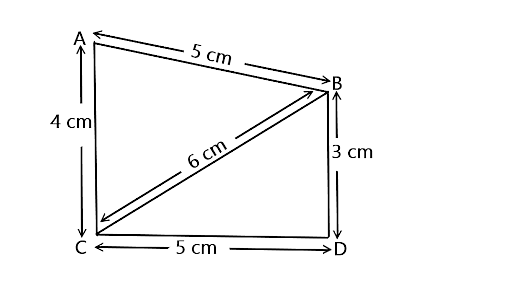
Construction of quadrilaterals
Now start the construction using a compass and ruler and draw the quadrilateral according to the following steps:
Step I: Draw a line segment of length 5 cm and mark the ends as C and D.

Step II: Set your compass radius to 3 cm and make an arc from point D above the line segment.
Step III: Set the compass radius to 6 cm and make an arc from point C on the previous arc.
Step IV: Mark the point as B where the two arcs intersect each other. Join the points C and B as well as B and C.
STEP V: Set your compass radius to 4 cm and make an arc from C above the line segment
STEP VI: Set your compass radius to 5 cm and make an arc from point B on the previous arc.
Step VII: Mark the point as A where the two arcs cross each other.
Step VIII: Join points A and C as well as A and B.

You have obtained the desired quadrilateral ABCD of the required measurements.
Read More: Quadrilateral Angle Sum Property
(II) Dimensions of three sides and two angles of a quadrilateral are given
Let’s construct a quadrilateral ABCD of the measurements mentioned below:
- AB = 4 cm
- BC = 6 cm
- AD = 4 cm
- ∠D = 100 degrees
- ∠C = 120 degrees
For the construction of quadrilaterals with the above-mentioned measurements, we will first draw a rough figure of the quadrilateral with the given dimensions.
Let’s start the construction using a compass and scale, the steps are written below:
Step I: Draw a line segment of length 5 cm and mark the ends as D and C.

Step II: Using a protractor or a compass, draw a line from point B making 120 degrees, and another line from point D making 100 degrees with the line segment DC.

Step III: Set your compass to the radius of 4 cm and make an arc from point D on the 100-degree line. Mark the point as A where the arc intersects the line.
Step IV: Similarly, set the compass to a radius of 6 cm and make an arc from point C on the 120-degree line. Mark the point as B where the arc intersects the line.

Step V: Join points A and B.
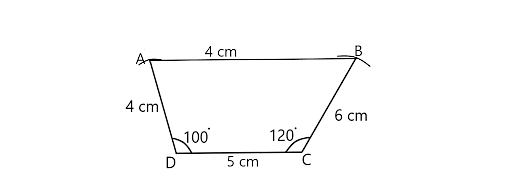
You obtain the quadrilateral ‘A B C D’ of the required measurements
Read More: Quadrilaterals Important Questions
(III) Dimensions of two sides and three angles of a quadrilateral are given
Let’s construct a quadrilateral ‘A B C D’ whose measurements are provided below:
- AB = 5 cm
- BC = 3 cm
- ∠A = 120 degrees
- ∠B = 110 degrees
- ∠C = 90 degrees
The steps for the construction of the quadrilateral ABCD are:
Step I: Draw a line segment of length 5 cm and mark the ends as A and B.

Step II: Using a protractor or compass, draw a line from point A making 120 degrees with the line segment AB.
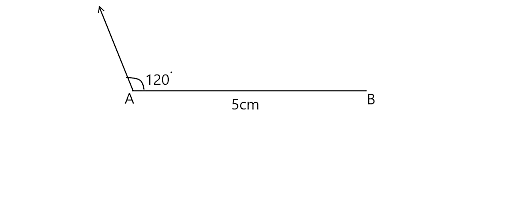
Step III: Using the protractor or compass, draw a line from point B making 110 degrees with the line segment BA

Step IV: Set your compass to the radius of 3 cm and make an arc from point B at an angle of 110-degree. Mark the point as C where the arc intercepts the line.
Step V: Using the protractor or compass, draw a line from point C making 90 degrees with the line segment CB. Mark the point as D where the arc intercepts the 120-degree line.

You have obtained the desired quadrilateral ABCD of the assumed measurements. As we know the sum of the interior angles of a quadrilateral is 360 degrees, you can check the measure of ∠D which should be equal to 40 degrees (360 – [120 + 110 + 90]).
Read More: Quadrilaterals MCQs
(IV) Dimensions of four sides and one angle are given.
Let’s Construct the following quadrilateral with the given measurements ABCD, AB = BC = 3.5 cm, CD = 5.2cm, DA = 5.3cm and angle B = 120 degrees
First, draw a rough figure before proceeding to the actual drawing

Step I. Draw a line segment AB having the dimension of 3.5 cm.
Step II. Make angle B = 120 degrees. Draw ray BX.
Step III. With B as the center draw an arc of radius 3.5 cm and cut the ray BX at C.
Step IV. With C as center draw an arc of radius 5.2cm and with A as center draw an arc intersecting the previous arc. Name that point D.
Step V: Join AD and CD

ABCD is the required quadrilateral.
Read More: Cyclic Quadrilateral
(V) Dimensions of two diagonals and three sides are given.
Let’s Construct a quadrilateral ABCD in which
AB= 6 cm,
BC= 5cm,
CD= 7.5cm,
Diagonal (BD) = 10 cm,
Diagonal (AC) = 6 cm
First, draw a rough figure of the quadrilateral of given dimensions.

Thus, quadrilateral ABCD will be formed.
Step I. Draw a line segment DC= 7.5 cm
Step II. Take D as a center and draw an arc of radius DB=10 cm.
Step III. Taking C as a center, draw an arc of the radius of 5 cm which c the arc drawn earlier.
Step IV. Taking B as the center, draw an arc of a radius of s 6 cm
Step V. Taking C as the center, draw an arc of the radius of 6 cm, which cuts the arc drawn in the last step.
Step VI: Join AD, AB, AC, BD, and BC.

ABCD is the required quadrilateral formed.
Things to Remember
- A two-dimensional closed figure bounded by four-line segments is called a quadrilateral.
- There are various kinds of quadrilaterals such as rectangle, square, kite, parallelogram, and trapezium.
- A quadrilateral has 10 elements, i.e, it has 4 sides, 4 angles, and 2 diagonals. Thus, a quadrilateral can be constructed only if five measurements of the quadrilateral are given.
- We can not draw a quadrilateral when any four parts of a quadrilateral are known.
- To construct a quadrilateral, there are certain conditions of dimensions that must be met. We first need to draw a rough sketch of the quadrilateral and mention the measurements of the five parts in the rough figure. And, then, we can construct the quadrilateral by analyzing the given measurements.
Also Read:
Sample Questions
Ques. Construct a parallelogram ABCD in which AB=12 cm, BC=9 cm CD=12 cm, AD=9cm and diagonal AC=13.6 cm (3 Marks)
Ans. Draw a rough sketch of the required parallelogram of given dimensions.

- Step I. Draw AB=12 cm.
- Step II. With A as the center radius of 13.6 cm, draw an arc.
- Step III. With B as center radius, 9cm draw another arc, cutting the previous arc at C
- Step IV. Join BC and AC
- Step V. With A as the center and radius of 9cm, draw an arc.
- Step VI. With C as center and radius, 12 cm draw another arc, cutting the previously drawn arc at D.
- Step VII. Join AD and CD.

Then, ABCD is the required parallelogram.
Ques. Can a quadrilateral be constructed with four dimensions? (3 Marks)
Ans. A quadrilateral has 4 sides, 4 angles, and 2 diagonals. A quadrilateral can be constructed only if there are a minimum of five measurements given to us. It cannot be drawn when any four or fewer parts of a quadrilateral are known. A quadrilateral is constructed with the help of a ruler and compass.
Ques. Construct a quadrilateral ABCD in which AB=3.8 cm, CD=4.5 cm, BC=3.4 cm, AD=4 cm and ⦟B=80°. Also, write the steps of construction. (3 Marks)
Ans. The construction steps are given as follows:
- Draw AB=3 cm
- Now, draw ⦟XBA =80°
- Taking B as the center, draw an arc of the radius of 3.4 cm on BX that cut ⦟BX at point C.
- With C as the center and a radius of 4.5 cm draw an arc.
- With A as the center and a radius of 4cm, draw another arc to cut the drawn arc of step (D) at D.
- Lastly, join DC and DA.
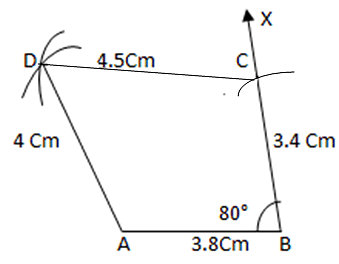
Thus, ABCD is the required quadrilateral.
Ques. What is the first step in the construction of a quadrilateral? (3 Marks)
Ans. For the first step, we must draw a rough sketch of the quadrilateral and mention or label the given measurements of the five parts in the rough figure. After that, we can draw the quadrilateral by analyzing the given measurements.
Ques. Construct a quadrilateral ABCD in which BC = 4 cm, ∠ABC = 800, AB = 3.6 cm, ∠ BAD = 1200 and AD = 5 cm. (3 Marks)
Ans. The construction steps are given as follows:
- First, draw AB = 3.6 cm.
- Construct ∠ABX = 800
- With B as the center and a radius of 4 cm, draw an arc, cutting BX at C.
- Now, construct ∠ BAY = 1200
- With A a center and radius of 5 cm, draw an arc, cutting AY at D.
- Lastly, join CD.

Thus, ABCD is the required quadrilateral.
Ques. What are the conditions required to construct a triangle? (3 Marks)
Ans. In order to construct a triangle, here are the required conditions:
- All measurements of four sides and one diagonal of the quadrilateral are given.
- Dimensions of three sides and two angles of a quadrilateral are given.
- Dimensions of adjacent two sides and three angles of a quadrilateral are given
- Dimensions of four sides and one angle are given.
- Dimensions of two diagonals and three sides are given.
Ques. Construct a quadrilateral ABCD in which AB = 5.5 cm, CD = 4 cm, BC = 3.5 cm, AD = 5 cm, and ∠A = 45°. (3 Marks)
Ans. The construction steps are given as follows:
- First, Draw AB = 5.5 cm
- Now, at A, construct ∠BAK = 45°
- Cut AD = 5 cm from AK.
- With B and D as centers and radii 3.5 cm and 4 cm respectively, draw two arcs that cut each other at C.
- Lastly, join BC and DC.

Hence, ABCD is the required quadrilateral.
Read More:
| Related Links | ||
|---|---|---|
| Area of rectangle | Properties of hexagon | Area of square |
| Exterior angles of a polygon | Types of Polygon | Heptagon |
Check out:



Comments