



Education Journalist | Study Abroad Lead
A curved line is any line that is not straight and is slightly bent. A straight line is the shortest line between two points if the point moves in only one direction. On the contrary, a curved line is formed when the point does not move in a single direction. The curved line can be seen in real life too for example railway tracks and road turnings. Curves can be described mathematically using equations, such as:
- A quadratic equation of the form y = ax2 + bx + c, which describes a parabolic curve.
- A cubic equation of the form y = ax3 + bx2 + cx + d, which describes a curve with two inflexion points.
- A sinusoidal equation of the form y = a sin(x) + b cos(x), which describes a periodic curve such as a sine wave.
Curved lines can also be defined using parametric equations, which describe the x and y coordinates of points on the curve as functions of a third parameter, such as time or distance along the curve.
| Table of Content |
Key terms: Algebraic curve, transcendental curve, isoquant curve, parametric equations, curved lines, straight line
What is a Curved Line?
[Click Here for Sample Questions]
A curved line is a line that is not straight but rather has a bend or a curve to it. This curve is typically smooth and continuous, meaning that it flows without any sudden jumps or breaks. A curve is defined as a collection of points that resemble a straight line between two adjacent points, but the curvature of a curved line is not zero, unlike a straight line. Consider two points A and B, any line joining them that changes direction and is not straight can be called a curved line. It is smooth and continuous.
- The curvature of a straight line is zero and that of a curved line is not zero.
- We can see many examples of curves around us for example the alphabets C and S are curved.
- Graphical representation of functions in mathematics often employs the usage of curved lines.
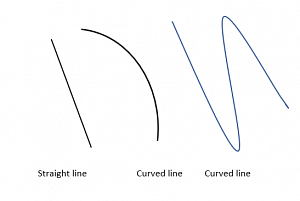
Lines
Read More:
| Related Articles | ||
|---|---|---|
| Statistics | Intersecting and non-intersecting lines | Pair of linear equations in two variables formula |
| Line Segment | Angle between two lines | Concurrent lines |
Types of Curved Lines
[Click Here for Sample Questions]
There are the following types of curved lines:
- Open curved line: The open curve is one where the endpoints do not meet. For example a parabola.
- Closed curved line: In a close curve the starting and end point is the same. For example a circle or eclipse.
- Simple curved line: A simple curve does not intersect itself. It can be of two types open and closed. A closed curve forms a path starting from any point and terminating at the same point. Thus, it may be open or closed.
- Non-simple curved line: A non-simple curve intersects itself along with changing its direction. They are also of two types open and closed.
- Algebraic curved line: In this type of curve a set of points are placed on the Euclidean plane. They are represented in polynomials, and the curve degree is denoted by the polynomial’s degree.
C = {(a, b) ∈ R2: P(a, b) = 0}
- Transcendental Curved line: This type of curve has multiple inflexions and intersection points. The transcendental curve is not an a and b-based polynomial. It does not represent any algebraic function. For example cycloid and spiral curves.
- Isoquant Curved line: The term is formed by “iso” which means equal and “quant” which means quantity. It is defined as a convex-shaped curve that is formed by the joining of the points. Its significance is for business purposes in adjusting inputs to maximize profit and production.
Read More:
| Related Articles | ||
|---|---|---|
| Polynomials | Parallelogram | Quadratic Equation |
| Algebra | Linear Equation | Probability |
Difference between a Straight Line and a Curved Line?
[Click Here for Sample Questions]
| Straight Line | Curved Line |
|---|---|
|
|
How to calculate the area under the curve?
[Click Here for Sample Questions]
The area under the curve can be calculated by doing a definite integral between two points.
To find you can use the following formula:
y = f(x); between x = a and x = b.
Then, integrate y= f(x) between the limits of a and b.
Read more:
| Related Articles | ||
|---|---|---|
| Number System | Trignometry | Relations and functions |
| Binomial Theorem | Sequence and series | Straight lines |
| Conic Sections | Introduction to three-dimensional geometry | Limits and derivatives |
Things to Remember
- A curve is a line that is not straight. It is smooth and continuous with no bends.
- The curved line can be opened or closed.
- There are several types of curved lines simple, non-simple, closed, open, transcendental, algebraic, and isoquant.
- A straight line has zero curvature and a curved line has non-zero curvature.
- A curve can be defined mathematically using equations or parametric equations, which describe the x and y coordinates of points on the curve as functions of a third parameter.
- Curved lines are used in many fields of mathematics, science, and engineering, including geometry, calculus, physics, and computer graphics.
Sample Questions
Ques. What are the types of curved lines? (3 marks)
Ans. The different types of curved lines are:
- Open curved line.
- Closed curved line.
- Simple curved line.
- Non-simple curved line
- Algebraic curved line.
- Transcendental curved line.
- Isoquant curved line.
Ques. Could a straight line make a curve? (2 marks)
Ans. A family of straight lines can represent many curves. But they are not a part of the curve; however, they somehow describe the curve. The straight lines are tangent to the curve. So, the curve is called the envelope of the family of straight lines.
Ques. What are examples of curved lines? (2 marks)
Ans. The common examples of curved lines are alphabets C and S. On the other hand, the letters L, N, A, and Z are examples of straight lines as they are formed by two or more consecutive lines. Natural examples of curved lines are the moon, rainbow, umbrella, curvy road, and railway tracks.
Ques. What is the shape of a straight line? (1 mark)
Ans. The straight line is an endless one-dimensional figure. It can be considered as a combination of endless points joined on both sides of a point. It has no width or curve at all.
Ques. What are curved lines called? (1 mark)
Ans. The arc of lines is called segments, rays, or lines depending on their configuration. It is called an arc in a circle and sphere. It is called a great arc in a great ellipse.
Ques. Can a triangle be called a curve? (2 marks)
Ans. The triangle can be considered a polygonal curve. It is created by three line segments. Any three non-collinear points form a unique triangle that can be isosceles scalene or equilateral. Triangle has three sides, three angles, and three vertices.
Ques. Is a rectangle a curve? (1 mark)
Ans. A rectangle can be considered a polygonal curve with four sides and a union of four line segments. It is a two-dimensional figure with four sides, four angles, and four vertices.
Ques. Define open and closed curves. (2 marks)
Ans. An open curve has two endpoints and does not enclose any area within itself. On the other hand, a closed curve has no endpoints and encloses an area. The close curve is said to be formed by joining the two end points of an open curve together. Example Circles and ellipses.
Ques. Define a closed curve and its components. (3 marks)
Ans. A closed curve is formed by joining two end points of an open curve. Its components are:
Interior: Area inside the curve.
Exterior: Area outside the curve.
Boundary: Point that lies on the curve.
Ques. What is a polygon and can it be considered a curve? (2 marks)
Ans. A polygon is formed by a set of line segments connected as if none cross each other. The simplest form of a polygon can have three sides like a triangle, and four sides like a rectangle. A polygon is considered a form of a closed curve and is also called a polygonal curve.
For Latest Updates on Upcoming Board Exams, Click Here: https://t.me/class_10_12_board_updates
Check-Out:



Comments