



Education Journalist | Study Abroad Lead
Concurrent Lines refer to the set of three or more three lines which pass through the common points. The concurrent lines are the set of non-parallel lines which extend indefinitely in both directions. In other words, these lines coincide at a common point. All the intersecting lines are termed to be concurrent lines. The common point where all these lines meet is the term to be the point of concurrency. The condition of the point of concurrency can be seen in all types of triangles. Concurrent Lines are an important concept that applies to 2-dimensional geometry. In the 2-Dimensional geometry, only two coordinate axis X and Y are present.
Read More: Properties of Parallel Lines
Key Terms: Concurrent Lines, Point of Concurrency, Triangles, 2-D Geometry, Coordinates, Intersecting Lines, Altitudes, Angle Bisectors, Medians
Concurrent Lines
[Click Here for Sample Questions]
If three non-parallel lines intersect at the common point then the condition of concurrency can be seen. Suppose, the following three lines:
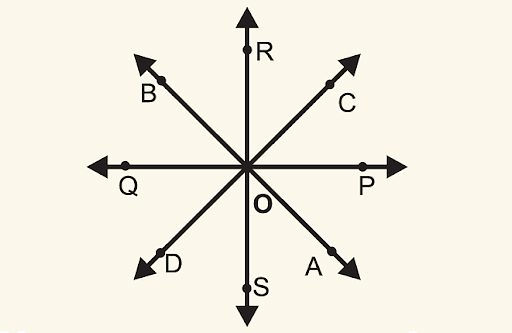
Concurrent Lines
P1x + Q1y + R1 =0…………………….(1)
P2x + Q2y + R2 =0…………………….(2)
P3X + Q3y + R3 =0…………………….(3)
Then the situation of the concurrency can be seen by the following expression:
\(\begin{bmatrix}P_1 & Q_1 & R_1 \\[0.3em]P_2 & Q_2 & R_2\\[0.3em]P_3 & Q_3 & R_3 \\[0.3em] \end{bmatrix}\) = 0
Also Read:
Point of Concurrency
[Click Here for Previous years Questions]
When three or more three lines intersect at the common point of intersection, then the condition is known as the point of concurrency. Moreover, the common point of the intersection is known as the concurrency point. For example, if the line P, line Q and line R are three non-parallel lines. When these three non-parallels meet at the common point of intersection then the point is known as the point of concurrency. Point P is the point of concurrency of the three lines as indicated in the below figure.
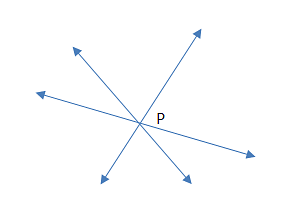
Point of Concurrency
Intersecting Lines and Concurrent Lines
[Click Here for Sample Questions]
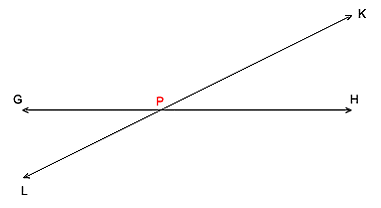
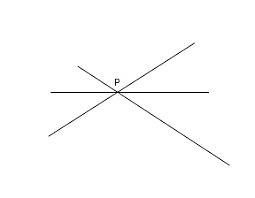
The concurrent lines are the lines which meet at the common point which is known as the point of the concurrency of lines. On the other hand, in the case of the intersecting lines, only two lines meet each other at the common point. Below are some of the differences between the intersecting lines and concurrent lines:
| Intersecting Lines | Concurrent Lines |
| Two lines are referred to as intersecting lines when they meet each other at a common point of intersection. | Concurrent lines are the set of three or more three lines which meet at the common point of meeting. |
| The point of meeting of the two intersecting lines is termed to be the point of intersection. | The point of meeting these concurrent lines is termed to be the point of concurrency. |
| Point P is the point of the intersection of the two lines as indicated in the figure below:
| Point P is the point of concurrency of the four lines as indicated in the figure below:
|
Read More: Angle between Two Lines
Concurrent Lines in Triangle
[Click Here for Previous years Questions]
Triangles have different types of concurrent lines. Altitudes, angle bisectors, medians and perpendicular bisectors are the main types of concurrent lines that can be seen in the triangle.
- Altitude: In any triangle, three altitudes when intersecting each other at the common point of the intersection then the point of concurrency is known as the orthocentre of the triangle.
- Angle bisectors: When the three angle bisectors of the triangle meet at the common point of the intersection, then the common point is known as the incentre of the triangle.
-
Medians: When the three medians of the triangle intersect at the common point then the common point is known as the centroid of the triangle.
- Perpendicular bisector: When the three perpendicular bisectors from the opposite sides intersect at the common point then the point of concurrency is known as the circumcentre of the triangle.
Read More: Area of a Triangle
Things to Remember
- Concurrent lines are the non-parallel lines. The parallel lines cannot be the concurrent line since, these lines are extended, in an indefinite manner. The phenomenon of the concurrent lines can be seen in the 2D geometry.
- Concurrent lines can be perpendicular to each other. The point of the intersection of the three lines is known as a concurrency point. For the condition of the concurrency, three lines must intersect at the common point.
- Four types of concurrent lines can be present in the triangle. Altitudes, perpendicular bisectors, angle bisectors and medians are the four types of the concurrent line present in the triangle.
- Four points of concurrency involve the centroid, incentre, circumcentre and orthocentre of the triangle.
Previous Year Questions
- Foot of the perpendicular drawn from the point (1, 3, 4) to the plane 2x - y + z + 3 = 0 is… [KCET 2019]
- XY - plane divides the line joining the points A (2, 3, - 5) and B (-1, -2, -3) in the ratio… [KCET 2019]
- A variable plane passes through a fixed point (3, 2, 1) and meets x, y and z axes at A, B and C respectively. A plane is drawn parallel to yz-plane through A, a second plane is drawn parallel zx-plane through B and a third plane is drawn parallel to xy-plane through C. Then the locus of the point of intersection of these three planes, is :… [JEE Main 2018]
- Which one of the following is not a statement?… [KEAM]
- The angle between two diagonals of a cube is… [KCET 2014]
Sample Questions
Ques. What is the point of concurrency known for the point of intersection of three medians in the triangles? (3 Marks)
Ans. Medians are the lines drawn from the opposite vertex to another side. These lines divide the other line into two equal parts. The median is the non-parallel line and thus the point of the concurrency or intersection of the medians is termed to be the centroid. Further a single median divides the triangle into two equal areas.
Ques. Show that lines 2x-3y+5=0, 3x+4y-7=0 and 9x-5y+8=0 are the concurrent lines. (3 Marks)
Ans. We know that in the case of the concurrent lines the below condition will satisfy. P1x +Q1y+R1=0…………………….(1) P2x+Q2y+R2=0…………………….(2) P3X+Q3y+R3=0………………….(3) P1 Q1 R1 P2 Q2 R2 = 0 P3 Q3 R3
⇒ 2 -3 5 3 4 -7 = 0 9 -5 8 = 2(32-35)+3(24+63)+5(-15-36) = -6+261-255 =0 Therefore, the above lines are a pair of concurrent lines.
Ques. What is the point of concurrency known for the point of intersection of three altitudes in the triangles? (3 Marks)
Ans. Orthocentre is made up of two terms i.e., ortho- right and centre- point of intersection of all lines. The point of the concurrency of the three or more than three non-parallel lines that is, altitudes are termed to be the orthocentre of the triangle. Furthermore, the orthocentre can be defined as the centre of the rights angles dropping to the opposite side from the vertices of the triangles.
Ques. How many types of concurrent lines are present in the triangle? (3 Marks)
Ans. Four types of concurrent lines are present in the triangle. These lines are termed altitudes, perpendicular bisectors, medians and angle bisectors. Where altitudes are the heights of the triangle. Perpendicular bisectors are the lines that bisect the perpendicular drawn from opposite sides. Medians are the lines drawn from the opposite side to the other side and bisects that side. Angle bisectors are the lines that bisect the angle in equal parts.
Ques. What is the formula for checking the concurrency between the lines? (3 Marks)
Ans. When the three lines are concurrent then the below condition is used for checking the concurrency of the lines. Where P1x +Q1y+R1=0, P2x+Q2y+R2=0 and P3X+Q3y+R3=0 are the lines that are intersecting at the point of the concurrency. P1x +Q1y+R1=0…………………….(1) P2x+Q2y+R2=0…………………….(2) P3X+Q3y+R3=0………………….(3) P1 Q1 R1 P2 Q2 R2 = 0 P3 Q3 R3
Ques. If the lines 2x-3y+5=0, 3x+4y-7=0 and 9x-5y+k=0 are concurrent lines then find the value of k? (3 Marks)
Ans. 2 -3 5 3 4 -7 = 0 9 -5 k We know from the condition of the point of the concurrency that the three lines when intersecting each other then the below condition will satisfy: P1 Q1 R1 P2 Q2 R2 = 0 P3 Q3 R3 ⇒ 2(4K-35)+3(3K+63)+5(-15-36)=0 ⇒ 15K -70+189-255= 0 ⇒ K=8
Ques. Can the two parallel lines term be the concurrent lines in the 2D geometry? (3 Marks)
Ans. Since the parallel lines extend indefinitely and thus the point of the intersection f these lines cannot be evaluated. Though the parallel lines intersect each other at a single point of the intersection even these lines are not concurrent lines. No, for the lines to be concurrent they must have to be nonparallel lines.
Ques. Show that lines 2x-5y+ 8=0, 3x+4y-14=0 and 9x-5y+6=0 are the concurrent lines. (3 Marks)
Ans. 2 -5 8 3 4 -14 = 0 9 -5 6 We know from the condition of the point of the concurrency that the three lines when intersecting each other then the below condition will satisfy: P1 Q1 R1 P2 Q2 R2 = 0 P3 Q3 R3 ⇒ 2 (24-70)+5(18+ 126)+ 8(-15-36) ⇒ -92+720-408 ⇒220 is not equal to zero. Therefore, the above lines are not concurrent.
Ques. Can two lines be called concurrent lines? (1 Mark)
Ans. No, for the concurrency condition three lines are required.
Ques. Can four lines intersect at more than four points? (1 Mark)
Ans. No, the maximum number of intersection points between the four lines is four. Therefore, the given condition is impossible.
Ques. Which types of lines never meet at the common point? (1 Mark)
Ans. Parallel lines are the lines that never meet at a common point.
Also check:



Comments