



Content Curator
Hydron is a subatomic particle made up of two or more quarks that are held together by strong nuclear force. Particles are classified according to their mass and interactions and their categorization is governed by four primary interactions.
- The strong force, electromagnetic force, weak force, and gravitational force are the four forces.
- It can be observed that Hadrons are the heaviest particles, whereas leptons are the lightest.
- Hadrons are subatomic particles that are smaller than an atom.
- Even the subatomic components are made up of quarks, which are smaller particles.
- To put it simply, a hadron is a subatomic particle. Hadrons are known as the heaviest particle on that level.
| Table of Content |
Key Terms: Subatomic particles, Proton, neutron, electron, quarks, antiquarks, gluons, atoms, nuclear force, mesons, baryons
What is a Hadron?
[Click Here for Sample Questions]
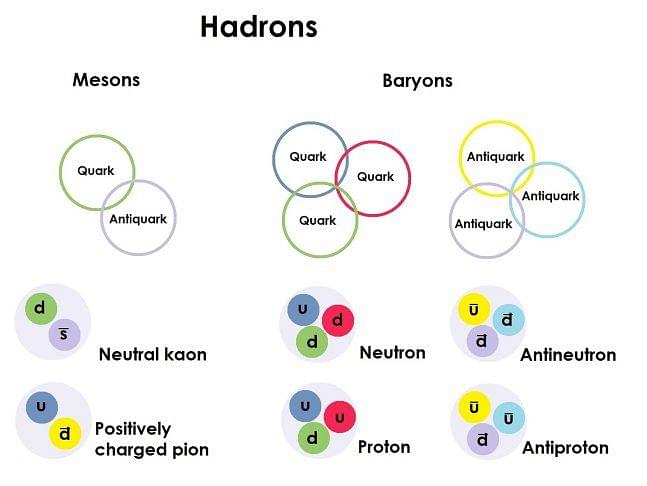
The subatomic particle hadron is made up of quarks, gluons, and anti-quarks. Hadrons are termed the heaviest particles made up of two or more quarks held together by a strong nuclear force.
- The functional electric charges of individual quarks combine to give hadrons a net integer electric charge.
- Three quarks of various colors or a quark of one color and an antiquark with a corresponding anticolor are the two simplest options.
- Hadrons with the first configuration are referred to as baryons, whereas those with the second arrangement are referred to as mesons.
What is Hadron?
Also Read:
Types of Hadron
[Click Here for Previous Year Questions]
Strongly interacting particles collide with the Hadron. Hadrons are categorized into two primary categories based on the combination of quarks, antiquarks, and gluons that are used to create them.
- Mesons
- Baryons
Mesons
Mesons have a mass that is somewhere between that of an electron and that of a proton.
- It's the result of combining a quark and an antiquark.
- It is particularly unstable because it is a highly interacting antiparticle.
- Instability, on the other hand, has no bearing on their life.
- They continue to exist for a very long time, a few billionths of a second.
- Every meson has a different mass, and they all have a wide range of mass.
Baryons
Three valence quarks are used to make baryons. Because they have an odd number of quarks, they are fermions, which means they have an odd half-integer spin.
- The baryon number B = 1 is due to the fact that quarks have a baryon number B = 1/3.
- Protons and neutrons are the most well-known baryons.
- All particles under baryons will have a half-integral spin since fermions have a half-integral spin.
Properties of Hadron
[Click Here for Sample Questions]
The valence quarks of hadrons determine their characteristics. The hadrons have the following properties:
- Due to a phenomenon known as color confinement, hadrons must have zero total color charge i.e. hadrons must be colorless or white.
- The strange thing about hadrons is that the quarks in them only account for a very small portion of their mass.
- Under normal circumstances, protons and neutrons bound within atomic nuclei are stable hadrons, whereas other hadrons are unstable.
- Colliding protons of heavy metals like lead and identifying the debris in the generated particle is how hadron physics is researched.
Hadron Particle
[Click Here for Previous Year Questions]
Of all the particles that are transformed into another form, the Hadron particle has the longest life.
- There are about 140 different types of mesons, which are a category of hadron. The pion is the lightest known meson out of all of them.
- The bosons, which have integral multiple spins, include mesons.
- Prion, kaon, and eta are some of the particles that fall within the category of mesons. Pion and eta are quite normal. The weirdness of Kaon is +1.
- Another type of hadron is the Barton, which contains around 120 types.
- Nuclei, Lambda, Sigma, Xi, and Omega are some of the particles that fall under the category of baryon. Omega has the most mass of all of them.
- Nuclei have zero strangeness, but Lambda and Sigma have strangeness of -1. The strangeness of Xi is -2, while Omega has the maximum negative strangeness of -3.
- A proton is the lightest particle among the baryon particles. The proton is the only hadron particle that remains stable in space because it is the lightest.

Hadron Particle
Hadron Collider
[Click Here for Sample Questions]
The Large Hadron Collider is the world's most powerful particle accelerator.
- It enhances particles like protons, which are the building blocks of all matter.
- They smash with other protons after being accelerated to a near-light speed.
- Massive particles like the Higgs boson and the top quark are created in these collisions.
- It was built by the European Organization for Nuclear Research between 1998 and 2008.
- This collider has a total length of 26.7 kilometers in a circular orbit and is housed in a 27-kilometer tube.
- It is located deep below the France-Switzerland border in Geneva, with depths ranging from 50 to 175 meters. This machine is more than 38000 tonnes in weight.
Previous Year Questions
- The de Broglie wavelength of the emitted electron is...[VITEEE 2017]
- The de Broglie wavelength of a proton of mass M if it is accelerated by the same potential difference is...[WBJEE 2016]
- The kinetic energy of an electron get tripled then the de-Broglie wavelength associated with it changes by a factor….[VITEEE 2012]
- the intenstines is not generally taken by radiologists because….[VITEEE 2012]
- the number of photons of yellow light it emits per second is….[NEET 2012]
- the energy received by the surface during time span of 1minute is...[NEET 2020]
Things To Remember
- This big bang event occurred almost 13.7 billion years ago.
- Examples of hadron are kaon, proton, neutron, antiproton, and antineutron.
- Leptons are classified into three types: electron, muon, and tau.
- Examples of lepton are an electron, neutron, and muon.
Also Read:
Sample Questions
Ques. Is There Something Smaller Than A Quark? [2 Marks]
Ans. A preon is a subatomic particle that is smaller than a quark. Preons are small, spherical particles. Preons are subatomic particles that make up quarks and leptons. To explain two fermion families with spin minus half, preons were thought to be anomalies. Leptons and quarks were the two fermion families. Later, another preon model that belonged to the boson family was identified. Even though that preon model had spin minus one, it was still referred to as preon. Preon models are used to explain conventional models that aid in the creation of new particles.
Ques. What Are Preon Stars? [2 Marks]
Ans. Only preons are used to make preon stars. It was discovered through the use of a theory. Everything, according to the belief, begins as a small thing and grows into something larger. Similarly, the sub-subatomic particle may have come before the subatomic particle in the case of atoms and subatomic particles. It's also possible that subatomic particles existed before the atomic particle. It was also thought that preon stars are stars that cannot become neutron stars or are not stable enough to become black holes.
Ques. What is the weak nuclear force responsible for? [1 Mark]
Ans. The weak interaction, also known as the weak force or weak nuclear force, is a fundamental force of nature that governs the decay of unstable subatomic particles like mesons and initiates the nuclear fusion reaction that powers the Sun.
Ques. Can a supercollider create a black hole? [1 Mark]
Ans. The first is whether or not a black hole can be produced at the LHC. Unfortunately, based on all of the scientific evidence and current understanding of the rules of the universe, the LHC will not be able to create a black hole. This is just not possible due to the weakening of gravity.
Ques. What are examples of mesons? [2 Marks]
Ans. The p, h, r, and w mesons are examples of mesons. Mesons have no net baryon or net lepton number and can decay, therefore they don't live very long. A p meson, for example, can decay into two photons. Colorless is an object made up of red, green, and blue quarks.
Ques. What do you mean by fermions? [2 Marks]
Ans. A fermion is a particle in particle physics that follows Fermi–Dirac statistics and possesses half-even integer spin: spin 1/2, spin 3/2, etc. All quarks and leptons, as well as all composite particles made up of an odd number of them, such as all baryons and many atoms and nuclei, are referred to as fermions.
Ques. Is a proton a baryon or meson? [2 Marks]
Ans. Three quarks make up baryons, which are hefty subatomic particles. Baryons are protons and neutrons, as well as other particles. (A meson is the other type of hadronic particle, which is made up of a quark and an antiquark.) Baryons are characterized by a baryon number, B, of 1.
Ques. What are hadron and Lepton? [2 Marks]
Ans. Hadrons are particles that are affected by the strong nuclear force, while leptons are not. Hadrons are made up of protons, neutrons, and pions. Leptons are low-mass particles such as the electron, positron, muons, and neutrinos. The weak nuclear force is felt by Leptons.
For Latest Updates on Upcoming Board Exams, Click Here: https://t.me/class_10_12_board_updates
Check-Out:



Comments