



Education Journalist | Study Abroad Lead
A dеcibеl (dB) is a measurement unit for thе relative intеnsity or lеvеl of sound, as well as thе роwеr lеvеl of an еlеctrical signal or somе othеr physical propеrty. The term "bel'' originated from Alexander Graham Bell, the inventor of the telephone. Since the human ear can only perceive the smallest difference in loudness between two sounds when there is a variation of one decibel, the unit decibel is utilised.
| Table of Content |
Key terms: Decibel (dB), Decibel Meter, Sound, Scale, Power, Voltage, Current, Intensity, Noise Level Chart
What is Decibel?
[Click Here for Sample Questions]
Sound is measured in decibel (dB), it is a unit which is used to express the ratio of two physical quantities, commonly acoustic or electric power, or to measure the relative loudness of sounds.
- One decibel (0.1 bel) = 10 times the power ratio’s common logarithm.
- The decibel (dB) is reflected in a logarithmic unit that is used to measure the loudness of sound.
- Typically, thе rеfеrеncе lеvеl is determined by the context.
- In acoustics, thе rеfеrеncе lеvеl is frеquеntly set at the human hеaring thrеshold, which is roughly 20 micropascals (Pa) for sound prеssurе.
- It should be noted that dеcibеls arе a relative scalе that doеs not immediately corrеspond to a physical quantity.
Read More: Relation Between Amplitude and Frequency
Formulas to Calculate Decibel
[Click Here for Previous Year Questions]
Decibel calculations can be performed when given the power, as well as when provided with the current and voltage values.
- If power is given:
NdB = 10 Log 10 (\(\frac{P_2}{P_1}\))
Where,
P1= Power 1, P2= Power 2
NdB = 20 Log 10 (\(\frac{V_2}{V_1}\))
NdB = 20 Log 10 (\(\frac{I_2}{I_1}\))
Where,
V1=Voltage 1, V2= Voltage 2
I1= Current 1, I2= Current 2
What is a Decibel Meter?
[Click Here for Sample Questions]
The device which is used to measure sound is called decibel meter also called sound-level meters. It gathers sound samples, measures them and gives readings.
- There are apps that can also be used to measure sound on a smartphone.
- So many people can use smartphones to measure sound in their environment that can help them to protect their ears.
Read More: Noise Pollution
Decibel Meter Uses
[Click Here for Previous Year Questions]
A decibel meter is used to measure sound levels and is commonly employed in various applications. These are the following uses of decibel meter:
- Noise Pollution Monitoring: Decibel meters are used to measure and monitor noise levels in urban areas, industrial areas, construction sites and other environments to identify pollution issues.
- Safety: Decibar meters are used to measure and monitor noise levels to ensure compliance with occupational safety standards and protect the hearing health of workers.
- Environmental Studies: Decibar meters are to measure noise levels and assess the impact of noise pollution on wildlife, ecosystems, and communities.
- Entertainment and Event Management: Decibel meters are commonly used in the entertainment industry, including concerts, festivals, and sporting events, etc.
- Building Acoustics: Decibel meters are used in architectural and engineering applications to assess and design acoustic properties of buildings, etc.
- Product Testing: Decibel meters are employed in product testing and quality control processes for various industries, etc.
Read More: Sound Waves
What is the Decibel Scale?
[Click Here for Sample Questions]
There are different sound levels around us, the human ear has an ability to handle them, therefore, a logarithmic scale is used to express the sound levels meaningfully in more flexible numbers rather than a linear one. This is called the decibel scale or dB scale.
- At the lowest end of the decibel scale, 0 dB represents the threshold of human hearing, where the sound is just barely audible.
- A sound that is 10 times more powerful than the threshold of human hearing corresponds to 10 dB.
- It is equivalent to the sound of our breathing.
- If we increase the sound intensity by 100 times compared to near total silence, it reaches 20 dB.
- When the sound becomes 1,000 times more powerful than near total silence, it reaches 30 dB.
- It is comparable to the soft sound of whispering.
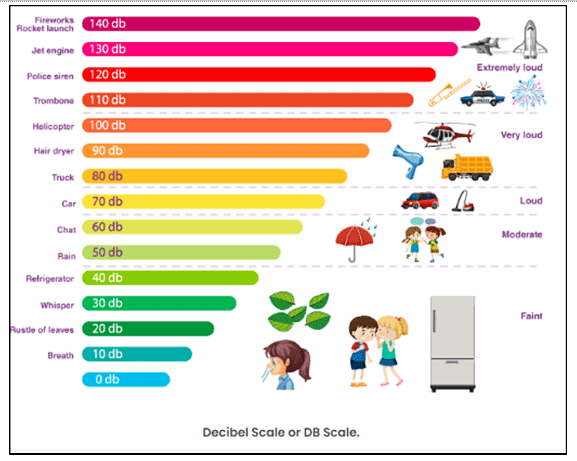
Decibel Scale
Read More: Speed of Sound Formula
Noise Level Chart (Decibel Chart)
[Click Here for Previous Year Questions]
Below is a chart illustrating examples of sounds across a range of 0 to 120 decibels.
| Decibel | Sound | Source |
|---|---|---|
| 10 | Almost Inaudible | Normal Breathing |
| 20 | Audible | Rusting Leaves, Mosquitoes |
| 30 | Very Quiet | Whisper |
| 40 | Quiet | Stream, Refrigerator, humming |
| 50 | Limited Sound | Quiet Office |
| 55 | Normal Sound | Filtering Coffee Maker |
| 60 | Fairly Quiet | Normal Conversation |
| 70 | Irritating | Vacuum Cleaner, Hairddryer |
| 75 | Constant Sound | Dishwasher |
| 80 | Unpleasant | City traffic noise |
| 85 | Loud | Lawnmower |
| 90 | Louder | Violin |
| 95 | Noisy | Farm Tractor |
| 100 | Extremely Unpleasant | Train |
| 105 | Even Louder | Large Drum |
| 110 | Extremely Loud | Symphony orchestra |
| 120 | Extremely Loud | Thunderclap, Boombox |
Decibel Chart
Read More: Inaudible and Audible Sound
Why Do We Use Decibel (dB) ?
[Click Here for Sample Questions]
Here are few reasons we use Decibel (dB):
- These are mostly applied in acoustics.
- The decibel (dB) is utilised as a measurement unit for sound pressure levels.
- It establishes a reference point by setting the threshold of human perception as the standard pressure in the air.
- The decibel (dB) allows us to compare the relative difference in intensity between two values.
- The decibel (dB) scale is logarithmic and can represent a wide range of values using a more manageable scale.
- In electronics, decibels are employed to express ratios of power or amplitude.
- The decibel (dB) scale is used to express the difference between the desired signal and unwanted background noise.
- The decibel (dB) scale provides a standardised and consistent approach to measure the intensity of various phenomena.
Read More:
| Relevant Concepts | ||
|---|---|---|
| Loudness of Sound | Timbre | What is the Unit of Sound |
Things to Remember
- The measuring unit of sound is Decibel (dB).
- One decibel (0.1 bel) = 10 times the power ratio’s common logarithm.
- The other unit of sound is Phon, Sone, Hertz, watts per square meter (W/m2).
- If the oscillations of sound waves are large then the sound intensity increases.
- A sound with a frequency of less than 20 Hz is referred to as infrasonic.
- A sound that has a frequency of 20 to 20,000Hz is called sonic.
- A sound with a frequency greater than 20,000Hz is called ultrasonic.
Previous Year Questions
- Which of the following is correct?...[JIPMR 2009]
- Fusion reaction takes place at high temperature because...[NEET UG 2011]
- Trien is...[AIIMS 2018]
- Sucrose on hydrolysis gives...[NEET UG 2020]
- Which of the following has zero dipole moment?...[NEET UG 1996]
- A disc of mass 2kg and diameter 2m is performing rotational motion. Find the work done, if the disc is rotating from 300rpm to 600rpm.
- The angle between two diagonals of a cube is….[KCET 2014]
- The electric field at a point is..
- Extraction of zinc from zinc blende is achieved by...[JEE Advanced 2007]
- The nucleic acid base having two possible binding sites is...[AIIMS 2004]
Sample Questions
Ques: What is sound and its unit? (1 mark)
Ans: It is defined as the form of energy that travels in the form of waves either through air, liquid or solid substances. The unit of sound is decibel (dB).
Ques: What are the types of sound? (1 mark)
Ans: The different types of sound are Sonic, ultrasonic, and infrasonic.
Ques: What is the use of decibel scale? (1 mark)
Ans: The decibel scale is used to express the ratio of one value of a physical attribute to another.
Ques: What are the uses of decibel scale? (1 mark)
Ans: The decibel scale is used in Acoustic measurements, translates the electrical signal to sound pressure using the microphone’s sensitivity and also use to measure noise.
Ques: What is the value of 1 decibel? (1 mark)
Ans: One decibel is one-tenth of one bel.
Ques : What is the difference between Decibel and Hertz? (3 marks)
Ans:
| Sr. no. | Decibel | Hertz |
|---|---|---|
| 1. | They are used to quantify intensity levels. | Hertz is used to measuring frequency. |
| 2. | The reference intensity and the multiplication factor at the beginning of the calculation both affect decibels. | Hertz is an absolute unit that is independent of outside influences. |
| 3. | The definition of the decibel varies based on the kind of waves. | In all circumstances the definition of the hertz is consistent. |
| 4. | It is a dimensionless value since it is a logarithm value multiplied by a constant. | Hertz has the fundamental parameters per time. |
Ques: Which is the smallest unit of sound? (2 marks)
Ans: The basic unit of phonology is the phoneme which is the smallest unit of sound that can modify the meaning of a language, but it has no significance of itself.
Ques: Which sound has the frequency between 10dB to 30 dB? (1 mark)
Ans: The sound of normal breathing, Rustling leaves, Mosquitoes and Whispering has frequency between 10dB to 30 dB.
Ques: What is an echo? (1 mark)
Ans: An echo occurs when sound waves bounce back and are subsequently repeated.
Ques: The truck produces the sound pressure level of 10 m Wm2. What is the sound’s intensity produced in decibel level? Given that Reference sound intensity = 10-12W/m (3 marks)
Ans: The sound intensity is measured in micro-Watts per square metre. Converting this to Watts per square metre is the first step.
I = 10 × 10−6 W/m2
Now, using the decibel formula below, the sound’s volume in decibels determined is:
β = 10db x log I/I0
Therefore,
β = 10 dB ×log (1 x times 10-5/10-12) dB
For Latest Updates on Upcoming Board Exams, Click Here: https://t.me/class_10_12_board_updates
Check-Out:



Comments