



Content Curator
Pressure is defined as the normal force applied on an object per unit area of the surface on which force is applied. It is denoted by the symbol ‘P or p’. The SI unit of pressure is Pascal (Pa). Various examples of pressure in real life are:
- To cut fruit or vegetables, sharp knives are used instead of blunt ones so that pressure can be applied more quickly to the fruit.
- To put more pressure on the wall, the nails on the wall are very pointy.
- To increase the surface area and reduce pressure, porters wear a round piece of cloth on their heads.
There are different types of pressure, and also different units of pressure are used to express it.
| Table of Content |
Key Terms: Atmospheric Pressure, Barometer, Absolute Pressure, Force, Sphygmomanometer, Unit of Pressure, Manometer
What is Pressure?
[Click Here for Sample Questions]
Pressure is the amount of normal force acting on a given area. It is defined as the force applied in a perpendicular direction on the surface of a body per unit area. Different units are used to express pressure. Such as
- SI unit of pressure is Pascal (Pa).
- A pressure of one pascal is defined as the force of 1 Newton applied in a perpendicular direction over a surface of area 1 m2.
- Atmospheric pressure (atm) is also used as a unit of pressure.
- It is defined as the average atmospheric pressure of the earth at sea level.
- One atm is equal to 101325 Pa.
- Pressures can also be expressed in terms of the height of the column of a particular fluid in a manometer such as the millimeter of mercury, centimeter of water, and inch of mercury.
Mathematically, pressure is given by the formula
P = F/A
Where
- P is pressure
- F is the magnitude of the normal force
- A is the area of the surface on which force is applied.
Pressure is a scalar quantity that relates two vectors i.e. area vector and the normal force acting on it.

Pressure
Also Read: Pressure Drop Formula
Types of Pressure
[Click Here for Sample Questions]
There are four major types of pressure measurement. These are
- Absolute Pressure
- Gauge Pressure
- Sealed Pressure or Vacuum Pressure
- Differential Pressure
Absolute Pressure
The absolute pressure is relative to zero pressure and takes the pressure of a perfect vacuum or empty space i.e. air-free space, as a reference where no pressure is present.
- It is denoted by ‘Pabs’.
- The reference point as absolute zero pressure is taken in the measurement of absolute pressure.
- It is measured by using a Barometer
The formula for the measurement of absolute pressure is
Pabs = Patm + Pgauge
Where
- Pabs = absolute pressure
- Patm = atmospheric pressure
- Pgauge = gauge pressure
Gauge Pressure
In Gauge pressure measurement the pressure of the surrounding air, gas, or liquid are taken as the reference pressure. It is the difference between absolute pressure and atmospheric pressure.
- It is also known as relative pressure.
- It can either be positive or negative.
- The positive values of gauge pressure are called overpressure.
- The negative values of gauge pressure are called under pressure or partial vacuum.
The formula for the measurement of absolute pressure is
Pgauge = Pabs - Patm
Where
- Pabs = absolute pressure
- Patm = atmospheric pressure
- Pgauge = gauge pressure
A diaphragm sensor is used to measure gauge pressure. One side of the diaphragm is exposed to the pressure media that is to be measured, and the other side is exposed to ambient atmospheric pressure.
A sphygmomanometer is a device used to measure blood pressure. It is a mercury-filled manometer. The maximum blood pressure is referred to as Systolic Pressure and the minimum blood pressure is referred to as Diastolic pressure.
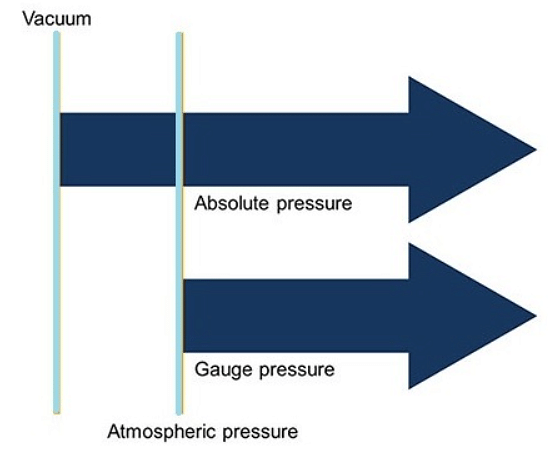
Difference between the different types of pressure measurement
Sealed Pressure
The pressure inside a sealed or enclosed system is known as sealed pressure. There is no exchange of matter with the surroundings that takes place in a sealed system i.e. no solids, liquids, or gases can enter or escape from the system. Therefore, any pressure generated within the system remains trapped and can be increased over time.
- Sealed pressure has great importance in containers and tanks used for storing gases, liquids, or chemicals.
- It ensures that the materials inside the containers of tanks remain on them and they do not leak or escape.
- Some examples are pressurized gas cylinders, compressed air systems, fuel tanks, and hydraulic systems.
Differential Pressure
The measure of the difference between pressures of two different points is known as Differential pressure. It is a type of gauge pressure that measures the pressure difference.
- The pressure of the two points should be of the same unit to measure the differential pressure.
- It is denoted by ‘Pd’.
The formula for differential pressure is given by
Pd = P2 - P1
Where
- Pd is the differential pressure
- P1 is the pressure of the first point
- P2 is the pressure of the second point
Also Read:
Applications of Types of Pressure
[Click Here for Sample Questions]
The applications of different types of pressure measurements are given below.
- Absolute Pressure: The applications of absolute pressure is used in measuring Barometric pressure. It is also used in weather stations and meteorological applications.
- Gauge Pressure: Its applications are used in water level measurement, chamber pressure, car tires, and hydraulic applications.
- Sealed Pressure: It is used in industrial applications, washdown environments, etc.
- Differential Pressure: The applications of differential pressure are used in air conditioners, filters and pump monitoring, etc.
Things to Remember
- Pressure is defined as the normal force acting on a surface per unit area of the surface.
- Pascal (Pa) and atmospheric pressure (atm) are the different units of pressure.
- For the measurement of absolute pressure, the pressure of the vacuum is taken as the reference i.e. zero pressure.
- The measurement of the difference in the pressure between the two points is known as differential pressure.
- The gauge pressure is the difference between absolute pressure and atmospheric pressure.
Also Read: Value of R in atm
Sample Questions
Ques. Define Pressure. (1 Mark)
Ans. Pressure is defined as the force acting on a surface at the right angle per unit area of the surface. Mathematically, it is given by P = F/A
Ques. Write the dimensional formula of pressure. (2 Marks)
Ans. The formula for pressure is given by
P = F/A
The dimensional formula of force is, [F] = [MLT-2]
The dimensional formula of the area is [A] = [L2]
Therefore, the dimensional formula of pressure is
[P] = [MLT-2]/[L2]
⇒ [P] = [ML-1T-2]
Ques. Which device is used to measure blood pressure? (1 Mark)
Ans. Sphygmomanometer is used to measure blood pressure.
Ques. A pressure gauge measures the reading as 32 psi. If the atmospheric pressure is 15 psi. Compute the absolute pressure that corresponds to this gauge pressure reading. (3 Marks)
Ans. The parameters given are
- Reading of pressure gauge, Pgauge = 32 psi
- Atmospheric pressure, Patm = 15 psi
The formula for the measurement of absolute pressure is
Pabs = Patm + Pgauge
On substituting the values on the above formula, we get
Absolute pressure, Pabs = 15 + 32 = 47 psi
Ques. Determine (a) gauge pressure and (b) the absolute pressure of water at a depth of 10 m from the surface and the atmospheric pressure is 10 N/m2. Take g = 10 m/s2. (5 Marks)
Ans. The given parameters are
- Depth, h = 10 m
- Atmospheric pressure, Patm = 10 N/m2
- Acceleration due to gravity, g = 10 m/s2
- Gauge pressure is given by
Pgauge = ρgh
Where ρ = 1000 kg/m3 is the density of water
On substituting the values, we get
Pgauge = 1000 x 10 x 10 = 100000 N/m2
- The formula for the measurement of absolute pressure is
Pabs = Patm + Pgauge
On substituting the values on the above formula, we get
Absolute pressure, Pabs = 10 + 100000 = 100010 N/m2
Ques. A pressure gauge measures the reading as 220632 pascals. If the atmospheric pressure is 101325 pascals. Compute the absolute pressure that corresponds to this gauge pressure reading in psi (pound per square inch). (5 Marks)
Ans. The parameters given are
- Reading of pressure gauge, Pgauge = 220632 Pa
- Atmospheric pressure, Patm = 101325 Pa
The formula for the measurement of absolute pressure is
Pabs = Patm + Pgauge
On substituting the values on the above formula, we get
Absolute pressure, Pabs = 101325 + 220632 = 321957 Pa
Now, 1 pascal = 0.000145038 psi
Therefore, 321957 pascals = 46.7 psi
Ques. Define absolute pressure and write its one application. (2 Marks)
Ans. Absolute pressure is defined as the pressure for which reference is taken as the pressure of a perfect vacuum or empty space where pressure is zero.
The measurement of absolute pressure is used in weather stations and meteorological applications.
Ques. Determine the gauge pressure of water at a depth of 5 m from the surface. Take g = 10 m/s2. (3 Marks)
Ans. The given parameters are
- Depth, h = 5 m
- Atmospheric pressure, Patm = 105 Pa
- Acceleration due to gravity, g = 10 m/s2
Gauge pressure is given by
Pgauge = ρgh
Where ρ = 1000 kg/m3 is the density of water
On substituting the values, we get
Pgauge = 1000 x 10 x 5 = 50000 N/m2
For Latest Updates on Upcoming Board Exams, Click Here: https://t.me/class_10_12_board_updates
Check-Out:



Comments