



Content Curator
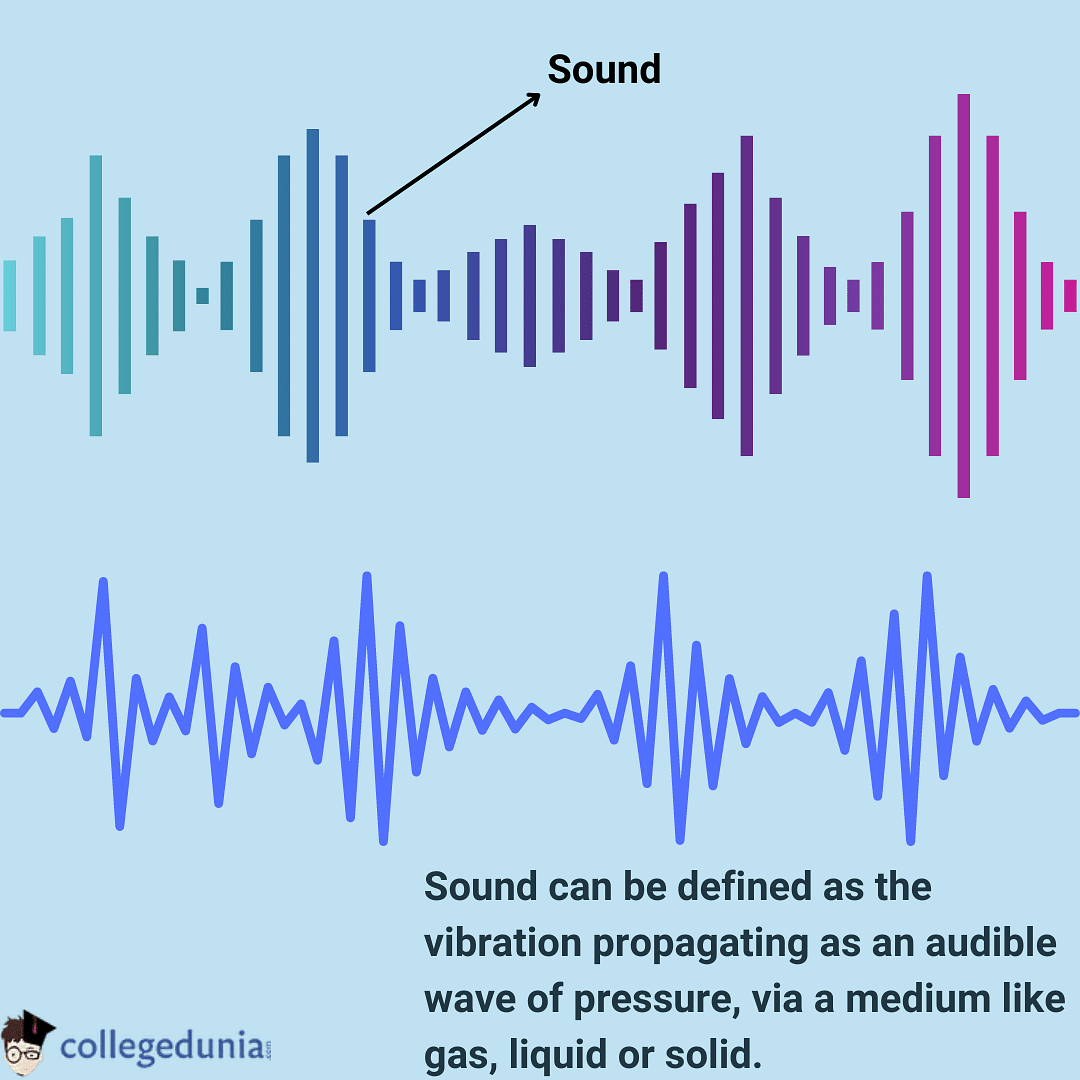
Sound waves are patterns of disturbances that are caused by energy travelling away from a sound source. Sound can be defined as the vibration propagating as an audible wave of pressure, via a medium like gas, liquid or solid.
Some of the examples of sound waves are:
- The vibrations produced by the throat when speaking
- The sound of a ringing cell phone
- The sound of musical instruments
A sound is a form of a wave travelling in the medium having different frequencies that reach our ears and we hear it. A sound is a form of vibration propagating in a medium in the form of mechanical waves. Sound waves can propagate in all the mediums like solid, liquid, and gas. The sound waves travel in the solid medium relatively faster as compared to the liquid and gaseous medium.
Read More: Wave Speed
| Table of Contents |
Key Terms: Sound Waves, Sound, Wavelength, Vibration, Decibel Scale, Frequency, Amplitude, Time, Waves, Pressure, Speed
What is Sound?
[Click Here for Previous Year Questions]
Sound is simply defined as the vibrations propagating in the medium in the form of mechanical waves. Sound can be expressed as:
| “A vibration which is seen to propagate as an audible wave of pressure, via a medium such as a gas, liquid or solid.” |
Sound
- In Physics, Sound is a vibration that produces an acoustic wave that travels in all the mediums such as solid, liquid, and gas.
- Sound even travels through a gaseous medium. It is something that can be heard.
- The speed of sound is different in different mediums.
- Sound can also be defined as the reception of mechanical waves and their perception by the human brain.
What is Decibel Scale?
The Decibel scale can be expressed as:
- The ear is able to respond to both small and large pressure waves, which means, it can respond to sounds of very small amplitude than to sounds which are of very large amplitude.
- A decibel is a relative unit of measurement which is equivalent to one-tenth of a bel.
- It basically is the ratio of two values of a power or root-power quantity based on the logarithmic scale.
What is a Sound Wave?
[Click Here for Sample Questions]
Sound wave can be defined as:
| “The patterns of disturbances which are caused by the movement of energy travelling via a medium (examples include air and water)” |
- It is a way by which energy is transferred from one point to another in the form of longitudinal mechanical waves.
- Sound waves require a medium for propagation as they cannot propagate in a vacuum.
- Sound waves are produced when the disturbance is caused in the medium and travels longitudinally means the vibration of particles is parallel to the direction of energy wave propagation.
- The particles move back and forth creating a high-pressure and low-pressure region in the medium.
- The high-pressure region is termed compression and the low-pressure region is termed rarefaction.
- These regions transfer to another medium also which is responsible for the propagation of sound in the other medium also.
Sound Waves
Some important terms and formulae related to sound waves are mentioned below:
- Period: The time required to complete the one cycle by sound waves, is denoted by T.
- Frequency: It is the number of cycles completed by sound waves in one second, denoted by nu(v). Formula: Frequency = 1/T
- Wavelength (λ): It is the distance covered between two compressions and the rarefaction of sound waves. Formula: Wavelength (λ) = v/F
- Amplitude: It is the maximum distance travelled by the particle on either side of the compression and interaction of the sound waves.
Also Read: Relation between Frequency and Velocity
Types of Sound Waves
[Click Here for Previous Year Questions]
The three main types of Sound Waves are elaborated below:
Longitudinal Sound Waves
The longitudinal waves are the waves in which the motion of particles of the medium is parallel to the sound waves. While in transverse waves the particles of medium travel perpendicular to the direction of propagation of sound waves.
Mechanical Sound Waves
Generally, sound waves are mechanical waves that require a medium for propagation. When the disturbance is produced in the medium the energy is transferred from particle to particle through mechanical waves. For example, if a string is touched the violations are reached at the end through the propagation of mechanical waves.
Pressure Sound Waves
The sound waves travel in the medium between high-pressure and low-pressure regions such as compression and rarefactions. Due to this sound waves can be considered pressure waves. For example, the human ear hears the sound from the surrounding environment through high-pressure and low-pressure regions by pressure waves.

Response of a Simple Oscillator to a Sinusoidal Force
Also Read: Transverse and Longitudinal Waves
Nature of Sound Waves
[Click Here for Sample Questions]
Sounds can be differentiated on the basis of their properties. The sound of vehicle horns and microphones can only be identified through their specific properties. Properties like frequency, wavelength, amplitude, etc. are responsible for characterizing the sound waves.
Period (T)
The period of sound waves is defined as the time required to complete the one cycle of sound waves. In one complete cycle both compression and rarefaction occur. It is denoted by T and time is measured in seconds.
Frequency
The frequency of sound waves is the number of cycles completed by the wave in one second. It is also defined as the number of vibrations created by the wave in one second. Frequency is the reciprocal of the period. It is denoted by nu (ν) or f, its SI unit is Hertz (Hz). The Formula of Frequency = 1/T

Frequency response of an Oscillating System
Wavelength (λ)
The wavelength of sound waves is defined as the distance between successive compression and rarefaction. In other words, it is the minimum distance covered by the wave before it starts repeating itself. It is denoted by the symbol λ and its SI unit is a meter. The Formula of Wavelength λ = ν/F
where,
- v = Velocity of sound waves
- F = Frequency of sound waves
Amplitude
The amplitude of a sound wave is the maximum distance travelled by particles on either side of the compression or rarefaction. The energy of a wave can be identified by its amplitude.
Velocity
The velocity of sound waves is the distance travelled by the wave in unit time. Its SI unit is meter/second. The Formula of Velocity of sound wave = wavelength/period or wavelength × frequency
Thus, v = λ × ν (m/sec)
Also Read: Relation Between Amplitude and Frequency
Speed of Sound Waves
[Click Here for Previous Year Questions]
The speed of sound waves is defined as the speed at which sound waves travel in the medium.
- The speed of sound varies from medium to medium.
- The speed of the sound is generally more in the solid medium because in the solid the atoms are very close and compressed.
- But in liquid or gases, the speed of sound is relatively low.
- The interaction between atoms depends on the distance between them.
- In liquids and gases, the separation of atoms is far as compared to solids. It is denoted by the letter c.
The speed of sound is given by using the below formula:
| c = d/t |
Where,
- c = speed of sound
- d = distance travelled by the sound wave
- t = time required to cover the distance
The speed of sound in different mediums is different. The speed of sound in some mediums is given below.
| Medium | Speed of Sound |
|---|---|
| Air | 343.2 m/s |
| Water | 1481 m/s |
| Glass | 4540 m/s |
| Copper | 4600 m/s |
| Aluminium | 6320 m/s |
| Hydrogen | 1270 m/s |
| Rubber | 60 m/s |
| Gold | 3240 m/s |
| Lead | 1210 m/s |
Newton's Formula for Speed of Sound
The Scientist Newton proposed a formula to calculate the speed of sound in the medium. The speed of sound in all the three mediums solid, liquid and gas are determined. Newton's formula for the speed of sound is.
| v = √E.P |
Where,
- E = Modulus of Elasticity of the medium
- P = Density of the medium
Speed of Sound in Solid Medium
Sound travel faster in solids. The formula to calculate the speed of sound in a solid medium is given by
| v = √P.Y |
Where,
- P = Young's modulus of solid material
- Y = Density of the medium
Speed of Sound in Liquid Medium
The formula for the speed of sound in a liquid medium is given by:
| v = √P.B |
Where,
- P = Bulk Modulus of the liquid
- B = Density of the liquid
Speed of Sound Waves is Gaseous Medium
Newton considered the propagation of sound waves in a gaseous medium as an isothermal process PV = Constant. Then he started the formula for the speed of sound in gases is v=√γ/ρ.
This formula is not considered good to determine the speed of sound in a gaseous medium. Then Laplace corrected this formula and proposed a new formula to calculate the speed of the sound waves in the gaseous medium.
Factors Affecting the Speed of Sound in Gaseous MediumVarious factors affect the speed of sound in the gases. The physical and environmental factors affect the speed of sound in the gaseous medium. Some important factors are as follows:
|
Check More:
Reflection of Sound Waves
[Click Here for Sample Questions]
The reflection of sound waves is similar to the reflection of light.
- When the sound waves strike the hard surface, it returns towards the source. It is also termed an echo.
- While the soft surfaces absorb the sound waves. The sound with low frequency doesn't get returned as it gets absorbed.
- When multiple echoes are generated from the source and have several hard surfaces this phenomenon is termed reverberation.

Response Curves of Oscillating Systems
Things to Remember
- Sound waves are mechanical waves that travel without a medium.
- The speed of sound waves is maximum in solid medium and minimum in liquid and gaseous medium comparatively. Its speed varies from medium to medium.
- The reflection of sound waves is similar to the reflection of light.
- The factors like temperature, physical state, pressure, humidity, composition, and metallic and non-metallic behaviour influence the speed of sound waves.
- The sound waves having a frequency range 20Hz to 20000Hz can be heard by human ears.
- The sound can be heard at a longer distance due to the refraction of sound waves.
- The quality of sound waves can be identified by the pitch of sound waves. It depends on the frequency of sound waves. The high pitch sound has a higher frequency and the low-pitch sound has a lower frequency.
Read Also:
Previous Year Questions
- If the frequency of A is 530Hz, the original frequency of B will be ...[NEET 2020]
- For what value of λ, is the maximum particle velocity equal to two times ...[NEET 1998]
- If the frequency of the tuning for is 320Hz ...[NEET 2018]
- A closed organ pipe (closed at one end) is excited to support the third overtone …[NEET 1991]
- After the elapse of what fraction of the time period the velocity of the point will be …[NEET 2008]
- The sum of the maximum and minimum intensities is….[NEET 2008]
- Where x is in meters and t in sec. The phase difference ...[NEET 2011]
- When both the strings vibrate simultaneously the number of beats is ….[NEET 2009]
- The equation of a wave is represented by ...[NEET 2001]
- If in the resultant wave the frequency and amplitude remain equal to amplitude ...[NEET 2001]
Sample Questions
Ques. Why the sound waves cannot propagate in the vacuum of space? (1 Mark)
Ans. The propagation of sound waves is only possible in the presence of a medium. In the vacuum of space, there are no molecules of the medium present which are responsible for the propagation of sound waves. It cannot propagate in the absence of a medium.
Ques. What is the amplitude of sound waves? (1 Mark)
Ans. The amplitude of the sound waves is defined as the maximum distance travelled by the particles of sound waves in either compression or rarefaction. The amplitude of sound waves tells the energy of sound waves also.
Ques. Which characteristics of sound waves make the difference between sharp and dull sounds? (1 Mark)
a) Amplitude
b) Reverberation
c) Pitch
d) Wavelength
Ans. (c) Pitch is a characteristic is sound waves responsible to distinguish between sharp and dull sounds. The sharp sound has a higher frequency while the dull sound has a low frequency. It depends on the frequency of sound waves.
Ques. Due to which phenomenal sound waves can hear from longer distances at night which is not possible in a daytime? (1 Mark)
a) Reflection
b) Refraction
c) Reverberation
d) Echo
Ans. (b) The sound can be heard from a long distance at night due to the refraction of sound waves. It cannot be heard at longer distances in the daytime.
Ques. Why the speed of sound is more in the solid medium? (2 Marks)
Ans. The speed of sound waves is more in the solid medium because in solids the atoms are closely packed with negligible separation and the energy transfer between molecule to molecule is done easily in the solids.
While in liquids and gases the separation between molecules is more than in solids that's why the energy transfer cannot be done easily, as a result, the speed of sound waves is low in liquids and gases compared to solids.
Ques. What is the sound with more frequency that is audible to humans? (2 Marks)
Ans. The audible frequency range of sound for the human ear is 20Hz to 20,000Hz. The sound that has more than a frequency of 20,000Hz is called ultrasonic sound which cannot be heard by human ears and is harmful to the human ear also. The higher frequency sound waves can damage the human ear.
This sound is used in SONAR and other applications. A dog whistle that cannot be heard by humans is an example of an Ultrasonic sound.
Ques. Define the frequency of sound waves. How is the frequency of sound waves influenced by a change of medium? (2 Marks)
Ans. The number of cycles completed by sound waves in one second is called the frequency of sound waves. It is the reciprocal of the period of sound waves. Its SI unit is Hertz.
The frequency of sound waves remains unchanged with changes in the medium. The medium doesn't affect the frequency of sound waves. It remains the same in all the mediums namely solid, liquid and gas. These sound waves are independent of variation in the medium.
Ques. Does the reflection of sound waves occur? (2 Marks)
Ans. Yes, the reflection of sound is the same as the reflection of light. The sound gets return returns the source by striking the hard surfaces and it gets absorbed by soft surfaces. The sound gets returns after striking the hard surfaces called echo.
To be simple, the reflection of sound is similar to the reflection of light and thus it also abides by the laws of reflection in which the angle of incidence is equal to the angle of reflection.
Ques. What is the audible frequency range for human ears? (2 Marks)
Ans. There is a fixed frequency range of sound that can be heated by the human ear. Above this range, the human ear cannot hear this sound or it harms the ear also. The audible frequency range of sound for human ears is 20 Hz to 20,000 Hz. As per the laboratory test observed the human ear can hear the sound with a low frequency of 12 Hz.
The normal audible range for loudness is 0 -180dB, however, anything that is over 85dB is considered to be damaging and people should avoid that. As humans age over the years, they tend to lose the upper frequencies and by the middle-age, people can expect to hear up to around 14,000Hz.
Ques. Define the term reverberation. (2 Marks)
Ans. When multiple echoes are produced from the source and many hard surfaces like huge walls and empty rooms are present then we hear multiple echoes and this phenomenon is termed reverberation.
Reverberation is used by music producers to enhance sound quality. Numerous systems have been developed in order to produce and simulate reverberations. Some the example are Chamber reverberators in which sound is produced by a loudspeaker and then picked by a microphone.
Ques. Classify the types of Sound waves. (3 Marks)
Ans. The sound waves are mechanical because it requires a medium for their propagation. Mechanical waves cannot be propagated without a medium or in a vacuum.
The three main types of Sound Waves are given below:
- Longitudinal Sound Waves
- Mechanical Sound Waves
- Pressure Sound Waves
Check More:



Comments