


Define one atomic mass unit (a.m.u.).

Jasmine Grover logo

Jasmine Grover

Education Journalist | Study Abroad Lead

An atomic mass unit is defined as 1/12th the mass of a carbon-12 atom. It is a unit of mass that is used to represent the atomic masses of elements.

  • Elements are the simplest substances of matter that cannot be chemically reduced any further.
  • It is difficult to measure the mass of individual atoms as they are so small that the metric ‘grams’ is not practical to use.
  • The mass of one atom of C-12 is 1.99×10⁻²³g.
  • Atomic physicists and chemists, therefore, assumed the unified atomic mass unit (AMU) to describe the atomic masses on the basis of their subatomic particles.
  • The atomic mass unit is also expressed as a.m.u or u (unified).
  • A carbon-12 atom comprises 6 neutrons and 6 protons.
  • 1 amu can be understood as the average of the proton and neutron rest mass.
  • We can represent 1 a.m.u. = 1.67377 x 10⁻²⁷ kilogram or 1.67377 x 10⁻²⁴ gram.
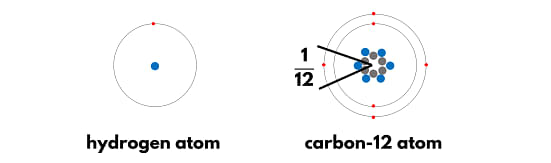
Atomic Mass Unit

The unified atomic mass unit is a unit describing the mass of a neutral carbon-12 isotope at rest. Every proton and neutron weighs approximately 1 AMU.


Also Check:

CBSE CLASS XII Related Questions

  • 1.
    61 g benzoic acid (M = 122 g mol$^{-1}$) dissolved in 500 g benzene. Vapour pressure of pure benzene = 66 torr. Assume complete dimerisation. Calculate vapour pressure of solution.


      • 2.
        Predict the alkene formed by dehydrohalogenation of 1-Bromo-1-methylcyclohexane.


          • 3.
            Why are magnesium blocks attached to iron water pipelines?


              • 4.
                What happens when acidic solution of potassium permanganate is allowed to stand for sometime ? Give the equation involved. What is this type of reaction called ?


                  • 5.
                    Write mechanism of acid dehydration of ethanol to ethene.


                      • 6.
                        Explain: (i) Presence of carbonyl group in glucose. (ii) Presence of five $-$OH groups attached to different carbon atoms.

                          CBSE CLASS XII Previous Year Papers

                          Comments


                          No Comments To Show
