



Education Content Expert
Destructive Distillation is the process of breaking down a compound into its components by heating it to a high temperature. It is a process used to extract useful products from a material.
- Destructive Distillation is used to make a variety of products, including methanol, ethanol, and gasoline.
- It is also used in the production of coal tar, which is useful to produce pharmaceuticals and synthetic rubber.
- It is the process in which organic matter decomposes at extremely high temperatures, in the absence of oxygen.
- It takes place in a sealed vessel at temperatures ranging from 500 to 900 °C in an oxygen-free atmosphere.
- It is an irreversible chemical reaction where complicated substances are broken down into simpler substances.
Read More: NCERT Solutions for Class 9 Science Is Matter Around Us Pure
Key Terms: Destructive Distillation, Pyrolysis, Combustion, Coal, Coal Tar, Methanol, Carbon Dioxide, Chemical Reaction
What is Destructive Distillation?
[Click Here for Sample Questions]
Destructive Distillation is defined as a chemical reaction by which unprocessed material is subjected to decomposition by heating, thereby producing 'cracks' in relatively large molecules.
- It is used for the treatment of certain organic substances with limited amounts of oxygen and certain reagents, solvents, or catalysts such as phenols and steam.
- It is the processing of organic materials in an atmosphere of pyrolysis in the absence of air.
- It can be seen as an application of the concept of pyrolysis (the thermal decomposition of certain substances at very high temperatures under a relatively inert atmosphere).
- Destructive distillation is known to create 'cracks' in relatively large molecules.
- It is not uncommon for these large molecules to break up completely when subjected to destructive distillation.
- For example, when coal is subjected to destructive distillation, a wide range of commercially important products are formed such as coke, ammonium hydroxide, coal oil, gas carbon, coal tar, and coal gas.
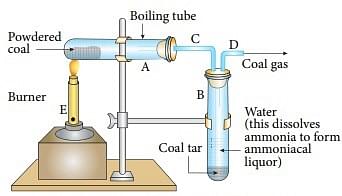
Destructive Distillation
Destructive Distillation of Coal
- In the first step, coal is heated in the presence of air to produce a gas called coal gas.
- In the next step, the gas is passed via a red-hot furnace to make hydrogen and carbon monoxide.
- Carbon monoxide is used to produce carbon dioxide and methanol, while hydrogen is used to produce ammonia and water.
Read More:
Destructive Distillation Products
[Click Here for Sample Questions]
When inorganic substances are subjected to destructive distillation, only a few products are produced. However, when organic matter is subjected to this process, a wide range of different products are produced. In fact, it is not uncommon for hundreds of products to be obtained from the destructive distillation of some organic matter.
- Distillates from destructive distillation processes are often of relatively low molecular weight.
- However, some fractions of these distillates are known to be capable to undergo polymerization and create moderately large molecules.
- Larger molecules can also be formed from certain chemical reactions carried out by distilled molecules.
- Common examples of products formed from such interactions between distillate molecules include chars and tars, which are heat-stable.
- The process of destructive distillation, along with various other forms of pyrolysis, has helped in the discovery of new chemical compounds and the elucidation of the chemical structures of these compounds.
- It has helped chemists understand the chemical nature of some natural materials.
- For example, insight into the structure of furanoses and pyranoses was obtained from the destructive distillation of certain organic materials.
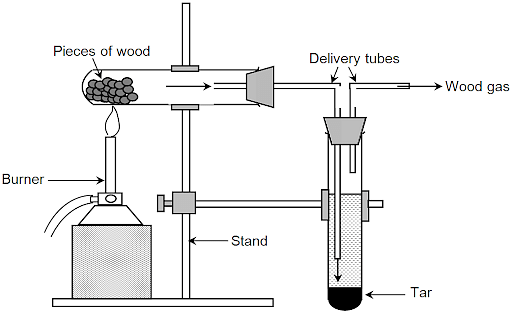
Destructive Distillation of Wood
Read More: Is Matter Around Us Pure Important Questions
Destructive Distillation Process
[Click Here for Sample Questions]
Destructive Distillation is the process of heating a substance to separate it into its component parts. This can be done physically or chemically. The component parts can then be utilized for other objectives.
- Destructive distillation is the process of breaking a compound into its component parts by heating them to high temperatures.
- It can be done in a number of ways, including using a furnace, kiln, or open flame. The component parts can then be purified and separated.
- It can be used to produce a variety of products, including ethanol, methanol, and acetone.
- Destructive Distillation can also be used to produce a variety of industrial chemicals, including ammonia, hydrogen sulfide, and carbon monoxide.
Uses of Destructive Distillation
[Click Here for Sample Questions]
The following are the uses of destructive distillation:
- Destructive Distillation is used to obtain methanol and turpentine from wood.
- Destructive distillation of wood leaves behind a residue of solid charcoal, a substance that has a wide range of commercial applications.
- It is also known to produce several other compounds of commercial value, such as terpenes and tar.
- One of the most important uses of destructive distillation is the processing of coal in order to obtain several commercially important compounds such as coke, ammonium hydroxide, coal gas, and coal tar.
- The waste processing of polymers through destructive distillation leads to their constituent monomers, which can be reused in suitable processes.
Check More:
Things to Remember
- Destructive Distillation is a chemical process used to decompose unprocessed materials.
- It is done by heating the unprocessed material leading to a relatively large amount of 'cracks'.
- It is the treatment of certain organic substances with a fixed amount of oxygen.
- It is useful in producing a variety of products, including ethanol, methanol, and acetone.
- It also produces a variety of industrial chemicals, including ammonia, hydrogen sulfide, and carbon monoxide.
- Producing ethanol from sources such as corn, sugarcane, or cellulose is the most common application of destructive distillation.
- Destructive Distillation of Coal helps to obtain several commercially important compounds such as coke, ammonium hydroxide, coal gas, and coal tar.
Sample Questions
Ques. What are the major products formed after the Destructive Distillation of Coal? (3 Marks)
Ans. Destructive Distillation of Coal is the procedure of heating coal in the absence of air. Coal contains many elements like carbon, hydrogen, oxygen, nitrogen, and sulfur. A number of products are obtained when coal is heated in the absence of air. The main products obtained by the destructive distillation of coal are
- Coke
- Coal Tar
- Coal Gas
Ques. Explain the uses of products formed after the Destructive Distillation of Coal. (3 Marks)
Ans. Coke, Coal Tar, and Coal Gas are the three main products obtained after the Destructive Distillation of Coal.
- Coke: It contains 98 % carbon. It is tough, black, porous, and the purest form of coal. It is a good fuel like charcoal and burns without smoke. It is mostly used as a reducing agent in the extraction of metals from their ores. It is also used to produce fuel gases such as producer gas and water gas.
- Coal Tar (Liquid): Coal tar is a combination of various carbon compounds. It's a thick, black liquid with an unpleasant smell. The fractional distillation of coal tar gives many chemical substances which are used in the preparation of dyes, explosives, paints, synthetic fibers, drugs, and pesticides.
- Coal Gas: Coal gas is primarily a combination of methane, hydrogen, and carbon monoxide. The gases present in coal gas are flammable and therefore, it is an awesome fuel. It has a high calorific value. It was used in Mumbai until 1950 for lighting factories, houses, and streets. It was also used for cooling earlier.
Ques. State the various uses of Distillation. (5 Marks)
Ans. Some of the uses of Distillation are as follows:
- It can be used to conduct experiments in the laboratory. The results are not of immediate use, although they may help in chemical and medicinal research.
- Distillation can remove numerous pollutants from water, making it beneficial for purification. Desalination plants use a seawater distillation process to obtain purified water. While preparing infant food, parents use distilled water.
- When crude oil is distilled, different compounds like wax, fuel oil, gasoline, lubricating oil, and other petrochemical products divide at various boiling points.
- Flavoring of food is done by steam distillation. For example, citrus oil.
- Acetone and methyl alcohol are separated by fractional distillation.
- Nitrogen, carbon dioxide, oxygen, argon, and other gases are discovered in the air. Cryogenic distillation can be useful in removing such gases.
- The sugarcane industry utilizes vacuum distillation for concentrating sugarcane juice.
Ques. Explain Fractional Distillation. (5 Marks)
Ans. Fractional Distillation is a process used to separate the hydrocarbon components in crude oil. This method involves separating important components according to the difference between their boiling points. In other words, it utilizes distillation for fractionating crude oil.
The following are the steps in the Fractional Distillation Procedure:
- Crude oil is heated at a very high temperature and high pressure.
- Crude oil starts to evaporate.
- This steam then takes entry into the fractional distillation column from the bottom of the column.
- This column is made of plates with small holes (plates are in different layers or heights). These holes allow steam to pass through the column.
- There is a temperature gradient across the column. The bottom is full of hot vapor, but the top of the column is cool.
- The vapor passing through the column is cooled.
- When the vapor's boiling point equals the column temperature, the vapor condenses to form a liquid.
- Vapors are composed of mixtures of components that have different boiling points. Hence, various components condense at various temperatures at various heights of the column.
- The plates collect the condensed liquid. This liquid can be further cooled in a condenser and transferred to a storage tank for further processing.
The liquid fractions collected from various plates are known as crude oil fractions. From this fractional distillation method, one can separate mixtures of components that have even slight differences in boiling points.
Ques. Name the products formed after the Destructive Distillation of Wood. (3 Marks)
Ans. Destructive Distillation of Wood is carried out to prepare methanol at a small scale. In this process, wood is heated in the absence or in a limited supply of air to produce a mixture of tar, turpentine, charcoal, and methanol. The products formed after the destructive distillation of wood are turpentine and methanol.
- After the destructive distillation of wood, charcoal, and wood alcohol are also obtained.
- Wood charcoal is produced when the wood is heated in a limited supply of air.
- Locally wood charcoal is prepared by stacking wooden logs on top of each other with a gap in the center of the pile.
- The pile is covered with moist soil to prevent the ingress of air.
- Some holes are left at the base of the pile. The wood is set on fire.
- After some time when the fire is extinguished, the charcoal is left behind.
- The other substances are pyroligneous acid, wood tar, and wood gas.
Ques. What is the difference between Pyrolysis and Combustion? (3 Marks)
Ans. Pyrolysis or Destructive Distillation is an irreversible chemical change, which is the result of the action of heat in the absence of oxygen while combustion is an irreversible chemical change that takes place when oxygen is present.
- Combustion is a chemical reaction in which substances react with oxygen to produce heat and light as energy forms. It happens in the atmosphere in the presence of oxygen. More importantly, it produces gaseous end products.
- Pyrolysis is a decomposition reaction in which organic matter breaks down when oxygen is absent. It occurs in the absence of oxygen in the atmosphere. Unlike combustion, it makes gaseous components with trace amounts of solid and liquid residues.
Ques. State the distinction between Distillation and Fractional Distillation. (5 Marks)
Ans. The following table outlines the differences between distillation and fractional distillation:
| Distillation | Fractional Distillation |
|---|---|
| Distillation is a technique of separating liquids with boiling points that differ by at least 50 degrees. | Fractional Distillation is useful in separating liquids with similar boiling points. |
| Simple Distillation is useful in each step of evaporation-condensation. | In the fractional distillation technique, multiple basic distillation processes are carried out in a single apparatus with small losses. |
| The experimental setup is straightforward. A basic apparatus with a condenser and two flasks is essential. | The setup for the experiment is complicated. A complex apparatus with a fractionation column is essential. |
| It is useful in purifying seawater. | It is useful in refining crude oil. |
Ques. What is the Residue left after processing coal by Destructive Distillation? (3 Marks)
Ans. The residue is the material remaining after a process of preparation, purification, or separation like evaporation, distillation, or filtration. It can also indicate unwanted by-products of a chemical reaction.
- Destructive Distillation is a process in which complex organic and inorganic substances are broken down into simpler and smaller materials.
- Because of this when coal is processed through destructive distillation, it produces much smaller and simpler materials.
- However, the most prominent residue is carbon. The other residue left in the process is coke used in steel production.
- Coal gas is a mixture of hydrogen, carbon monoxide, methane, and other gases.
- Coke is a black substance and porous left as a residue when coal is processed by the destructive distillation process. It is a pure form of carbon containing 90% carbon.
Ques. Is Distilled Water acidic, basic, or neutral? (3 Marks)
Ans. Distilled water is neutral. It can be verified in the laboratory by performing the litmus paper test. Distilled water is the purest form of water without any ions, meaning deionized water. It contains Hydrogen and Oxygen atoms. Distilled water has a neutral pH, indicating it is neither basic nor acidic. By using red and blue litmus paper, the neutral nature of the distilled water can be ascertained. Since the distilled water is neutral, it won't have any effect on the color of the litmus paper, whether it is blue or red.
- Distillation Process removes almost all of its ionic, mineral, and organic impurities, making it one of the purest forms of water available.
- As distilled water comes in contact with air, carbon dioxide gas dissolves in it and forms a dilute solution of carbonic acid.
- This is the reason why demineralized water, another purified water product, reacts badly with metals such as steel.
Ques. What is Neoprene? (3 Marks)
Ans. Neoprene is the first discovered synthetic rubber formed from isoprene. Isoprene is obtained by the destructive distillation of natural rubber. Neoprene is stronger, stiffer, and more water, oil, and solvent resistant than natural rubber.
- Polychloroprene or Neoprene is part of a family of synthetic rubbers made by the polymerization of chloroprene.
- Polychloroprene polymer is the primary component of neoprene and is described by its heat and temperature performance as well as chemical resistance.
- On its own, neoprene is generally useful in producing reliable gaskets, tubing, cable jackets, O-rings, tire sidewalls, seals, wetsuits, gasoline hoses, and orthopedic braces.
- It is also a base resin in coatings and adhesives and electrical insulation because of its broad range of useful properties and affordable price.
Ques. What is the difference between Destructive Distillation and Fractional Distillation? (3 Marks)
Ans. Destructive distillation is a procedure that involves decomposing a solid by heating it in a closed container and collecting the resulting volatile components. It is used primarily for the distillation of coal. Fractional distillation is the process of separating volatile components of miscible liquids on the basis of differences in their boiling points and is mainly used for the distillation of crude oil to separate its components.
In destructive distillation, the components are divided by the decomposition of the solid, while in fractional distillation, the components are divided by dissimilarities in boiling point. It is useful in separating hydrocarbons from crude oil.
For Latest Updates on Upcoming Board Exams, Click Here: https://t.me/class_10_12_board_updates
Check More:



Comments