



Education Content Expert
Purification of Organic Compounds is an essential and complex step after the extraction of the compound from natural sources or laboratory synthesis.
- It depends on the types of impurities present in the compound.
- There are a variety of methods that are used for the purification of organic compounds.
- The method employed usually depends on the nature of the substances which can be either solid or liquid.
- Ann organic compound needs to be purified necessarily if has been synthesized in the laboratory.
Sublimation, Crystallization, Distillation, Differential Extraction, and Chromatography are a few methods used for the purification of an organic compound.
Read More: NCERT Solutions For Class 11 Chemistry Organic Chemistry Some- Basic Principles and Techniques
Key Terms: Purification of Organic Compound, Organic Compounds, Distillation, Chromatography, Crystallization, Sublimation
What are Organic Compounds?
[Click Here for Sample Questions]
Organic Compounds are the chemical compounds that have carbon-hydrogen or carbon-carbon bonds.
- Organic compounds are known due the tendency of carbon to catenate, i.e. form chains with other carbon atoms.
- Organic chemistry is the science that studies the characteristics, reactions, and synthesis of organic molecules.
- A few classes of carbon-containing compounds such as carbonate salts and cyanide salt are not categorized as organic and are classified as inorganic compounds.
Read More:
Purification of Solids
[Click Here for Previous Year Questions]
There are two processes used for the purification of the solids namely Sublimation and Crystallization. A detailed description of the processes is given below:
Sublimation
- Some solid substances like Naphthalene or camphor can pass directly from the solid to the vapor state without passing through the solid state.
- The vapors on cooling give back the solid substances.
- This procedure is known as sublimation and it plays a very important role in separating volatile solids from non-volatile solids.
- In sublimation, the powdered substance is taken in a China dish that is covered with an inverted funnel and with perforated filter paper.
- The vapors of the substance get solid on the funnel.

Sublimation
Crystallization
- In crystallization, the solution is to be heated to get a saturated solution.
- After cooling the heated solution, the crystals present in the compounds are removed by the filtration process.
- For instance, the benzoic acid crystals can be crystallized with water.
- Benzoic acid is soluble in hot water, whereas it is sparingly soluble in cold water.
- If the mixture contains impurities that have similar solubility as the compound that is to be purified, crystallization has to be repeated.

Crystallization
Purification of Liquids
[Click Here for Sample Questions]
The methods that are involved in the purification of liquid substances are Distillation, Extraction, and Chromatography. These methods are different from the methods as those of the solids and are mentioned in detail below:
Distillation
- The principle involved in distillation is that the mixture of liquids present in the distillation process gets separated based on the difference in their boiling points.
- The temperature at which the vapor pressure and the atmospheric pressure are equal to each other is known as the boiling point.
- The distillation methods separate the volatile compounds from non-volatile compounds.
- The component with the lower boiling point evaporates rapidly and is collected in a separate container.
- Usage of the condenser is required to hasten the process of condensation.

Distillation
- For instance, through the distillation method, a mixture of chloroform and aniline can be separated.
- The boiling point of the chloroform is 60°C while the boiling point of aniline is 189°C.
- Therefore, the distillation method of purification is used to separate a mixture of chloroform and aniline.
Fractional Distillation
- Fractional distillation method is used when the difference between the boiling points of the liquids is not much.
- The vapors of some liquids might condense together, on the mouth of the RB flask a fractionating column gets fixed.
Vacuum Distillation
- In this method of purification, the boiling point depends upon the atmospheric pressure.
- The liquids are boiled at a temperature that is generally lesser than its boiling point if they were distilled in an atmosphere that has lower pressure.
- It is achieved by using the vacuum pump.
- As the atmospheric pressure is reduced the liquids can boil faster and because of this, the whole distillation process gets faster.
Read More: Organic Chemistry Class 11 Important Questions
Steam Distillation
- In the steam distillation, the steam is passed into the flask that contains the liquids, that are to be separated.
- The principle involved in the steam distillation process of purification is that the liquids that are present in this method will boil faster due to the aqueous tension, that is, the vapor pressure of water.
- It plays a very important and helpful role in equalizing atmospheric pressure.
- If the aqueous tension is not present, the process of boiling remains continues to equalize the atmospheric pressure.
Differential Extraction
- Differential extraction is used for purification is used for immiscible liquids.
- Immiscible liquids refer to those liquids that do not mix.
- For instance, oil and water are liquids that do not mix.
- The immiscible liquids are taken in a separating funnel and are left undisturbed.
- After some time it can be separated from the heavier liquid at the bottom according to its gravities.
- According to the preferential solubilities that are present in the liquid, the substances can be separated.
- For instance, if phenol is to be extracted, it can be preferentially extracted by using NaOH solution by considering it as one of the liquids used.
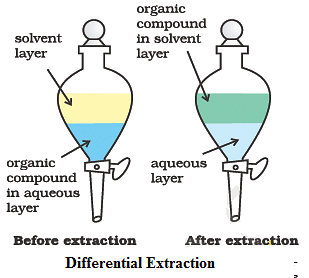
Differential Extraction
Chromatography
Chromatography plays an important role in separating the constituent particles of a mixture of substances.
- It also helps in purifying the compounds and checking the purification of an organic compound.
- On the stationary phase, the mixture of gas or pure solvent is allowed to move slowly, due to which the components started their separation from each other.
- Chromatography is basically of two types, namely adsorption chromatography and partition chromatography.
Check More:
Adsorption Chromatography
- Adsorption chromatography is based on the principle that components absorb to varying degrees on an adsorbent.
- The adsorbents that are used generally are silica and aluminum.
- When the mobile phase generally moves on the fixed phase, the different constituents of the mixtures that are present in it get adsorbed over the fixed phase at various distances.

Adsorption Chromatography
Adsorption chromatography is further classified into two categories, namely column chromatography and thin-layer chromatography.
- Column Chromatography: In column chromatography, a mixture is separated over a column of silica gel or alumina that is packed in a glass column. The constituent with the most affinity that also has the fixed phase is adsorbed at the top. By using an eluent, it can be retrieved. After this, the solvent gets evaporated.
- Thin-Layer Chromatography: In thin-layer chromatography, a sheet of alumina is taken, probably 0.2 mm thick. A small amount of mixture is placed on the sheet of alumina and then it is kept in a suitable solvent. The constituent rises with the solvent that depends on its differential adsorption, similarly, the solvent also rises due to the capillary action.
Partition Chromatography
- It is a method that is based on the separation of the components of a mixture into stationary and mobile phases respectively.
- It is predicated on the observation that various components exhibit varying degrees of gravitational attraction to the stationary phase.
- The forces that are responsible for the adsorption of components by the stationary phase are quite weak.
Things to Remember
- Purification of Organic Compound is a crucial step after the extraction or synthesis of an organic compound.
- It depends upon the nature of the compound and the impurities present.
- Sublimation, Crystallisation, Distillation, Differential Extraction, and Chromatography are the general methods used for the purification of organic compounds.
- Sublimation and Crystallization are the two methods used for the purification of solids.
- Distillation, Fractional Distillation, Vacuum Distillation, Differential Extraction, and Chromatography are the methods for the purification of liquids.
Previous Years’ Questions
- Styrene can be purified by… (JCECE - 2007)
- A liquid compound (x) can be purified by steam distillation… (NEET - 2020)
- In Dumas method one gram of carbon compound gives… (AP EAMCET - 2019)
- The principle of column chromatography is… (JEE Main - 2019)
- Paper chromatography is an example of… (NEET - 2020)
- Paper chromatography is a type of partition chromatography…
- The distillation technique most suited for separating glycerol… (JEE Main - 2016)
- Distillation under reduced pressure is employed for…
- Which is purified by steam distillation… (Rajasthan PMT - 2007)
- Phenol on distillation with zinc dust gives…
Sample Questions
Ques. Name the process that represents the simple ratio of the atoms of different elements present in a molecule of the substance? (1 Mark)
Ans. Crystallization is the process that represents the simple ratio of the atoms of different elements present in a molecule of the substance.
Ques. What are the purification techniques for the purification of organic compounds? (1 Mark)
Ans. The purification techniques for the organic compounds are Sublimation, Crystallization, Distillation, Differential Extraction, and Chromatography.
Ques. Write three advantages of crystallization. (3 Marks)
Ans. The following are the advantages of crystallization:
- A high-purity product can be generated in a single step using the crystallization method.
- The crystallized dry goods can be packed and stored right away.
- This technology consumes less energy and runs at a low temperature.
Ques. When will fractional distillation be used? (1 Mark)
Ans. The fractional distillation is used when the difference in the boiling points of two liquids is less.
Ques. When does the distillation under the reduced pressure be used? (1 Mark)
Ans. The distillation under the pressure is used when the liquid has very high boiling and it can decompose at a low boiling point.
Ques. Write the applications of fractional distillation. (3 Marks)
Ans. Some applications of fractional distillation are
- Fractional distillation is used to purify water, and it is also used to separate acetone and water.
- In a range of industries, including oil refineries and chemical plants, fractional distillation is used to purify and separate diverse organic compounds.
- Fractional distillation is also used to separate (liquefied) air. Among the components obtained are liquid nitrogen, oxygen, and concentrated argon.
- Distillation is used to extract high-purity silicon from chlorosilanes. Silicon is a widely used material in semiconductors.
Ques. For what to detect, ninhydrin solution be used in Chromatography? (1 Mark)
Ans. The ninhydrin Solution is used to detect the amino acids in chromatography.
Ques. If a compound consists of C = 90 percent and H = 10 percent, what will be the empirical formula? (1 Mark)
Ans. The empirical formula will be C3H2.
Ques. Write short note adsorption Chromatography. (3 Marks)
Ans. It is based on the concept that components absorb to varying degrees on an adsorbent. Adsorbents such as silica gel or alumina are frequently used. When a mobile phase passes over the stationary phase, different constituents of the mixture are adsorbed at different distances across it.
Adsorption chromatography can be further classified as follows:
- Column chromatography: In this step, a mixture is separated using a glass column packed with silica gel or alumina. The chemical with the highest affinity for the fixed phase is adsorbed at the top, and so on. It is then retrieved by using an eluent. The solvent is then evaporated to obtain the component.
- Thin Layer Chromatography: A 0.2 mm thick alumina sheet is utilized to cover a little patch of the mixture, which is then stored in a suitable solvent. The solvent rises due to capillary action, and the components rise with it due to differential adsorption, allowing them to be separated.
Ques. What does Rf in the chromatography mean? (1 Mark)
Ans. RF in the chromatography refers to the retardation factor.
Ques. Name the method that is used for the purification of camphor containing an impurity of the common salt? (1 Mark)
Ans. The method used for the purification of camphor containing the impurity of the common salt is Sublimation.
Ques. Write the role of chromatography in purification. (2 Marks)
Ans. Chromatography is used in industrial settings to filter chemicals, test small amounts of substances, separate chiral compounds, and perform quality control testing on commodities. Chromatography is the physical technique of separating or analyzing complex mixtures.
Check-Out:



Comments