



Content Curator
The study of organic compounds is known as organic chemistry. Whereas studying inorganic compounds is known as inorganic chemistry. A compound in chemistry is a substance formed by a chemical bond between the atoms of two or more different elements. Chemistry in compounds is broadly divided into two categories. One is known as an inorganic compound and the other is an organic compound. The smallest unit of a compound is recognized as a molecule. In the universe, all matter is composed of different atoms and different chemical elements which combine in their pure form to form a chemical compound.
Read Also: Cis-Trans Isomers
| Table of Content |
Key Terms: Compound, Organic Compound, Inorganic Compound, Solubility, Polar solvents , Boiling Point, Melting Point , Combustion , Living beings
History Of Compounds
[Click Here for Sample Questions]
The science of organic chemistry is about 200 years old. It all started around the year 1780 when the distinction between organic compounds and inorganic compounds was started by the chemist. According to the chemists, organic compounds are obtained from plants and animals, and from the mineral resources, the inorganic compound was formed.
A Swedish chemist named Berzelius proposed that for the formation of organic compounds a vital force was responsible. But this notion was rejected in 1828 when F. Wohler synthesized an organic compound, urea from an inorganic compound, ammonium cyanate.
After that Kolbe in 1845 performed pioneering synthesizers of Acetic Acid and Berthelot in 1856 performed pioneering synthesizers of methane, resulting in showing that organic compounds could be synthesized from inorganic sources in a laboratory.
Read More: Versatile Nature of Carbon
Organic Compound
[Click Here for Previous Year Questions]
The compounds which have mainly one or more carbon atoms covalently bonded with other atom elements are known as organic compounds. Basically, organic compounds contain carbon as one of their constituents irrespective of the state in which it is present. Generally, hydrogen, oxygen, nitrogen atoms are bonded with these carbon atoms, two common organic compounds. In a normal room temperature, all three physical states of organic compounds can be found. Like amides in solid phases, alcohols like ethanol in liquid and gases like methane in gas phases.
The organic compound is an end term output from the input activities of living beings like humans and animals. Almost all organisms contain organic compounds in their body so it is an essential part of the earth.
On the basis of its structure organic compounds can be broadly classified into two categories:
- Acyclic or open chain compounds
- Alicyclic or closed chain or ring
These are further categorized into more subcategories.
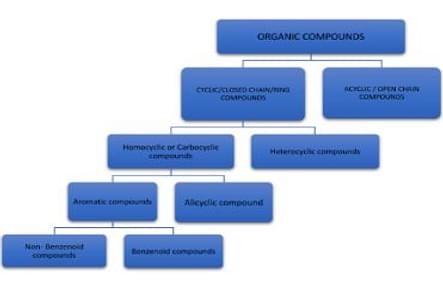
Fig: Classification of Organic Compounds on the basis of structure
Now, let us look at some of the organic compounds on the basis of structure.
- Acyclic Compounds: These compounds consist of straight or branched chain compounds. They are also known as aliphatic compounds.
Example: CH3 CH3 (Ethane), CH3COOH (Acetic Acid), Isobutane.
- Alicyclic / Aliphatic Cyclic Compounds: In these compounds carbon atoms and joined in the form of a ring (homocyclic). But sometimes atoms in heterocyclic ring other than carbon might be present in the ring.
Example:

- Aromatic Compounds: They consists of conjugated planner ring of atoms joined by covalent bonds of two different kind of atoms.
Example: Benzenoid Aromatic like benzene , aniline , napthelene

(Benzene)
- Non Benzenoid Compound:

(Tropolone)
- Heterocyclic Aromatic Compounds:

Pyridine
Examples: Furan, Thiophene, Pyridine.
Also read: Organic Compounds
Characteristics Of Organic Compounds
[Click Here for Sample Questions]
- Solubility in polar solvents: Most of the organic compounds are insoluble in polar solvents like water. As the organic compounds are non-polar in nature, so they do not mix with polar molecules like water, acetone, methanol.
- Solubility in Non-Polar solvents: The organic compounds are non-polar in nature. So, they are soluble in non-polar solvents like benzene, toluene.
- State Of Compound: Organic compounds can be present in any state like solid, liquid, or gas at room temperature.
- Low melting and boiling point: Organic compounds are held together by a covalent bond between the individual molecule. As the individual forces between the molecules are weak, thus, results in taking less energy to break the bond present between them. So, they easily melt and boil.
- Combustion: Burning any compound in the presence of oxygen results in the formation of carbon dioxide and water as the end product is called combustion. Organic compounds undergo combustion, like gasoline-burning in cars engine or natural gas like methane burning in heater or stove. they are mostly exothermic reactions (processes that emit out a lot of heat on burning).
Examples of combustion:
CH4 + 2O2→ CO2 + 2H2O + heat
2C8H18 + 25O2→ 16 CO2 + 18H2O + heat
Read More: Relation Between Molarity and Molality
Inorganic Compounds
[Click Here for Previous Year Questions]
The compounds in which any chemical substance, usually other than carbon are combined nearly in definite proportions are called inorganic compounds. Moreover, they also include some carbon-containing compounds with a deficiency of carbon-carbon bonds. The inorganic compounds do not result from any life forms present on the earth or any living being activities. But they are obtained from the natural processes that are not conducted in any Laboratories. Also, they exist in solid states only. Inorganic compounds are composed of metal and metal ions like Silicon, phosphorus, sodium and many more.
Also Read:
| Related Articles | ||
|---|---|---|
| Atomisation enthalpy solution | Acids Bases and Salt | Ionic Bond (Electrovalent Bond) |
| D and F Block Important Questions | Amines MCQ | difference between isotropic and anisotropic |
Characteristics Of Inorganic Compounds
[Click Here for Sample Questions]
- Solubility in polar solvents: Most of the inorganic compounds are soluble in polar solvents like water. As the inorganic compounds are polar in nature so they combine with the polar solvents molecules to form the ionic bond with them.
- Solubility in Non-Polar solvents: The inorganic compounds are polar in nature. So, they are insoluble in non-polar solvents like benzene, toluene.
- State Of Compound: Inorganic compounds are generally solid in state at room temperature.
Like: Sodium chloride (NaCl , salt).
- Melting and boiling point: The inorganic compounds consist of alternating positive and negative charged ions. Thus, creating a very strong electrostatic force between the elements and exists as one molecule. So, to break an inorganic compound more energy is needed to break the bond between the ions so that they can move around easily. Thus, results in a very high melting and boiling point between the elements to break the electrostatic force present between them.
- Combustion: In general inorganic compounds do not undergo combustion, that is, burn in the presence of oxygen.
Read More: Versatile Nature of Carbon
Difference between Organic and Inorganic Compounds
[Click Here for Previous Year Questions]
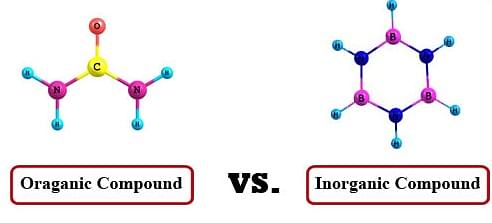
Difference between Organic and Inorganic Compounds
| S.No. | ORGANIC COMPOUNDS | INORGANIC COMPOUNDS |
|---|---|---|
| 1. | Identified by the presence of carbon atoms in them | Mostly do not contain carbon atoms (C) in them except some exceptions do exists. |
| 2. | Highly inflammable and volatile | Not inflammable and Non-volatile |
| 3. | Exist in all three states of matter solid, liquid and gas | Only exists as solid in state |
| 4. | Low melting and boiling point | High melting and boiling point |
| 5. | Insoluble in water | Highly Soluble in water |
| 6. | Soluble in non-polar solvents like benzene | Insoluble in non-polar solvents like benzene |
| 7. | Undergoes combustion which results in an exothermic reaction | Do not undergo combustion |
| 8. | The atoms between the molecules have covalent bond between them | They contain ionic bonds between the atoms of molecules |
| 9. | Mostly poor conductors of heat and electricity in the aqueous solution | Good conductors of heat and electricity in the aqueous solution. Due to the presence of ions in the compound. |
| 10. | Mostly present in the living organism present on the earth. Like: nucleic acid, hemoglobin, enzymes, chlorophyll. | Mostly present in the non-living things. |
Things to Remember
- Combustion is the process of burning any substance in the presence of oxygen.
- Some compounds contain carbon atoms bonded to other atoms and are still not considered as organic compounds are exceptions in chemistry.
- Our body is made up of organic compounds like carbohydrates, lipids, fats.
- Covalent bond is weaker than an ionic bond.
- Polar Solvents have positive as well as negative charges present at a different locations in their structures.
Also Read:
Previous Year Questions
- Why is the heat evolved in neutralization of HF is highest… [UPSEE 2018]
- The enthalpies of combustion of carbon and carbon monoxide are… [JCECE 2008]
- The enthalpy of sublimation of aluminium is 330 KJ/mol… [BITSAT 2014]
- If the enthalpy of vaporization of water is 186.5 KJ/mol… [BITSAT 2014]
- 6g of graphite is burnt in a bomb calorimeter at… [AP EAPCET 2019]
- The bond dissociation energies of X2, Y2 and XY are in the ratio… [NEET 2018]
- For an ideal solution, the correct option is… [NEET 2019]
- A 5% solution of cane sugar (MW = 342) isisotonic with 1% solution… [NEET 1998]
- An ideal solution is formed when its components… [NEET 1988]
- For determination of molar mass of colloids, polymers and protein… [NEET 2000]
- A solution of acetone in ethanol… [NEET 2006]
- Which of the following are not state functions? (I) q + W (II) q (III) w (IV) H-TS…. [NEET 2004]
- Unit of entropy is… [NEET 2002]
- Under isothermal condition, a gas at 300 K expands from 0.1 L to 0.25 L against a constant externalpressureof2bar Theworkdonebythe gas is… [NEET 2019]
- The efficiency of an ideal heat engine working between the freezing point and boiling point of water, is…. [NEET 2018]
- The efficiency of a fuel cell is given by… [NEET 2007]
- The correct thermodynamic conditions for the spontaneous reaction at all temperatures is… [NEET 2016]
- In which case change in entropy is negative? [NEET 2019]
Sample Questions
Ques. What are organic compounds? Explain with example. [3 marks]
Ans. The compounds which have mainly one or more carbon atoms covalently bonded with other atom elements irrespective of the state in which carbon is present are known as organic compounds. Some examples of organic compounds are Benzene, toluene, cyclohexane, and many others. Benzene belongs to the aromatic organic compound family. Benzene contains hydrogen atoms which are connected to carbon atoms. Thus, forming a ring-like structure and each carbon atom participates in the formation of the double bond. Also, these bonds are alternate single and double bonds around the carbon atom.
Ques. What are inorganic compounds? Explain with example. [3 marks]
Ans. The compounds in which any chemical substances, usually other than carbon are combined nearly in definite proportions are called inorganic compounds. It doesn’t contain carbon bonded atoms. Some examples of inorganic compounds are sodium chloride ( NaCl), sodium bicarbonate ( NaHCO3 ), muriatic acid, and many others. Sodium bicarbonate is commonly known as baking soda or bicarbonate of soda. It has a chemical formula ( NaHCO3 ), this is a salt that contains cations as well as anions in it. The cationic part is Sodium ( (Na+) and the anionic part is bicarbonate anion (HCO3−).
Ques. What are different types of organic compounds on the basis of structure? Name them.[ 2 marks]
Ans. The different types of organic compounds on the basis of structure can be divided broadly into two main categories Acyclic or open chain compounds and Alicyclic or closed chain or ring compounds. Also closed chain compounds are further sub-classified into homocyclic and heterocyclic compounds.
Ques. Why are inorganic compounds a good conductor of electricity?[ 2marks]
Ans. The inorganic compounds contain charged ions (positive and negative charged ions) which provides mobility of ions. Thus, both negative and positive ions are responsible for the conduction of electricity. Hence, inorganic compounds conduct electricity.
Ques. In which state are organic compounds available on the earth? Discuss with example. [ 3marks]
Ans. The organic compound can be present in any state of matter on the earth (at room temperature).
Example: Solid - Alkanes (when n>=18)
Liquid – Mercury, Bromine
Gas – Neon (Ne), carbon monoxide (CO)
Ques. List down some examples of aliphatic organic compounds and acyclic compounds.[2 marks]
Ans. Acyclic organic compounds: CH3 CH3 (Ethane), CH3COOH (Acetic Acid), Isobutane.
Aliphatic organic compounds: Cyclopropane, Cyclohexane, Cyclohexene
Ques. Is Carbon dioxide (CO2 ) an organic or inorganic compound?[1 marks]
Ans. In a CO2 molecule carbon atom has bonded with two oxygen atoms but do not contain both carbon and hydrogen bond. So, it is classified as an inorganic compound.
Ques. List down the five organic compounds which are present in the carbohydrates of a human body.[2 marks]
Ans. Glucose, Fructose, Sucrose (table sugar), Chitin, Cellulose.
Ques. Distinguish between organic and inorganic compounds on the basis of : [5 marks]
(a)Solubility in benzene
(b)Melting Point
(c)Boiling Point
(d)Rate Of Reaction
Conduction of Electricity
Ans :
| On the basis of | Organic Compounds | Inorganic Compounds |
|---|---|---|
| Solubility in benzene | Soluble in benzene | Insoluble in benzene |
| Melting Point | Low melting point due to the presence of covalent bond | High Melting point due to the presence of ionic bond |
| Boiling Point | Low boiling point | High melting point |
| Rate Of Reaction | The slower rate of reaction | Higher rate of reaction |
| Conduction of Electricity | Poor conductor of electricity | Good conductor of electricity due to the presence of ionic bond or simply due to the presence of positive as well as negatively charged ions which are responsible for the conduction of electricity |
Ques. Which among them will have a high boiling point: Water or Ethanol? Explain with reason/ [5 marks]
Ans. Water will have a high boiling point because it is an inorganic compound. As we know that inorganic compounds consist of alternating positive and negative charged ions. Thus, creating a very strong electrostatic force between the elements and exists as one molecule. So, to break an inorganic compound more energy is needed to break the bond between the ions and resulting in a high boiling point. Whereas ethanol is an organic compound that has covalent bonding between the molecules. A covalent bond requires less energy to break the bond present between them. Thus, resulting in boiling easily.
For Latest Updates on Upcoming Board Exams, Click Here: https://t.me/class_10_12_board_updates
Check-Out:



Comments