



Education Journalist | Study Abroad Lead
D-block comprises elements from group 3 to 12 where the d-orbital is filled in an increasing order, while f-block is composed of the elements in the Lanthanoids and Actinoids series and includes elements where 4f and 5f orbitals are filled in an increasing order. D-block and f-block elements are also known as transition elements and inner transition elements, respectively.

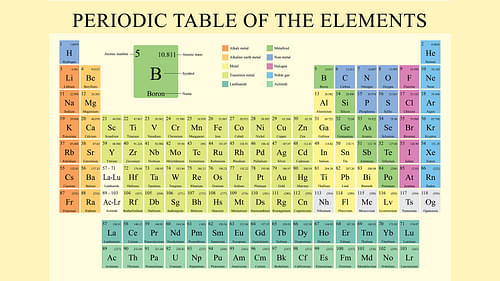
Periodic table
Very Short Answer Questions [1 Mark Questions]
Ques. Which element shows +3 oxidation states exclusively?
Ans. The only element that shows +3 oxidation states is Scandium (Sc).
Ques. What is the electronic configuration of Cr3+? [Cr = 24]
Ans. [Ar] 4s0 3d3 is the electronic configuration of Cr3+.
Ques. Which element does not show varying oxidation states?
Ans. Zinc (Zn) does not show variable oxidation states.
Ques. What is the hybridization of Chromate ions?
Ans. The hybridization of Chromate ions are sp3 hybridized.
Ques. What is the most common oxidation state of f-block elements?
Ans. F-block elements mostly possess the oxidation state of +3.
Ques: What element among the lanthanoids shows the oxidation state of +4?
Ans: Cerium is known to show the oxidation state of +4.
Short Answer Questions [2 Marks Questions]
Ques. Why is the +3 oxidation state of Lanthanum (Z = 57) Gadolinium (Z = 64) and Lutetium (Z = 71) stable?
Ans: Lanthanum = [Xe] 6s2 5d1 4f0, Gadolinium = [Xe] 6s2 5d14f7 and Lutetium = [Xe] 6s25d14f14 basically have empty, half-filled or completely filled 4f orbitals, allowing their +3 states to be stable.
Ques. Why are Mn2+ compounds more stable than Fe2+ towards oxidation to their +3 state?
Ans. Mn2+ has the electronic configuration [Ar] 4s0 3d5, while that of Fe2+ is [Ar] 4s2 3d4. Mn2+ has half-filled orbitals, therefore they are more stable and the delocalization of electrons does not happen easily for Mn2+.
Ques. Why is the third ionization energy of Manganese (Mn) so high?
Ans. The electronic configuration of Mn (at no = 25) is [Ar] 4s2 3d5. Losing two electrons makes it Mn2+ and due to that the d-orbital becomes half filled and stable. Now removing another electron will require a lot of energy, which is why its third ionization energy is so high.
Ques. Why does the melting point for Manganese dip?
Ans. The electronic configuration of Mn is [Ar] 4s2 3d5. Clearly, it has a half-filled d-orbital, allowing it to be stable. For the same reason, the electron delocalization is less.
Ques. Why is the first ionization enthalpy of 5d series elements higher than that of 3d and 4d series elements?
Ans. Due to the weak shielding effect by 4f electrons, 5d series elements have a higher first ionization enthalpy. This is also due to the greater nuclear charge acting on the outermost shell electrons.
Check Out:
| Related Concepts | ||
|---|---|---|
| Praseodymium | Promethium | Raney Nickel |
| Dysprosium | Holmium | Einsteinium |
| Dichromate | Europium | Gadolinium |
Long Answer Questions [3 Marks Questions]
Ques. Explain why transition metals form colored compounds.
Ans. Transition metals are visible in color both in solid and aqueous mediums. They form colored compounds due to d-d transition. Transition elements possess an incomplete d-subshell, leading to the delocalization of electrons from one energy level to another in the same d subshell is feasible. The energy required to excite electrons is related to the energy levels of the various spectrums of visible light. When light falls on a transition element, it absorbs the energy of a certain color causing the delocalization of electrons, while the rest of it is emitted back resulting in the compound being colored.
Ques. Why is Zinc [Z=30] not considered a transition element, while Silver [47] is?
Ans. The elements which have partially filled d-subshell in their ground state or oxidation states are known as transition elements. Since silver has a partially filled d-subshell in its +2 oxidation state: [Kr] 5s1 4d9, therefore it is regarded as a transition element. Zinc, however, does not possess partially filled electrons in its d-subshell, neither in its ground state nor any one of its oxidation states. Hence, Zinc is not considered to be a transition element.
Ques. Give reasons:
- Transition elements form interstitial compounds.
- Actinoids are known to possess a large number of oxidation states as opposed to the lanthanides.
Ans (i). Transition elements can form interstitial compounds with smaller non-metals, such as Hydrogen, Carbon, and Nitrogen. These small atoms fit into the empty spaces of the lattices of the transition metals causing transition metals to become hard and solid. These compounds have the same chemical properties as their original elements, but differ in the physical properties: hardness, density, conductivity. These compounds have a different composition and cannot be expressed via formula which is why they are also known as non-stoichiometric compounds.
Ans (ii). Lanthanoids show a small number of oxidation states as compared to actinoids due to the large energy difference between the 5d and 4f subshells of the Lanthanoid series. Actinoids have various oxidation states because there is a small energy difference between the 5f, 6d and 7s orbitals.
Very Long Answer Questions [5 Marks Questions]
Ques. Explain the following:
- Lanthanoid Contraction and its effect over elements in the periodic table.
- Cu2+ ion is stable in aqueous solution.
Ans (i). The decrease in the size of atoms and ions with an increase in atomic number is known as Lanthanoid Contraction. On moving across the lanthanoid series, the nuclear charge effectively increases and the electrons that are being added to the f-subshell cause a shielding effect. However it is not enough to counteract the effects of the increasing nuclear charge and hence the atomic size decreases. The chemical properties of these elements are similar as well due to the small change in atomic size making separation of lanthanoids difficult.
Ans (ii). Cu2+ is stable in aqueous solutions due to its highly negative hydration enthalpy which makes up for the high ionization enthalpy of the Cu+ ion. Due to this Copper (I) ions are not stable in aqueous solution and undergoes disproportionation:
Ques. Explain each reason.
a) Define how Potassium Dichromate is prepared from chromite ore?
b) Mn2+ compounds are more stable than Fe2+.
c) Why is Cr2+ reducing and Mn3+ oxidizing when both have the same d4+ configuration?
Ans:
a) To prepare Potassium Dichromate, chromite ore is reacted with Sodium Carbonate.
4FeCr2O4 + 8Na2CO3 + 7O2 → 8Na2CrO4 + 2Fe2O3 + 8CO2
A yellow colored solution of Sodium Chromate is obtained. It is then reacted with Acidified H2SO4.
2Na2CrO4 + 2H+ → Na2Cr2O7 + H2O + 2Na
The sodium dichromate obtained after the reaction is orange coloured which is then treated with KCl.
Na2Cr2O7 + 2KCl → K2Cr2O7 + 2NaCl
Orange crystals of Potassium Dichromate are acquired.
b) The electronic configuration of Mn2+ is [Ar] 4s0 3d5. Clearly, the d-orbitals are half-filled and hence the delocalization of electrons would require more energy. While, Fe2+ has an electronic configuration of [Ar] 4s0 3d6. It will readily lose an electron to obtain the stable configuration of 3d5.
c) Cr2+ is reducing in nature due to its configuration changing from d4 to d3 which has half-filled t2g orbitals, while Mn3+ is oxidizing as its configuration changes from d4 to d5 which has a stable t2g and eg
Ques. Give reasons for the following:
- Electrode potential E0 irregular for M2+/M systems in 3d series.
- Decrease in the ionic radii of M2+ in 3d series.
- Most transition metals form complexes.
- Ce4+ is a good analytical reagent.
Ans 1. The irregular trends in the E0 values across the period is due to the varying changes in the ionization enthalpy, hydration enthalpy and heat of sublimation.
Ans 2. The increase in nuclear charge decreases the ionic radius. This is due the fact that the electrons enter the inner d-orbitals as the charge on the nucleus increases.
Ans 3. Transition metals have the electronic configuration ns2 (n-1)d1-10. These metals have a smaller size and possess a strong nuclear charge, and the presence of empty d-orbitals to accept the incoming electrons aids in them forming complexes with anions or molecules which have lone pairs of electrons.
Ans 4. Ce4+ is considered a good oxidizing reagent because it returns to the oxidized state of Ce3+ which is more stable. Its electrode potential is 1.74V meaning it can easily oxidize water and due to its stability it results in a slowed down reaction rate, making it a good analytical agent.
Ques. Answer the following.
- Change in pH affects chromates and dichromates. Explain with equations.
- Transition elements are less reactive than alkali metals or alkaline earth metals.
Ans 1.
Cr2O72- + H2O → 2CrO42- + 2H+
In the above reaction dichromate ions (Cr2O72-) give an orange color while the chromate ions (2CrO42- ) give a yellow color. When the concentration of H+ ions is increased the pH becomes acidic and the equilibrium shifts towards the left side and gives the orange color of Dichromate ions and when the OH- concentration is increased the pH becomes basic and the equilibrium shifts towards the right and the yellow color of Chromate ions is given.
Ans 2. The outermost shells of the Alkali metals and the Alkaline earth metals are the least filled and there’s less nuclear attraction, whereas the transition elements have partially filled or completely filled d-subshells which increases their ionization potential and melting point. It is due to that reason that the Transition elements are less reactive.
For Latest Updates on Upcoming Board Exams, Click Here: https://t.me/class_10_12_board_updates
Check Out:



Comments