



Content Writer
Titration of hydrochloric acid against standard sodium carbonate is a type of acid-base titration. It is based on the dissolution of a sample in excess of standard acid, followed by back titration with a standard base.
- Titration of hydrochloric acid against standard sodium carbonate determines unknown concentration in a sample.
- It uses an analytical method to determine the state of titration.
- The solution of known concentration whose molarity is known is called a standard solution or titrant.
- Titration is defined as the process of adding the standard solution to the solution of unknown concentration.
- The point at which the reaction is completed is called an equivalence point.
- It is also known as the theoretical or stoichiometric endpoint.
Read More: Volumetric Analysis
| Table of Content |
Key Terms: Titration of Hydrochloric Acid against Standard Sodium Carbonate, Titration, Hydrochloric Acid, Sodium Carbonate, Acid, Base, Methyl Orange, Solution
Theory
[Click Here for Sample Questions]
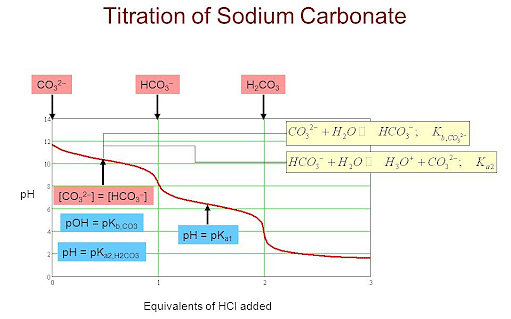
Titration of hydrochloric acid against standard sodium carbonate is a two-step reaction that uses phenolphthalein as an indicator in the first step. The hydrochloric acid solution can be titrated against the sodium carbonate solution using a methyl orange indicator.
- When a weak base is titrated with a strong acid solution, it is slightly acidic at the endpoint.
- The solution is slightly basic if a weak acid is titrated with a strong base since the salt produced is hydrolyzed.
- These are the hydrochloric acid and sodium carbonate equations.
- In acid-base titrations at the endpoint, the amount of the acid becomes chemically equivalent to the amount of base present.
- The solution becomes neutral with a strong acid and a strong base titration.
- The chemical reactions involved in this titration are given below.
Na2CO2(aq) + 2HCl(aq) → 2NaCl(aq) + CO2(g) + H2O(l)
CO32-(aq) + 2H+(aq) → CO2(g) + H2O(l)
Read More:
Aim
[Click Here for Sample Questions]
The aim of the experiment is to determine the strength of a given solution of dilute hydrochloric acid by titrating it against a standard solution of sodium carbonate(M/20).
Read More: Saturated Hydrocarbon
Materials Required
[Click Here for Sample Questions]
The materials required for titration of hydrochloric acid against standard sodium carbonate are as follows:
- Burette
- Pipette
- Conical flask
- Burette stand
- Funnel
- Stirrer
- White glazed tile
- Measuring flask
- Hydrochloric acid
- Sodium carbonate
- Methyl orange
- Watch glass

Procedure
[Click Here for Sample Questions]
The procedure for titration of hydrochloric acid against standard sodium carbonate is divided into two stages. The two stages of the experiment are as follows:
Preparation of standard solution of sodium carbonate
The steps followed in preparation of sodium carbonate are as follows:
- The molecular weight of sodium carbonate is 106g
- The amount of sodium carbonate required to prepare a solution of 250ml is 1.325g
- Prepare the standard solution by dissolving 1.325g of sodium carbonate in distilled water.
- Add the required amount of water to a 250ml measuring flask.
Read More: Carbonyl Compounds
Titration of Hydrochloric Acid and Sodium Carbonate Solution
The steps followed in the titration of hydrochloric acid and sodium carbonate are as follows:
- Wash, rinse, and fill the burette with M/10 Na2CO3 solution.
- Note the initial reading.
- Take 10cm3 of HCl solution with the help of a pipette.
- Transfer it into a clean washed titration flask.
- Add two drops of methyl orange into the titration flask.
- Add M/10 sodium carbonate solution to the titration flask till the colour changes to light pink.
- Note the final reading and find out the volume of sodium carbonate solution used to neutralise the HCl solution.
- Repeat the experiment till you get concordant readings.
Read More: High-Density Polyethylene structure
Observation
[Click Here for Sample Questions]
Volume of HCl solution is given as10cm3. The volume of sodium carbonate solution used = V cm3. The observation table for titration of hydrochloric acid against standard sodium carbonate are as follows:
| S.No | Initial reading of the burette | Final reading of the burette | Volume of Sodium carbonate solution used |
|---|---|---|---|
| 1 | acm3 | bcm3 | (b-a) cm3 |
| 2 | bcm3 | ccm3 | (c-b) cm3 |
| 3 | ccm3 | dcm3 | (d-c) cm3 |
Calculation
The calculation used for titration of hydrochloric acid against standard sodium carbonate are as follows:
- (Sodium carbonate) a1M1V1 = (HCl) a2M2V2.
- 2 × 1/10 × V = 1 × x × 10
- x = V/5
- The formula for strength is given as:
Strength in g/L = molarity × molar mass
- V/5 × 36.5.
Result and Discussion
The strength of the hydrochloric acid solution is ________ g/L.
Read More: Dalton’s atomic theory
Precautions
[Click Here for Sample Questions]
The precautions considered while performing experiments for titration of hydrochloric acid against standard sodium carbonate are as follows:
- Care should be taken while handling the acid and base.
- Always rinse the burette and the pipette with the solution.
- Remove the air gap, if any, from the burette before titration.
- Never forget to remove the funnel from the burette before noting the initial reading of the burette.
- Ensure that no drop is hanging from the nozzle.
- Always read the lower meniscus for all transparent solutions.
- The upper meniscus for the coloured solutions is read.
- Never use a burette and pipette with a broken nozzle.
- Never suck a strong acid or an alkali with the pipette, use a pipette bulb.
- Always keep the lower end of the pipette dipped in the liquid while sucking the liquid.
- While transferring the solution to the flask, do not blow out the last drop of the solution from the jet of the pipette.
Read More: Homogeneous Equilibrium
Things to Remember
- Titration of hydrochloric acid against standard sodium carbonate determines the strength of dilute hydrochloric acid.
- The acid-base titration is based on the dissolution of a sample in excess of acid.
- The hydrochloric acid solution can be titrated against the sodium carbonate solution using a methyl orange indicator.
- When a weak base is titrated with a strong acid solution, it is slightly acidic at the endpoint.
- The strength of the solution must be calculated up to the fourth decimal place.
Read More:
Sample Questions
Ques. Which indicator is used in the titration of sodium carbonate against hydrochloric acid and what is the colour change at the endpoint? (2 marks)
Ans. Methyl Orange is used in the titration of sodium carbonate against hydrochloric acid and the colour change at the endpoint will be from yellow to pinkish-red. When a weak base is titrated with a strong acid solution, it is slightly acidic at the endpoint. The strength of the solution must be calculated up to the fourth decimal place.
Ques. How will you prepare 250 mL of 0.05 M solution of sodium carbonate? (3 marks)
Ans. We can prepare a 0.05 M solution by dissolving 1.325 gm of sodium carbonate in 250 ml.
Given :
Molarity = 0.05
Volume of solution, V = 250 ml
Molar mass of sodium carbonate, M.wt. = 106 gm
We know that Molarity, M = (w × 1000)/(M.wt × V)
⇒ 0.05 = (w × 1000)/(106 × 250)
w = 1.325 gm
Thus, by mixing 1.325 gm of sodium carbonate in 250 we can get a 0.05M solution.
Ques. Though sodium carbonate is a salt yet its aqueous solution is weakly alkaline in nature. Explain why? (2 marks)
Ans. Sodium carbonate when dissolved in water is hydrolysed to form a weak acid, carbonic acid and a strong base sodium hydroxide. Hence, an aqueous solution of sodium carbonate is alkaline in nature.
Ques. How can you determine the acidity of sodium carbonate solution? (1 mark)
Ans. The acidity of sodium carbonate solution can be determined by using pH paper or litmus paper.
Ques. Why is methyl orange not an Arrhenius base? (2 marks)
Ans. Methyl orange is a pH indicator frequently used in titrations because of its clear and distinct colour change. Because it changes colour at the pH of a mid-strength acid, it is usually used in titrations for acids. Methyl orange shows red colour in acidic medium and yellow colour in basic medium.
Ques. How can you titrate a solution of the mixture of Na2CO3 and NaHCO3 against HCl? (3 marks)
Ans. Estimation of Na2CO3 and NaHCO3 in a mixture: Accurately weigh about 2.0 g of the mixture and prepare a solution in distilled water in a 250 ml standard flask. Slowly titrate 25 ml of this solution against standard hydrochloric acid using phenolphthalein as an indicator. Repeat to concordance (Vp ml).
Ques. What is the difference between an endpoint and an equivalence point? (2 marks)
Ans. The main difference between equivalence and endpoint is that the equivalence point is a point where the chemical reaction comes to an end while the endpoint is the point where the colour change occurs in a system.
Ques. Can you directly prepare standard solutions of HCl, HNO3 and H2SO4? (2 marks)
Ans. Hydrochloric acid, HCl, and sulfuric acid H2SO4 are not suitable for use as a primary standard because although they are both commercially available as concentrated solutions that are easily diluted, the concentration of the "concentrated" solution is NOT accurately known.
Ques. How will you prepare 150 mL of 0.05 M solution of sodium carbonate? (3 marks)
Ans. We can prepare a 0.05 M solution by dissolving 1.325 gm of sodium carbonate in 250 ml.
Given :
Molarity = 0.05
Volume of solution, V = 150 ml
Molar mass of sodium carbonate, M.wt. = 106 gm
We know that Molarity, M = (w × 1000)/(M.wt × V)
⇒ 0.05 = (w × 1000)/(106 × 150)
w = 0.795 gm
Thus, by mixing 0.795 gm of sodium carbonate in 250 we can get a 0.05M solution.
Ques. What are the reactions used in the titration of hydrochloric acid against standard sodium carbonate? (2 marks)
Ans. The reactions used in the titration of hydrochloric acid against standard sodium carbonate are as follows:
Na2CO2(aq) + 2HCl(aq) → 2NaCl(aq) + CO2(g) + H2O(l)
CO32-(aq) + 2H+(aq) → CO2(g) + H2O(l)
Ques. What materials are required for conducting an experiment for titration of hydrochloric acid against standard sodium carbonate? (2 marks)
Ans. The materials required for titration of hydrochloric acid against standard sodium carbonate are as follows:
- Burette
- Pipette
- Conical flask
- Burette stand
- Funnel
- Stirrer
- White glazed tile
- Measuring flask
- Hydrochloric acid
- Sodium carbonate
- Methyl orange
- Watch glass
Ques. How will you prepare 350 mL of 0.05 M solution of sodium carbonate? (3 marks)
Ans. We can prepare a 0.05 M solution by dissolving 1.325 gm of sodium carbonate in 250 ml.
Given :
Molarity = 0.05
Volume of solution, V = 350 ml
Molar mass of sodium carbonate, M.wt. = 106 gm
We know that Molarity, M = (w × 1000)/(M.wt × V)
⇒ 0.05 = (w × 1000)/(106 × 350)
w = 1.855 gm
Thus, by mixing 1.855 gm of sodium carbonate in 250 we can get a 0.05M solution.
Ques. What precautions should be taken when doing an experiment? (3 marks)
Ans. The precautions considered while performing experiments for titration of hydrochloric acid against standard sodium carbonate are as follows:
- Care should be taken while handling the acid and base.
- Always rinse the burette and the pipette with the solution.
- Remove the air gap, if any, from the burette before titration.
- Never forget to remove the funnel from the burette before noting the initial reading of the burette.
- Ensure that no drop is hanging from the nozzle.
- Always read the lower meniscus for all transparent solutions and the upper meniscus for the coloured solutions.
- Never use a burette and pipette with a broken nozzle.
Also Check:



Comments