



Content Curator
Sodium and potassium supply energy to cells. They act as an interaction medium for transmitting information such as blinking and muscle tension. These neurotransmitters carry instructions to the brain that give commands to perform activities. The amount of potassium and sodium required by humans should be 5 mmol-1 and 143 mmol-1, respectively. The proportion of ions varies on both sides of the cell membrane.
Read about: Types of Reflexes
| Table of Content |
Key Terms: Sodium, Potassium, Cell Membrane, Electrolytes, Enzymes
Sodium and Potassium Functions
[Click Here for Sample Questions]
Sodium ions are commonly found in human nerve cells. They are responsible for the regulation of water throughout the membrane. They are carriers of sugars and amino acids and are transported directly to cells. Helps maintain the electrolyte balance of the human body.
Potassium ions, on the other hand, are present in cell membranes and help maintain cell osmotic levels. It also controls basic pore functions such as opening and closing. Potassium ion functions as a cofactor for pyruvate kinase. It is also important for healthy heart function and muscle and skeletal contractions. Sodium-potassium pumps are a type of ATP found in the plasma membrane of animal cells.
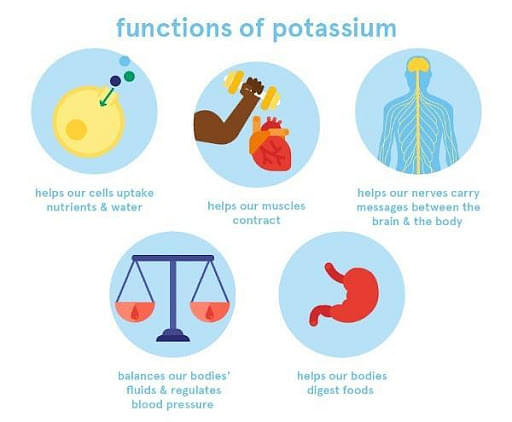
Functions of Potassium
Role of Sodium and Potassium in Conduction
[Click Here for Sample Questions]
Pure form of water does not have the ability to conduct electricity. Sodium and potassium ions, along with other electrolytes present in the body, play a role in conducting electricity through water. These ions move back and forth in the cell. In every movement, they conduct electricity. Proper electrolyte balance plays an important role in the human body. High sodium consumption and low potassium intake increase the risk of death and heart disease.

Role of Sodium and Potassium in Conduction
Organic Uses of Sodium
[Click Here for Sample Questions]
Sodium ions are found on the surface of cells in interstitial fluid and plasma. It acts as a cellular environment and generally conveys information to the brain. They also transport sugars and amino acids for proper cell function. Several other uses of sodium are in the manufacture of dyes and dye-added products. Sodium is used for the polymerization of unsaturated hydrocarbons and the purification of hydrocarbons.
Organic Uses of Potassium
[Click Here for Sample Questions]
Potassium ions are present in cell fluids and basically act. It is responsible for the transmission of information and helps activate the oxidation of sugar and enzymes.
Other uses of Potassium:
- Potassium is widely used in fertilizers.
- Potassium salts are used in a variety of fields, including potassium carbonate in the production of glass and potassium hydroxide in the production of liquid soaps and detergents.
- Potassium is also used in salt drops and medicines.
Things to Remember
- Sodium is used for the polymerization of unsaturated hydrocarbons and the purification of hydrocarbons
- They are responsible for the regulation of water throughout the membrane
- Potassium ion functions as a cofactor for pyruvate kinase
- High sodium consumption and low potassium intake increase the risk of death and heart disease.
- Sodium and potassium play a key role in conduction.
Sample Questions
Ques: Write the Biological Importance of Sodium? (2 Marks)
Ans: Sodium ions are accountable for retaining the electrolyte stage withinside the human body. They are the high companies of amino acids and sugar into the molecule. Sodium ions are observed withinside the nerve molecule and alter the go with the drift of water throughout the molecular membrane.
Ques: What are the Functions of Sodium inside the Human Body? (3 Marks)
Ans: Potassium facilitates withinside the functioning of the coronary heart is likewise accountable for the skeleton and muscular contractions additionally keeps the osmolarity of the cell Low potassium stage results in hypertensionPotassium is important to keep electrolyte stability inside the body.
Ques: Which Human Organ System Depends on the Na-K Pump? (2 Marks)
Ans: In the kidney, this pump facilitates keeping sodium and potassium levels. It performs a key function in regulating blood sugar. It displays unit cardiac contractions and forestalls coronary heart issues. If the Na-K pump fails, it may result in swelling of the molecule.
Ques: What are the uses of sodium? (2 Marks)
Ans: Sodium ions are usually found at the surface of the cells in the blood plasma and interstitial fluids which act as a surrounding to the cell. These are mainly used to transmit information, in the transportation of the sugar and amino acids within the cell, etc.
Ques: What are the uses of potassium? (2 Marks)
Ans: Potassium ions are a cation and they are present in the cell fluids. It is used to activate enzymes, the oxidation of sugars and is also responsible for transmitting the information.
Ques: What is the biological importance of sodium and potassium? (2 Marks)
Ans: Sodium maintains the electrolyte balance in the body. Potassium ions are primarily found inside the cell. Potassium ions maintain the osmolarity (the concentration of a solution expressed as the total number of solute particles per liter) of the cell. They also regulate the opening and the closing of the stomata.
Ques: What is the role of sodium and potassium in conduction? (3 Marks)
Ans: The pure form of water does not have the ability to conduct electricity.Sodium and potassium ions, along with other electrolytes present in the body, play a role in conducting electricity through water. These ions move back and forth in the cell. In every movement, they conduct electricity. Proper electrolyte balance plays an important role in the human body. High sodium consumption and low potassium intake increase the risk of death and heart disease.
Ques: How does the body use potassium? (2 Marks)
Ans: It helps your nerves to function and muscles to contract. hIt helps your heartbeat stay regular. It also helps move nutrients into cells and waste products out of cells. A diet rich in potassium helps to offset some of sodium`s harmful effects on blood pressure.
Ques: What cells need the sodium-potassium pump? (2 Marks)
Ans: This pump also known as the Na+/K+ pump or Na+/K+ATPase, is a protein pump found in the cell membrane of neurons (and other animal cells). Sodium and potassium ions are excreted from the cell membrane at a ratio of 3 sodium ions for every 2 introduced potassium ions.
Also read:



Comments