



Content Curator
The law of conservation of energy states that for an isolated system the total energy always remains conserved. This law is first proposed by Emilie du Chatelet which means energy can neither be created nor be destroyed, it can only be transformed from one form to another form.
- Conservation of energy according to classic physics is distinct from conservation of mass. However, according to special relativity, mass is related to energy and vice versa by equation E = mc2.
- The development of living forms on Earth necessitates the use of energy. It is defined as the ability to perform work in physics. We know that energy occurs in nature in various forms. the various forms of energy are heat energy, electricity, chemical energy, nuclear energy, and so on.
| Table of Content |
Key Terms: Energy, Law of Conservation energy, mass, heat energy, nuclear energy, Transformation of Energy
Read More: Elastic Limit
What is the Energy Conservation Law?
[Click Here for Sample Questions]
Energy cannot be generated or destroyed, according to the rule of conservation of energy.
- It may, however, be changed from one form to another. When all kinds of energy are considered, the total energy of an isolated system is always Constant.
- If there is a loss of energy in one area of an isolated system like the cosmos, there must be a gain of energy in another section of the universe.
- There is no known case of the concept of energy conservation being violated, despite the fact that it cannot be proved.
- The law of conservation of energy applies to all types of energy. In a nutshell, the law of energy conservation asserts that-:
“The total energy of a closed system, that is, one that is separated from its surroundings, is preserved.”
Read More:
The following equation determines the quantity of energy in any system:
\(U_T = U_i + W + Q\)Where
- The total energy of a system is UT.
- The initial energy of a system is called Ui.
- The heat generated or withdrawn from the system is denoted by Q.
- W denotes the amount of work done by or on the system.
The equation is used to calculate the change in the system's internal energy.
\(\Delta U = W + Q\)
Read More:
Energy Derivation- Law of Conservation
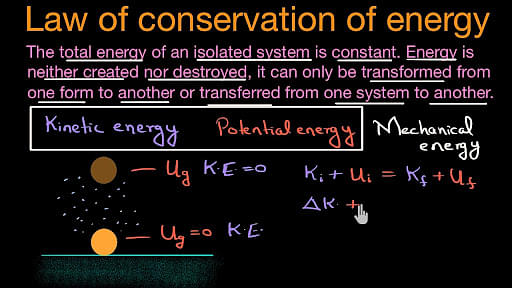
Assuming that the potential energy at the earth's surface is zero. Consider the case of a fruit falling from a tree.
Consider point A on the tree at a height of ‘H' from the ground; the fruit's velocity is zero, therefore potential energy is highest there.
E = mgH ...(1)
The fruit's potential energy decreases as it falls, but its kinetic energy increases.
The fruit is falling freely under gravity towards the bottom of the tree at point B, and it is at a height X from the ground, and it has speed as it reaches point B. As a result, it will have both kinetic and potential energy at this moment.
E = K.E + P.E
P.E = mgX ...(2)
According to the third equation of motion,
v2 = 2g(H–X)
⇒12mv2 =12m.2g(H–X)
⇒K.E=12m.2g(H–X)
⇒K.E=mg(H–X)
K.E=mg(H-X) ...(3)
Using (1), (2), and (3)
E = mg(H – X) + mgX
E = mg(H – X + X)
E = mgH
Similarly, if we look at the energy at point C, which is at the bottom of the tree, we get mgH. As the fruit falls to the bottom, we can observe how potential energy is being transformed into kinetic energy. As a result, there must be a point at which kinetic energy equals potential energy. Assume we need to determine the height ‘x' above the ground. At that time, we know,
K.E = P.E
=> P.E = K.E = E2 ...(4)
E2 is new energy obtained
Where, E = mgH2
H2 is the new height.
As the body is, from the ground, at height X,
P.E = mgX ...(5)
Using (4) and (5) we get,
mgX = mgH2
⇒ X = H2
The new height is referred to as H2.

Also Read:
Conservation of Energy
[Click Here for Sample Questions]
Energy conservation is not the same as restricting the use of finite resources that will eventually run out.
- Reduced demand on a restricted supply would be the optimum method to save, allowing the supply to begin to rebuild itself.
- Often, the easiest method to accomplish this is to switch to a different energy source.

Read More:
Examples of the Law of Conservation of Energy
[Click Here for Sample Questions]
Most inventions in physics are based on the notion that energy is conserved when it is moved from one form to another. Several electrical and mechanical devices work purely on the principle of energy conservation. We'll go through a few instances in this section.
Read More: Valance Electrons
- The chemical energy of the batteries is turned into electrical energy in a torch, which is then converted into light and heat.
- Waterfalls from a height on the turbines at hydroelectric power facilities. This causes the turbines to spin and create energy. As a result, water's potential energy is transformed into the turbine's kinetic energy, which is then translated into electrical energy.
- Electrical energy is transformed into sound energy in a loudspeaker.
- Sound energy is transformed into electrical energy in a microphone.
- Mechanical energy is transformed into electrical energy in a generator.
- Chemical energy is transformed into heat and light energy when fuels are burned.
- When food is broken down in the body, chemical energy is transformed into thermal energy, which is needed to keep the body warm.
Also Read:
Things to Remember
- The development of living forms on Earth necessitates the use of energy.
- Energy cannot be generated or destroyed, according to the rule of conservation of energy. It may, however, be changed from one form to another. When all kinds of energy are considered, the total energy of an isolated system is always Constant.
- The law of conservation of energy applies to all types of energy.
- The total energy of a system is UT.
- The initial energy of a system is called Ui.
- The heat generated or withdrawn from the system is denoted by Q.
- Energy conservation is not the same as restricting the use of finite resources that will eventually run out.
- The chemical energy of the batteries is turned into electrical energy in a torch, which is then converted into light and heat.
Sample Questions
Ques. What exactly is energy? (2 marks)
Ans. The ability to work is defined as energy.
Ques. What is the energy conservation law? (2 marks)
Ans. The total energy of a closed system, that is, one that is separated from its surroundings, is preserved.
Ques. When a block goes down a slope, what forms of energy are visible? (2 marks)
Ans. Potential energy is transformed into kinetic energy in this event.
Ques. Give an example of kinetic energy being transformed from potential energy. (2 marks)
Ans. Potential energy is transferred to kinetic energy when the dynamite explodes.
Ques. A 0.25 kilogram baseball is hit at home plate at a speed of 40 m/s. It is traveling at 30 m/s when it arrives in a seat in the left-field bleachers, 120 meters from home plate. How much effort is done on the ball by air resistance if it lands 20 meters above where it was hit? (2 marks)
Ans. 151J
Ques. A skier starts with 100J of potential energy at the top of a slope. She only has 75J of kinetic energy at the bottom of the slope. What can we infer if she has just potential energy at the top of the slope and only kinetic energy at the bottom? (3 marks)
Ans. Work equals change in energy, or W=U, according to the work-energy theorem.
The sum of potential and kinetic energies is total mechanical energy: ΔU=ΔPE+ΔKE
She starts with 100J and concludes with 75J in this scenario. Because there was a 25J change, the skier performed 25J of labor at some time throughout the system.
Also Read:



Comments