



Education Content Expert
Elastic Collision is a collision in which there is no net loss in kinetic energy in a system due to the collision. It means that the total kinetic energy of the bodies after the collision is equal to their total kinetic energy before the collision. Momentum and Kinetic Energy are both conserved in an elastic collision. In simpler terms, kinetic energy is not converted to any other form of energy.
Elastic Collision Formula is used to represent the situation of the elastic collision in the form of an equation. It is used to calculate the mass or velocity of the elastic bodies. Elastic Collision formula of momentum is m1u1 + m2u2 = m1v1 + m2v2. Elastic Collision formula of kinetic energy is 1/2 m1u12 + 1/2 m2u22 = 1/2 m1v12 +1/2 m2 v22 .
Read More: NCERT Solutions for class 11 Physics Work, Energy, and Power
| Table of Content |
Key Terms: Elastic Collision Formula, Elastic Collision, Kinetic Energy, Momentum, Energy, Mass, Velocity
What is Elastic Collision?
[Click Here for Sample Questions]
Elastic Collision is an encounter or collision between two bodies in which the total kinetic energy of both bodies remains the same. There is no net loss in kinetic energy in the system as a result of this type of collision. An elastic collision occurs only when there is no conversion of kinetic energy into different forms such as heat, noise, or potential energy.
- The overall kinetic energy and momentum are conserved in the case of elastic collision.
- For instance, if two similar cars are traveling toward each other with equal speed, then, if they collide, they would bounce off each other with no loss in speed.
- Elastic collision assumes that the objects preserve energy after the collision which is rare in real-life events.
- Thus, elastic collision is a standardized and hypothetical situation in Physics.
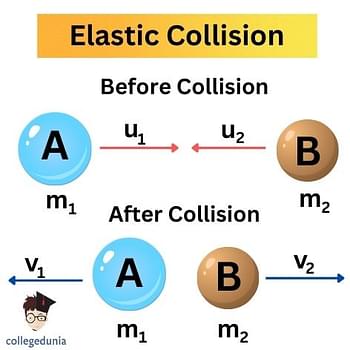
Elastic Collision
Check-Out:
Elastic Collision Formula
[Click Here for Previous Years’ Questions]
Elastic Collision assumes that both momentum and kinetic energy are preserved after the collision. Thus, the Elastic Collision Formula is given for both the momentum as well as kinetic energy.
Elastic Collision Formula of Momentum
Elastic Collision Formula of Momentum states that “Momentum before the collision is equivalent to the momentum after the collision.” It is expressed as:
| m1u1 + m2u2 = m1v1 + m2v2 |
Elastic Collision Formula of Kinetic Energy
Elastic Collision Formula of Kinetic Energy tells that “Kinetic Energy before the collision is equal to the kinetic energy after the collision.” The formula for the same is:
| 1/2 m1u12 + 1/2 m2u22 = 1/2 m1v12 +1/2 m2 v22 |
In both the Elastic Collision Formulas,
- m1: Mass of the 1st body.
- m2: Mass of the 2nd body
- u1: Initial velocity of the 1st body.
- u2: Initial velocity of the second body.
- v1: Final velocity of the first body.
- v2: Final velocity of the second body.
Read More: Work, Energy and Power Important Questions
Solved ExampleExample: A block of 15 Kg is moving with an initial velocity of 16 m/s. There is another block of 10 Kg that is moving towards the first block with a velocity of 6 m/s. Both the blocks collide and the first block comes to rest after the collision. What will be the final velocity of the second body? Solution: According to the question,
Using the Elastic Collision Formula, m1u1 + m2u2 = m1v1 + m2v2 15 x 16 + 10 x 6 = 15 x 0 + 10 x v2 240 + 60 = 10v2 v2 = 300/10 v2 = 30 m/s Thus, the final velocity of the second body is 30 m/s. |
Check-Out:
Things to Remember
- Elastic Collision refers to a type of collision in which there is no loss of kinetic energy as a result of the collision.
- The kinetic energy before and after the collision is the same in an elastic collision.
- The kinetic energy is not transferred to any other type of energy in such a collision.
- In an elastic collision, both momentum and kinetic energy are conserved.
- Elastic Collision Formula of Momentum: m1u1 + m2u2 = m1v1 + m2v2.
- Elastic Collision Formula of Kinetic Energy: 1/2 m1u12 + 1/2 m2u22 = 1/2 m1v12 +1/2 m2 v22.
Previous Years’ Questions (PYQs)
- A body of mass 5 kg makes an elastic collision with another… (AP EAPCET)
- Assertion (A) In an elastic collision between two bodies, the relative speed…
- A body of mass 2 kg makes an elastic collision with another…
- A body of mass 5kg makes an elastic collision with another body at… (BITSAT 2009)
- The elastic energy stored per unit volume in a stretched wire… (JKCET 2010)
- The coefficient of restitution e, for a perfectly elastic collision… (NEET 1988)
- When two bodies collide elastically. The force of interaction… (NTA Abhyas 2020)
- All ball of mass m1 collides elastically and head-on with one another… (BHU UET)
- In an inelastic collision, which of the following is… (COMEDK UGET 2014)
- In an inelastic collision… (KEAM 2013)
- In a perfectly inelastic collision the kinetic energy…
Sample Questions
Ques. A ball of 5 Kg is moving with a velocity of 12 m/s. It collides with a stationary ball of mass 7 kg and comes to rest. Find out the velocity of the second ball after the collision. (3 Marks)
Ans. Given that,
- Mass of First Ball (m1) = 5 Kg
- Mass of Second Ball (m2) = 7 Kg
- Initial Velocity of First Ball (u1) = 12 m/s
- Initial Velocity of Second Ball (u2) = 0 m/s
- Final Velocity of First Ball (v1) = 0 m/s
- Final Velocity of Second Ball (v2) =?
According to the Elastic Collision Formula,
1/2 m1u12 + 1/2 m2u22 = 1/2 m1v12 +1/2 m2 v22
{1 × 5 × (12)2 }/2+ (1 x 7 × 0) /2 = (1 × 5× 0)/2 + (1 × 7)/2 × v22
360 = 3.5 v2
v2 = 102.85
v = √102.85 = 10.141 m/s
Thus, the final velocity of the second ball is 10.141 m/s.
Ques. A block of 10 Kg is moving with an initial velocity of 12 m/s towards an 8 Kg wooden block moving with a velocity of 4 m/s. The second block comes to rest after the collision. What will be the final velocity of the first body? (3 Marks)
Ans. Given that,
- Mass of First Block (m1) = 10 Kg
- Initial Velocity of First Block (u1) = 12 m/s
- Final Velocity of First Block (v1) =?
- Mass of Second Block (m2) = 8 Kg
- Initial Velocity of Second Block (u2) = 4 m/s
- Final Velocity of Second Block (v2) = 0 m/s
Elastic Collision Formula is given as:
1/2 m1u12 + 1/2 m2u22 = 1/2 m1v12 +1/2 m2 v22
(10 × 12) + (8 × 4 )= (10 × v1) + (8 × 0)
120 + 32 = 10 v1 + 0
152 = 10 v1
v1 = 15.2 m/s
Thus, the final velocity of the first block is 15.2 m/s.
Ques. A blue ball with a mass of 0.2 kg collides with a red ball with a mass of 0.25 kg in an elastic collision. The initial velocity of the blue ball is 5 m/s and the red ball was at rest. The blue ball halts after the collision. What will be the final velocity of the red ball? (3 Marks)
Ans. Given parameters are,
- Mass of Blue Ball (m1) = 0.2 kg
- Mass of Red Ball (m2) = 0.25 kg
- Initial Velocity of Blue Ball (u1) = 5 m/s
- Initial Velocity of Red Ball (u2) = 0 m/s
- Final Velocity of Blue Ball (v1) = 0 m/s
- Final Velocity of Red Ball (v2) =?
According to the Elastic Collision Formula,
1/2 m1u12 + 1/2 m2u22 = 1/2 m1v12 +1/2 m2 v22
(0.2 kg) x (5 m/s) + (0.25 kg) x (0 m/s) = (0.2 kg) x (0) + (0.25 kg) x (v2)
1.0 kg.m/s + 0 = 0 + (0.25 kg) x (v2)
1.0 kg.m/s = (0.25 kg) x (v2)
(1.0 kg.m/s) / 0.25 kg = (v2)
v2 = 4 m/s
Thus, the final velocity of the red ball is 4 m/s.
Ques. What are the characteristics of an elastic collision? (3 Marks)
Ans. The characteristics of an elastic collision are:
- The linear momentum of an object is conserved in an elastic collision.
- The total kinetic energy of the object is also conserved.
- Conservative forces are involved in an elastic collision.
- The mechanical energy is not converted into heat in an elastic collision.
Ques. A ball of 5 kg ball is moving east at a speed of 6 m/s. It then strikes a 2 kg ball which is at rest. What will be the final velocities of the two balls assuming a perfectly elastic collision? (5 Marks)
Ans. Given that,
- Mass of First Ball (m1) = 5 Kg
- Mass of Second Ball (m2) = 2 Kg
- Initial Velocity of First Ball (u1) = 6 m/s
- Initial Velocity of Second Ball (u2) = 0 m/s
- Final Velocity of First Ball (v1) =?
- Final Velocity of Second Ball (v2) =?
Using the Elastic Collision Formula,
m1u1 + m2u2 = m1v1 + m2v2
Substituting the values,
(5 × 6) + (2 × 0) = 5v1 + 2v2
30 + 0 = 5v1 + 2v2
30 = 5v1 + 2v2 ⇢ (Equ. 1)
u1 + v1 = u2 + v2
6 + v1 = 0 + v2
6 = -v1 + v2 ⇢ (Equ. 2)
Using equations 1 and 2,
∴ v2 = 8.57 m/s
Put v2 = 8.57 in Equation 2,
-v1 + 8.57 = 6
v1 = 2.57 m/s
Thus, the final velocities of the first and the second ball are 2.57 m/s and 8.57 m/s respectively.
Ques. A body of mass 4 kg collides with a body at rest. The body then continues to move in the same direction at a speed of one-third of its original speed. What will be the mass of the second body? (3 Marks)
Ans. Given parameters are:
- m1 = 4 kg
- v1 = u1/3
- u2 = 0
- m2 =?
Rearranging the elastic collision formula,
v1 = ((m1 – m2) / (m1 + m2)) × u1 + (2m2u2) / (m1 + m2)
u1/3 = ((4 – m2) / (4 + m2)) × u1
4 + m2 = 12 – 3m2
4m2 = 12 – 4
m2 = 2 kg
Thus, the mass of the second body is 2 kg.
Ques. How to classify a collision as elastic? (3 Marks)
Ans. In order to make sure whether a collision is elastic or inelastic, we need to equate their total kinetic energy. This means, that if the kinetic energy remains the same before and after the said collision, it can be called an elastic collision. On the other hand, if there is a shift in the total kinetic energy, it means that the category of collision is inelastic. The loss of energy in an inelastic collision usually dissipates into sound and heat energy.
Ques. Give some examples of elastic collision. (3 Marks)
Ans. Here are a few examples of elastic collision:
- On dropping a ball on the floor, it bounces back to us immediately. In this case, the ball in motion preserves its overall momentum and kinetic energy, which is why it bounces back.
- When two atomic particles collide with each other, they experience an elastic collision. In case of no loss of energy after contact, it can be classified as a perfectly elastic collision.
Ques. Given that, m1 is 3 kg, m2 is 5 kg, u2 is 0 m/s, v1 is 2.2 m/s, and v2 is 2 m/s. Calculate the value of u1. (3 Marks)
Ans. Given information is that,
- m1 = 3 kg
- m2 = 5 kg
- u2 = 0
- v1 = 2.2 m/s
- v2 = 2 m/s
- u1 =?
Using the elastic collision formula,
m1u1 + m2u2 = m1v1 + m2v2
3 × u1 + 5 × 0 = 3 × 2.2 + 5 × 2
3u1 = 6.6 + 10
u1 = 5.53 m/s
Thus, the initial velocity of the first body is 5.53 m/s.
Ques. What is elastic collision? (2 Marks)
Ans. Elastic Collision refers to a type of collision between two bodies in which the total kinetic energy of both bodies before and after the collision remains the same. No kinetic energy is lost in this particular type of collision neither it is converted into any other form of energy.
Check-Out:



Comments