



Content Curator
Equal sets are sets in set theory with the same number of items and identical elements. It is a set equality idea.
- A set is a collection of well-defined items, such as letters, numbers, persons, and shapes.
- Typically, they are indicated by a capital letter and angle brackets.
- Two or more sets are known to be equal sets in case they have the same elements, along with the same number of elements.
- An example of equal sets is A = {1, 2, 3, 4, 5} and B = {1, 2, 3, 4, 5}
Read More: Types of Set
| Table of Content |
Key Terms: Set, Set Theory, Equal sets, Equivalent sets, Union, Intersection of Sets, Union of Sets
Equal Sets
[Click Here for Sample Questions]
Two sets with the same elements are referred to as Equal sets. It is important to note that two sets have exactly the same elements only then we can call them equal sets. An equal set definition may be written or represented as,
A = B
Now, if this condition is not met, then it is said that the sets are unequal. Unequal sets will be represented as,
A ≠ B
For instance, consider set A = {1, 2, 3, 4, 5} and B = {1, 2, 3, 4, 5}. Herein, both set A and B can be seen as equal sets since their elements are the same and they have the same cardinality.
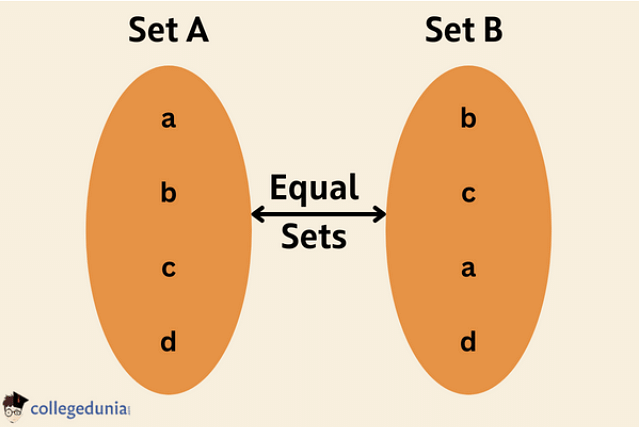
What are Equal Sets?
Equal Sets Representation Using Venn Diagram
Equal sets can also be represented using a Venn diagram. The Venn diagram shows two equal sets A and B that has the same number of elements and equal elements, which is., A = {12, 20, 30} = B.

Equal Sets Representation Using Venn Diagram
Read More: Equal and Equivalent Set
Properties of Equal Sets
[Click Here for Previous Year Questions]
The following are some of its crucial characteristics of Equal Sets:
- The equality of the two sets is unaffected by the elements' order.
- The cardinality of equal sets is the same, i.e., the number of elements in them.
- When two sets are subsets of one another, A B and B A are used in the set notation, and the two sets are equal. Thus, A = B.
- All of the elements in equal sets must be equal.
- The cardinal number is the same for the power set of equal sets as well.
- The same property of having an equal number of elements is shared by equal and equivalent sets.
- While the opposite is not true, all equal sets are equivalent sets.
Read Also:
| Topic-Relevant Concepts | ||
|---|---|---|
| Set Formula | Set Theory Symbols | Data Sets |
| Union and Intersection of Sets of Cardinal Numbers | Group Theory | Reflexive Relation |
Equal Set Example
[Click Here for Sample Questions]
An example of Equal Set can be represented as:
Example 1
If A = { 1, 3, 9, 5, −7} and B = {3, −7, 5, 1, 9,}, then A=B. From this example, we can conclude two things.
- For equal sets, the repetition of an element has no use.
- No matter how many times one element has repeated it will be counted once. The order of the elements also does not matter in this case.
Example 2
A = {M, A, N, G, O}; B= {N, G, M, O, A}; C= {M, A, N};
In this example, we can clearly see A and B are equal sets as they have exactly the same elements in a different order and A and B are also a subset of each other.
- A ⊂ B and and B ⊂ A which implies that A = B.
- But for A and C we can see A has all elements of C but C doesn’t have all elements of C.
- Thus, A is not a subset of C. So A and C are not equal sets.
- In mathematical terms we can write it as; C ⊂ A and A ⊄ C which implies that A ≠ C.
Equivalent Sets
[Click Here for Previous Year Questions]
If two sets have the same number of elements then we refer to them as equivalent sets. It is not necessary to have the same elements, just the number of elements should be the same.
- To be an equivalent set, the sets should have the same cardinality.
- It means there should be one-to-one correspondence between the elements belonging to both sets.
- One-to-one correspondence implies there exists an element in set Q for each element in set P, till both set P and Q get exhausted.
Symbol of Equivalent set:
[Click Here for Sample Questions]
Equivalents sets are represented with “ ~” or “≡”.
Equivalent Set Example
[Click Here for Previous Year Questions]
If A= {X: X, where X is stated to be positive integer} and B={N: N, where N is stated to be a natural number}, then A is said to be equivalent to B.
Therefore, we can conclude that an equivalent set is simply a set with an equal number of elements. However, it is not necessary for the sets to have the same elements but sets must consist of an equal number of elements.
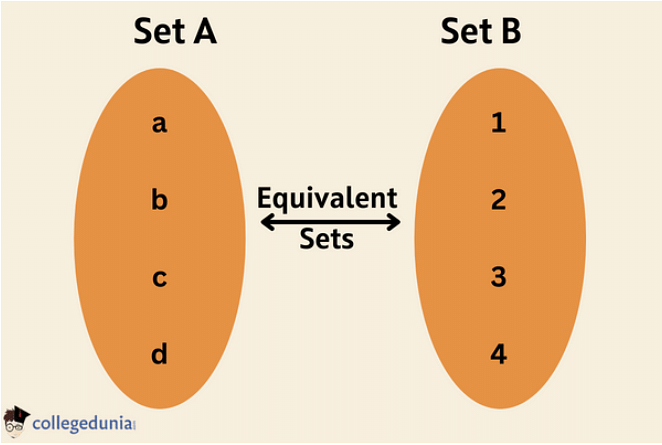
What are Equivalent Sets?
Let’s see some examples,
- If E = {1,−7,200011000,55} and F = {1,2,3,4}, then E is equivalent to F.
- Suppose if, M={Banana, Apple, Guava, Mango} and set N={Samsung, Asus, Redmi, Realme} it is to be noted that both set M and set N consists of words of different categories and have the same numbers of elements i.e. four.
Difference Between Equal And Equivalent Sets
[Click Here for Sample Questions]
The difference between equal sets and equivalent sets are:
| Equal Sets | Equivalent Sets |
|---|---|
| They are equal if all elements in two or more sets are equal. | If the number of elements in two or more sets is the same, then they are equivalent. |
| All equal sets are equivalent sets. | Equivalent sets can be either equal or not. |
| Same element should be there | Elements might not be the same |
| The word "=" is used to indicate equal sets. | To represent equivalent sets, use the symbols ~ or ≡. |
Things to Remember
- Equal sets can be defined as sets with the same number of items and identical elements.
- All null sets are equivalent sets to each other.
- It is not necessary for all infinite sets to be equivalent to each other. For example, a set of all-natural numbers and a set of all real numbers.
- Equal sets are equivalent, but they do not have to be equal.
- Sets with the same elements have the same value. When two sets are subsets of one another, they are equal as well.
Read More:
| Relevant Concepts | ||
|---|---|---|
| Set Theory | Onto Function | Types of Set |
| Probability | Functions | Types of functions |
Previous Years’ Questions
- The number of proper subsets of a set having… (COMEDK UGET 2014)
- If A and B are two sets, then A ∩ (A∪B)...
- If A and B are non-empty sets such that… (KEAM)
- Let A and B be two sets then (A∪B)′… (BITSAT 1990)
- For any two sets A and B, A-(A−B) equals… (WBJEE 2009)
- Let S be a set containing n elements and we select two subsets… (BITSAT 2005)
- Two finite sets have m and n elements. The total number…
- Which of the following sets is a finite set…
- If A and B are not disjoint sets, then n(A∪B)...
- Two sets A and B are as under: A = {(a,b)... (JEE Main 2018)
Sample Questions
Ques. Find the value of x and y if (2x, x+y) = (8, 6). (2 marks)
Ans: According to the question, we know,
2x = 8
Or, x = 4,
And, x + y = 6
Or, y = 6 – x
Or, y = 6 – 4
Or, y = 2.
Ques. Let P and Q be two sets containing 4 and 2 elements respectively. Then what is the number of subsets of the set PxQ, each having at least 3 elements? (2 marks)
Ans: n(P) = 4 and n(Q) = 2
Therefore, n(P x Q) = 8
Number of subsets of P x Q having at least 3 elements = 28 – 8C0 – 8C1 – 8C2
= 256 – 1 – 8 – 28
= 219
Ques. If P, Q and R are three sets such that P ∩ Q = P ∩ R and P U Q = P U R then, (3 marks)
(a) Q = R
(b) P = Q
(c) P = R
(d) P ∩ Q = 0 (empty set)
Ans: Option (a)
Explanation: P U Q = P U R
=> (P U Q) ∩ R = (P U R) ∩ R
=> (P ∩ R) U (Q ∩ R) = R
Using property: (P U R) ∩ R = R
=> (P ∩ Q) U (Q ∩ R) = R …..(i)
We know, P ∩ R = P ∩ Q
Again, P U Q = P U R
(P U Q) ∩ Q = (P U R) ∩ Q
Q = (P ∩ Q) U (R ∩ Q)
Q = (P ∩ Q) U (Q ∩ Q) ……….(ii)
From (i) and (ii)
Q = R
Ques. Given that M = {1, 2, 3, …, 100}, then:
(i) Write the subset P of M, whose elements are odd numbers.
(ii) Write the subset Q of M, whose elements are represented by x + 2, where x ∈ M. (2 marks)
Ans: (i) P = {x | x ∈ M and x is odd}
A = {1, 3, 5, 7, …, 99}
(ii) Q = {y | y = x + 2, x ∈ M}
1 ∈ M, y = 1 + 2 = 3
2 ∈ M, y = 2 + 2 = 4, and so on.
Therefore, Q = {3, 4, 5, 6, … , 100}
Ques. Let Y = {1, 2, 3, 4, 5, 6}. If m represent any member of Y, express the following as sets: (3 marks)
(i) m ∈ Y but 2m ∉ Y
(ii) m + 5 = 8
(iii) m is greater than 4
Ans: (i) For Y = {1, 2, 3, 4, 5, 6}, it is given that m ∈ Y, but 2m ∉ Y.
Let, P = {x | x ∈ Y and 2x ∉ Y}
Now, 1 ∉ P as 2.1 = 2 ∈ Y
2 ∉ P as 2.2 = 4 ∈ Y
3 ∉ P as 2.3 = 6 ∈ Y
But 4 ∈ P as 2.4 = 8 ∉ Y
5 ∈ P as 2.5 = 10 ∉ Y
6 ∈ P as 2.6 = 12 ∉ Y
Therefore, P = {4, 5, 6}
(ii) Let Q = {x | x ∈ Y and x + 5 = 8}
Here, Q = {3} as x = 3 ∈ Y and 3 + 5 = 8 and there is no other element belonging to Y such that x + 5 = 8.
(iii) Let D = {x | x ∈ Y, x > 4}
Therefore, D = {5, 6}
Ques. If f(x) + 2 f(1/x) = 3x, x ≠ 0 and A = {x Є R : f(x) = f(- x)}; then A (3 marks)
(a) is an empty set
(b) contains exactly one element
(c) contains more than two elements
(d) contains exactly two elements
Ans: Option (c)
Explanation: f(x) + 2 f(1/x) = 3x, x ≠ 0……(i)
Putting x = 1/x, we have
f(1/x) + 2 f(x) = (3/x)
or 2 f(x) + f(1/x) = 3/x…….(ii)
Multiply equation (ii) by 2 and subtract equation (i) from it.
3f(x) = 6/x – 3x
or f(x) = 2/x – x
Again, we are given f(x) = f(-x)
2/x – x = -2/x + x
=> x = ±√2
Therefore, S contains exactly 2 elements.
Ques. Using properties of sets prove that for all the sets P and Q, P – (P ∩ Q) = P – Q (2 marks)
Ans: P – (P ∩ Q) = P ∩ (P ∩ Q)′ (since P – Q = P ∩ Q′)
= P ∩ (P′ ∪ Q′) [by De Morgan’s law)
= (P∩P′) ∪ (P∩ Q′) [by distributive law]
= φ ∪ (P ∩ Q′)
= P ∩ Q′ = P – Q
Hence, proved that P – (P ∩ Q) = P – Q.
Ques. Let set A and B have 4 and 10 elements respectively. Then find out the maximum and the minimum number of elements in A U B. (3 marks)
Ans: According to the question
n(A) = 4 and n(B) = 10,
Let us assume that no element of set A is the same as set B. We can easily say A U B = 4 + 10 = 14.
Thus 14 is the maximum number of elements in set A U B.
Now let's assume, every element of the set A is same with set B such that:
n(A∩B) = 4.
So applying formula,
n(A U B) = n(A) + (n(B) – n (A ⋂ B)
= 4 + 10 – 4
= 10.
So the minimum element will be 10.
Ques. Let U = {1, 2, 3, 4, 5, 6, 7}, P = {2, 4, 6}, Q = {3, 5} and and R = {1, 2, 4, 7}, find (3 marks)
(i) P′ ∪ (Q ∩ R′)
(ii) (Q – P) ∪ (P – R)
Ans: Given,
U = {1, 2, 3, 4, 5, 6, 7}, P = {2, 4, 6}, Q = {3, 5} and and R = {1, 2, 4, 7}
(i) P′ = {1, 3, 5, 7}
R′ = {3, 5, 6}
Q ∩ R′ = {3, 5}
P′ ∪ (Q ∩ R′) = {1, 3, 5, 7}
(ii) Q – P = {3, 5}
P – R = {6}
(Q – P) ∪ (P – R) = {3, 5, 6}
Ques. Let U = {d : d ∈ N, d ≤ 9}; P = {d : d is an even number, 0 < d < 10}; Q = {2, 3, 5,7}. Write the set (P U Q)’. (2 marks)
Ans: Let U = {d : d ∈ N, d ≤ 9}; P = {d : d is an even number, 0 < d < 10}; Q = {2, 3, 5, 7}
Or, U = { 1, 2, 3, 4, 5, 6, 7, 8, 09};
P = {2, 4, 6, 8}
P U Q = {2, 3, 4, 5, 6, 7, 8}
(P U Q)’ = {1, 9}
Ques. In a survey of a total of 600 students in a college, 150 out of 600 students were found to be drinking Tea, and 225 out of 600 students drinking Coffee, 100 students were drinking both Tea and Coffee. Find the number of students who were drinking neither Tea or Coffee. (3 marks)
Ans: As per the Given statement,
The total number of students in the college = 600
Number of students were drinking Tea = n(T) == 150
Number of students were drinking Coffee = n(C) == 225
Number of students were drinking both Tea and Coffee == n(T ∩ C) = 100
n(T U C) = n(T) + n(C) – n(T ∩ C)
n(T U C) = 150 + 225 -100
n(T U C) = 375 – 100
n(T U C) = 275
Hence, the total number of students are drinking neither Tea nor Coffee == 600 – 275 = 325.
Ques. If two sets A and B such that n(A) = 5 and n(B) = 15 and n(AUB) = 17 then find out the value of n(A∩B). (2 marks)
Ans: We know,
n(A U B) = n(A) + (n(B) – n (A ⋂ B)
n (A ⋂ B) = n(A) + (n(B) – n(A U B)
n (A ⋂ B) = 5 + 15 – 17 = 3.
Check-Out:



Comments