



Content Writer-SME
The volume of a cylinder is the three-dimensional space occupied by it or the quantity of material that a cylinder can enclose. The formula for calculating volume of a cylinder in mathematics is equal to \(πr^2\times h\), where r is the radius of the circular base and h is the height of the cylinder.
The value of volume of any material is measured in cubic units. The volume of a cylinder thus measures the number of cubic units that will exactly fill the interior space of the cylinder. In this article we will learn about cylinders, their types and methods of calculating the volume of a cylinder with the help of some important examples.
What is a Cylinder?
[Click Here for Sample Questions]
A cylinder is a solid shape with two circular bases parallel to one another and is linked by a curved surface. This curved surface when visualized as a cylinder cut open is in fact a rectangle. The center of the cylinder has a line passing such that it joins the two circular discs and is termed the cylinder axis. The volume of the material enclosed uniformly can be a liquid or solid.
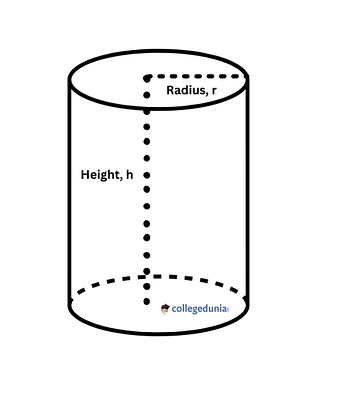
Cylinder with Radius r and Height h
Types of Cylinders
The volume of Cylinders are classified into the following categories:
- Right Circular Cylinder: This type of cylinder has two bases as circles and each line that is part of the lateral curved surface is perpendicular to the base.
- Oblique Cylinder: Oblique Cylinder has its sides leaning over the base at an angle that is not a right angle.
- Elliptic Cylinder: In an Elliptic Cylinder, the bases are not circular discs but are ellipses.
- Right Circular Hollow Cylinder: Right Circular Hollow Cylinder has two right circular cylinders bound one inside the other. The volume of a cylinder is the exact capacity the cylinder can enclose or hold inside it. Thus, this is equivalent to the amount of space occupied by the cylindrical shape.
Surface Areas of Cylinders
Total surface area and curved surface area are two types of surface area of a cylinder. Mathematically, the formula is given as:
- Total Surface Area of a Cylinder = 2πr2 + 2πr (r+h), and
- Curved Surface Area of a Cylinder = 2πrh
Read More:
| Concepts Related to Volume of a Cylinder | ||
|---|---|---|
| Area of Prism | Volume of Rectangular Prism | Square Pyramid Volume |
| Volume of Triangular Prism | Surface Area of a Prism Formula | Surface Area of Pyramid Formula |
Volume of a Cylinder
[Click Here for Sample Questions]
The volume of cylinder is measured by the number of cubic units of unit length that can fit inside the cylinder. This is equivalent to the three-dimensional space enclosed by the boundary of the cylinder. The volume of a cylinder is measured in cubic units like cm3, m3, in3, etc.
- The volume of a cylinder can be visualized by considering the cylinder as a collection of many congruent discs.
- These discs when stacked one above the other occupy the space inside the cylinder.
- Thus calculating the space occupied by each of these discs and adding them up, give the volume of a cylinder.
- The volume can thus be obtained by:
| Volume of Cylinder = Area of the Two Bases X Height of the Cylinder |
Volume of a Cylinder Formula
[Click Here for Sample Questions]
The volume of a cylinder formula can be given by the product of the area of base and height. Mathematically, Volume of a cylinder (V) can be represented as
\(V=A\times H\)
Where
A= Area of the base in square units
H= Height of the cylinder measured in length units
The following are the volume formula for different types of cylinders
Volume of a Right Circular Cylinder
We know that the base of a right circular cylinder is a circle and the area of a circle of radius 'r' is For a right circular cylinder, the base is a circle with area as πr2. The volume of the right circular cylinder formula is:
\(V=πr^2\times h\)
Where,
r = base radius
h = Cylinder height
Π = constant = 22/7 or 3.14
The volume is dependent on the height and the square of the radius.
Volume of an Oblique Cylinder
The volume of an oblique cylinder is the same as the right circular cylinder. The volume of an oblique cylinder formula with radius ‘r’ and height ‘h’ is given by:
\(V=πr^2\times h\)
Volume of an Elliptic Cylinder
An Elliptic cylinder had two radii as the bases are elliptical in shape. The area of the ellipse with radii a and b is πab. The volume of the elliptic cylinder formula is
\(V=πab h\)
Where,
Radii of the ellipse of the cylinder - a and b
Height of the elliptical cylinder -h
Π = constant = 22/7 or 3.14
Volume of a Right Circular Hollow Cylinder
For a right circular cylinder that is consists of two right circular cylinders bounded one inside the other, the volume of a cylinder formula is obtained by subtracting the volume of the inside cylinder from that of the outside cylinder. Mathematically,
\(V=π(R^2-r^2)\times h\)
R is the outer base radius of the cylinder
r is the inner base radius of the cylinder
h is the height of the cylinder
π is a constant= 22/7 = 3.14
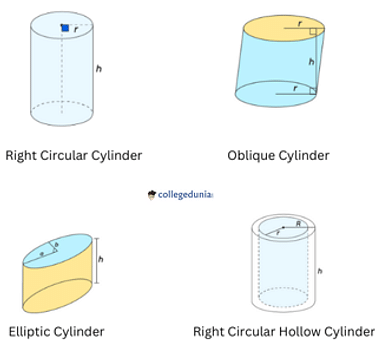
Volume of Different Cylinder Types
Read More: NCERT Solutions Class 10 Surface Areas & Volumes
How to Calculate Volume of a Cylinder?
[Click Here for Sample Questions]
Following are quick steps to calculate the volume of cylinder:
- Identify the radius and height of the given cylinder.
- Ensure both quantities are in the same units, if not convert them into a common unit system.
- Use the volume of a cylinder formula: \(V=πr^2\times h\). Substitute the values and determine the volume.
- The volume of a cylinder should be expressed in cubic units.
Read More: Properties of Cylinders
Conversions Units for Volume of a Cylinder
[Click Here for Sample Questions]
Volume of a cylinder is expressed in cubic units like cm3, m3, dm3, etc. Now, thousand cubic centimeters is equal to one litre. So to convert from litre to cm3, 1000 is multiplied to the number. Similarly, to convert cm3 to litre, the number is divided by 1000.
For example,
1 Litre = 1000 cubic cm or cm3
1 cm3 = 1/1000 litres
Solved Examples
[Click Here for Sample Questions]
A few solved examples are illustrated below for better understanding of how to find volume of a cylinder.
| Ques: Calculate the volume of a right circular cylinder having radius 20 cm and height 1 meter. Solution: Radius of the cylinder, r = 20 cm. Height of the cylinder, h = 1 meter = 100 cm. The volume of a cylinder formula, V = πr2h = (3.142)(20)2(100) = 125600 cm3. Ques: What is the radius of a cylindrical closed tube occupying a volume of 200 cm3 and height of 20 cm. Solution: Given: Volume of a cylinder, V = 200 cm3 Height, h = 20 cm Let radius be = r Volume of a cylinder formula is given by V = πr2h cubic units Substituting, So, 200 = 3.14× r2 × 20 r2 = (200)/(3.14 × 20) =200/62.8 = 4 Therefore, r = 1.78 cm Therefore, the radius of a cylinder = 1.78 cm. |
Things to Remember
- A cylinder is a three-dimensional shape with its bases circular, parallel, and congruent with one another.
- Cylinder can be visualized as a series of cubical units of unit length stacked together over one another.
- The volume occupied by the cylinder is given by the product of the sum of the areas occupied by the cubic units and the total height of the cylinder.
- The volume of a cylinder formula is given by \(V=πr^2\times h\)
- The volume of an elliptical cylinder is given by : \(V=πab h\)
- The volume of a right circular hollow cylinder is given by: \(V=π(R^2-r^2)\times h\)
Read More:
Sample Questions
Ques. What is a cylinder? (2 marks)
Ans. A cylinder is defined as a solid shape having two congruent circles in parallel with each other and their interiors. It is composed of line segments that are parallel to the segment containing the centers of both circles with endpoints on the circular regions.
Ques. What is the volume of a cylinder? (2 marks)
Ans. The volume of a cylinder formula is given by the product of the area and the height of the cylinder. It is mathematically represented by: V = πr2h
Where r= Radius of the circular base
h= Cylinder height
V= Cylinder volume
Ques. How to find the volume of a cylinder? (3 marks)
Ans. To find the volume of a cylinder,
- Determine the radius and height of the given cylinder
- Ensure uniformity of units
- Apply the formula V = πr2h
- Unit of volume to be expressed in cubic units
Ques. Calculate the volume of a cylinder with a radius 8 cm and height 15 cm. (2 marks)
Ans. Height, h= 15 cm
Radius, r = 8 cm
Volume is given by the formula, V = πr2h
Therefore, V = 3.14 x 82 x 15
= 3016 cm3
Ques. A cylinder has a base of radius 14 cm and a height of 10 cm. Calculate the volume of a cylinder? (2 marks)
Ans. Height, h= 10 cm
Radius, r = 14 cm
Volume of a cylinder formula is, V = πr2h
Therefore, V = 3.14 x 142 x 10
= 6160 cm3
Ques. The area of the base of a cylinder is 500cm2 and height is 100 cm. What is the volume of a cylinder? (2 marks)
Ans. Height, h= 100 cm
Radius, r2 = 500 cm
Volume of a cylinder formula is, V = πr2h
Therefore, V = 3.14 x 500 x 100
= 157 00 000 c3
Ques. What is the volume of a hollow cylinder? (2 marks)
Ans. A hollow cylinder is empty from the inside and has a difference between the inner and outer radii. The amount of space enclosed inside the hollow cylinder in the three-dimensional space is the volume of the hollow cylinder. The volume of a cylinder formula is given by: V = π(R2 - r2)h.
Ques. Calculate the cylinder volume when heigh and diameter are given? (3 marks)
Ans. Diameter d= 2 x radius
Therefore, r= d/2
Volume of a cylinder is given by
So, r = d/2
V = πr2h
= π(d/2)2h
V = (πd2h)/4
Therefore, the volume of a cylinder is (πd2h)/4, if its diameter and height are given.
Check Out:



Comments