



Content Writer
Focal length plays a significant role in the lens because lenses are named by their focal length.
- Focal length is used to determine the convergence and divergence of light inside a particular system in an optical system in physics.
- Focal length is usually an inverse of the optical power of the system.
- Focal length depends upon the v and u.
- With the increase and decrease in the values of v and u focal length changes.
- If the focal length is positive then the system converges to light.
- On the other hand, if the focal length is negative then the system diverges light.
Moreover, the focal length is an optical property of the lens. Focal length is used to measure distance in millimeters.
Read More: Lens Formula and Magnification
| Table of Content |
Key Terms: Focal Length, Mirror Formula, Concave Mirror, Convex Mirror, Ray Diagram, Sign Convention
Aim of the Experiment
[Click Here for Sample Questions]
To find the v value for different u values of a concave mirror and to find the focal length.
Apparatus Required
[Click Here for Sample Questions]
There are many laboratory apparatuses required for performing this experiment. The apparatus used in the given experiment are as follows:
- An optical bench with three uprights (zero-end upright and two outer upright with lateral movement)
- A Mirror Holder
- Concave Mirror
- Two Optical Needles (one thick and one thin)
- A Half-meter Rod
- A Knitting Needle
Also Read:
Ray Diagram
[Click Here for Sample Questions]
For performing the above experiment, it is necessary to establish a proper setup. So, the observations will be more accurate. Here below is the ray diagram which is required to perform the experiment:
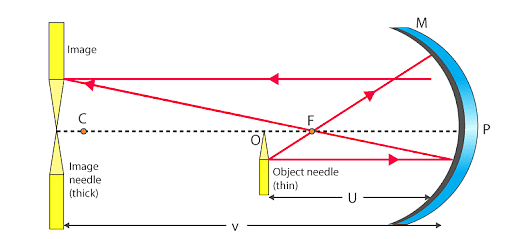
Ray Diagram
Theory
[Click Here for Sample Questions]
Focal length is used to measure the distance between the mirror and the image. Focal length is denoted as ‘f’. All these three factors depend on each other. The relationship between the three of them is given as
1/f = 1/u + 1/v
Where
- f indicates the focal length of the concave mirror.
- u indicates the distance of the object needle.
- v indicates the distance of the image needle from the pole of the mirror.
The above formula is called the Mirror formula.
Now,
f = uv/u+v
According to new cartesian sign conventions, In a concave mirror, u,v, and f all are negative. That means the focal length is negative in the case of a concave mirror.
Procedure
[Click Here for Sample Questions]
There are a number of steps that are used to perform this experiment. To make the procedure simpler, we shall divide it into some portions so that it will be easy to understand. The step-by-step guidance is provided below:
Steps to Find the Rough Focal Length
- Firstly, in the mirror holder, place the concave mirror. Then, face the mirror towards a distant tree or building in the open.
- The image of the tree or building is obtained on the white-painted wall(screen).
- To get a sharp image, move the mirror forward and backward.
- Now, determine the distance between the mirror and the wall(screen) which is equal to the rough focal length of the concave mirror.
Steps to Set Mirror and Needle
- Place the fixed upright near the zero mark of the optical bench and also fix the mirror holder in it.
- After that, the rest of the other two upright, place them near the 100 cm mark of the optical bench and fix the needle in each of them.
- Then mark the object needle as ‘O’ which is nearer to the mirror and the other image needle as ’I’ which is far away from the mirror.
- Now, adjust the heights of the needles. Adjust the center of the mirror in line with the tips of the two needles.
- Object needle ‘O’ should be placed in between the focus and center of the curvature of the mirror. Then, look for the inverted image of the needle.
- For fine line adjustments, it should be necessary that the tip of the image of the object needle just touches the tip of the imaging needle. Also, two needles are seen at the center of the mirror.
- infact, both images of needles are provided by the concave mirror. So, to identify the object needle we need to attach the small piece of paper to the tip of the object needle.
- When the eye moves sideways then the tip of the image needle, as well as the image of the object needle, will separate from each other which indicates that parallax is present in between two of the needles.
- To remove the parallax, we need to move the image needle ‘I’ towards or away from the mirror.
- When the image needle moves in the same direction where the eye is moving the eye sideways then the image needle is lying closer to the eye. The image needle should be slowly moved towards the mirror as well as away from the eye which causes the removal of parallax.
- However, when the needle moves in the opposite direction to the movement of the eye then the image needle should be slowly moved towards the eye i.e. away from the mirror.
- Note down the position of the concave mirror(P), image needle(I), and object needle(O) on the optical bench.
- Also, observe the distance between the concave mirror and the object needle which is indicated as u.
- Observe the distance between the concave mirror and the image needle which is indicated as v.
- To get different readings, change the distance of the object needle for the mirror by 1-2 cm in each observation.
- Repeat steps 10 to 19 for getting different readings at least five to six times.
- Finally, record the readings in tabular form.
Observations to Apply Index Correction
- To measure the actual length of the knitting needle, first, take a half-meter (1.5 m) rod. Let it be equal to x.
- Now, hold the knitting needle whose one end touches the center of the mirror and the other end touches the tip of the object needle between the concave mirror and the object needle.
- Then, note down the position of the concave mirror and the object needle on the optical bench. The observed length of the knitting needle which is placed between the concave mirror and the object needle. Let it be equal to y. Mathematically,
Index correction for the object distance, u = actual length of the knitting needle- observed length of the knitting needle
u = x - y
- By proceeding with the above step, remove the upright holding the object needle. Then, find the observed length of the knitting needle between the mirror and the imaging needle. Let the observed length be equal to z. Mathematically,
Index correction for the image distance, v = actual length of the knitting needle- observed length of the knitting needle
v = x - z
- Plot the graph between the u and v and then 1/u and 1/v. Therefore, calculate the focal length of the concave mirror from the two graphs.
Observations and Calculations
[Click Here for Sample Questions]
There are some basic observations that are essential such as:
- Rough focal length of the mirror = ………… cm
- Actual length of the knitting needle, x = ……….. cm
- Observed length of the knitting needle between the concave mirror and the object needle, y = ………. cm
- Observed length of knitting needle between the concave mirror and the image needle, z = ……… cm
- Index correction for the object distance, u = (x-y) cm = ……… cm
- Index correction for the image distance, v = (x-z)cm = …………cm
Apart from this, here is the table below which is used to calculate the observed distance from the values of u and v:
| Observation Table | |||
|---|---|---|---|
| Distance, u (in cm) | 12 | 16 | 20 |
| Distance, v (in cm) | - | - | - |
| Observed Distance, y = uv/u+v | - | - | - |
Calculations by Graphical Method
[Click Here for Sample Questions]
There are three types of graphs drawn between the u and v which shows how focal length is calculated. Such as:
- Graph between u and v
- Graph between 1/u and 1/v
- Graph between u and v (where a number of lines are intersecting at a single point)
Graph between u and v
The graph between u and v is obtained by considering u on x-axis and v on y-axis. As per the sign conventions, the values of u and v are negative. Therefore, the graph obtained between u and v will be a rectangular parabola.
Draw a line OA that makes an angle of 450 and meets at point A. Also, draw two perpendiculars such as AB and AD on the x-axis and y-axis respectively. The values of u and v are the same at point A then coordinates for A is (2f,2f). The values of u and v are the same when the object is placed at the center of the curvature in the concave mirror. Therefore, u=v=R=2f
Below is the graph between u and v:

Graph between u and v Diagram
Explanation: From the mirror formula it is concluded that in this case v= u.
Then, the focal length is obtained from the coordinates at point A.
So, Mean focal length, f = - ...........cm
Graph between 1/u and 1/v
The graph between 1/u and 1/v is plotted in the third quadrant along the x-axis and y-axis. The values of u and v are negative according to sign conventions. In this case, the graph obtained is a straight line which makes an angle of 450 . focal length is determined by measuring the distance OA and OB.
Below is the graph between 1/u and 1/v:

Graph between 1/u and 1/v Diagram
Explanation: According to mirror formula,
1/f = 1/u + 1/ v
When u= 0, then the intercept is OB.
? 1/f = 1/v
When v = 0, then the intercept is OA.
? 1/f = 1/u
Therefore, the focal length, f= - 1/OA = -1/OB
f = - …….. cm
Graph between u and v (Where the Number of Lines are Intersecting at a Single Point)
For drawing this graph, we need a suitable scale that represents u and v along the x-axis and the y-axis respectively. There are a number of distances along both axes. We should meet the distance points which make a straight line. Also, there are two perpendiculars such as L and KL along the x-axis and y-axis.
Below is the graph between u and v where a number of lines are meeting at a single point:

Graph between u and v
Explanation: focal length, f = OL = OM
f = - …….. cm ( f is negative as per sign conventions)
Result
[Click Here for Sample Questions]
The focal length of the concave mirror is measured by using the formulas which are mentioned below:
- From the mirror formula, focal length is calculated as, f= uv/u+v = …….. Cm
- From (u-v) graph, focal length is calculated, f = - …….. Cm
- From (1/u - 1/v), focal length is calculated, f = - ………. Cm
- From (u-v) graph, focal length is calculated, f = - …….. Cm ( where many lines intersects at a single point)
Precautions
[Click Here for Sample Questions]
There are some basic precautions that should be followed while performing the experiment. Such as:
- The uprights should be in the vertical direction.
- It should be necessary to remove the tip to tip parallax between the needle(I) and the image of the needle(O).
- To locate the position of the image it should be necessary to keep an eye at least 30 cm away from the needle.
- It should be necessary that the tips of the object and image needle lie at the same height in comparison with the pole in the concave mirror.
- It should be necessary to apply the index correction for u and v.
Source of Error
- When parallax removal may not be perfect.
- When uprights may not be vertical.
Things to Remember
- Focal length is used to determine the distance between u and v.
- In a concave mirror, the focal length is negative.
- The focal length can be calculated using tabular as well as graphical methods.
- There are chances of error in the reading when the parallax is not removed perfectly and uprights are not in the right direction.
- If index correction does not apply then the observations are not correct.
- The method to calculate the rough focal length is the same for the concave mirrors as well as for the convex mirrors.
Also Read:
Sample Questions
Ques. What do you mean by mirror formula? (2 Marks)
Ans. Mirror formula is defined as the relationship between the distance of the object, the distance of the image as well as the focal length of the mirror. The mirror formula is used for both planar and spherical mirrors. The mirror formula is denoted as ‘f’.
Mathematically,
1/f = 1/u +1/v
Where
- f represents the focal length of the mirror.
- u distance of the object.
- v distance of the image.
Ques. What do you mean by spherical mirror? Write down the name of different spherical mirrors. (2 Marks)
Ans. Spherical Mirror is defined as any mirror which makes a part of a sphere. Spherical mirrors are mainly of two types which are mentioned below:
- Concave Mirror
- Convex Mirror
Ques. Define focal plane. (2 Marks)
Ans. Any plane which is passing through the principal focus and is perpendicular to the principal axis is known as the focal plane. The focal plane is used in the mirror as well as the lens. To understand the focal plane more clearly let us see the diagram below:

Focal plane Diagram
Ques. Write down the difference between a real and a virtual image. (6 Marks)
Ans. There are some basic differences between the real and virtual images which are mentioned below:
| Parameters | Real Image | Virtual Image |
|---|---|---|
| Definition | Real image is defined as an image in which light rays meet at a particular point after the reflection or refraction. | Virtual image is defined as an image in which light rays appear to meet at a particular point after the reflection. |
| Image formed | An inverted image is formed. | An upright or erect image is formed |
| Lens used | In the real image, a converging lens is used. | In virtual images, the diverging lens is used. |
| Mirror used | A concave mirror is used in it. | Convex, Concave, and plane mirrors are used in it. |
| Reception of image | Image is obtained on the screen. | The image is not received on the screen.in fact, it appears that the image is on the mirror or lens. |
| Examples | The image on the screen of the cinema, an image formed at the photographic film of the camera, etc. | The image formed on a plane mirror, reflection in the mirror, etc. |
Ques. Can we find out the rough focal length of a convex mirror? Why or why not? (2 Marks)
Ans. No, it is not possible to find out the focal length of the convex mirror because a convex lens always forms the virtual image of the object which cannot be brought to the screen.
Ques. What is the magnifying power of a spherical mirror? (2 Marks)
Ans. The ratio of the size of the image formed to the size of the object is known as magnifying power. It is denoted as ‘M’.
Mathematically, Magnifying power, M = Size of the image/ Size of the object
M = I/O
Ques. Why can the magnification power of a concave mirror be positive or negative? (2 Marks)
Ans. This is so because a concave mirror can form the image erect and inverted. Magnification will be positive when the image formed is erect(virtual). On the other hand, magnification power will be negative when the image formed is inverted i.e. real.
Ques. Which mirror is used in the searchlight and why? (2 Marks)
Ans. In searchlights, a concave mirror is used as a reflector. To obtain a parallel beam of light, the bulb is held at the focus of the concave reflector which can travel a larger distance that’s why a concave mirror is used in searchlights.
Ques. How can we differentiate whether any mirror is a concave or convex mirror in a shape? (2 Marks)
Ans. First, we need to take the mirror and see our faces in it. When a small and clear image of the face is visible in the mirror then the given mirror is convex in shape. On the other hand, when the image of the face is not visible in the mirror then the given mirror is concave in shape.
Get Live Updates on Board Exams 2023: https://t.me/class_10_12_board_updates
Check-Out:



Comments