



Content Curator
Adiabatic process can be defined as a thermodynamic process wherein no amount of heat energy is transmitted across a system’s boundary. However, it doesn’t mean that temperature continues to be constant, but that the heat is not transferred in or out of the system. Adiabatic process, simply, is where no heat is gained or lost by a given system. According to the first law of thermodynamics, it is known that Q = 0 indicates that all the change in internal energy is in the form of work done. As per the Adiabatic process, we can say that, ∆U = U2 - U1 and W = – ∆U = U1 - U2.
| Table of Content |
Key Terms: Adiabatic Process, Thermodynamics, Heat, Internal Energy, External Energy, Work, Energy, Adiabatic Index
What is Adiabatic Process?
[Click Here for Previous Year Questions]
Adiabatic Process can be expressed as:
| “A thermodynamic process wherein, in the system, there is no exchange of heat to its surroundings, neither during expansion nor in compression.” |
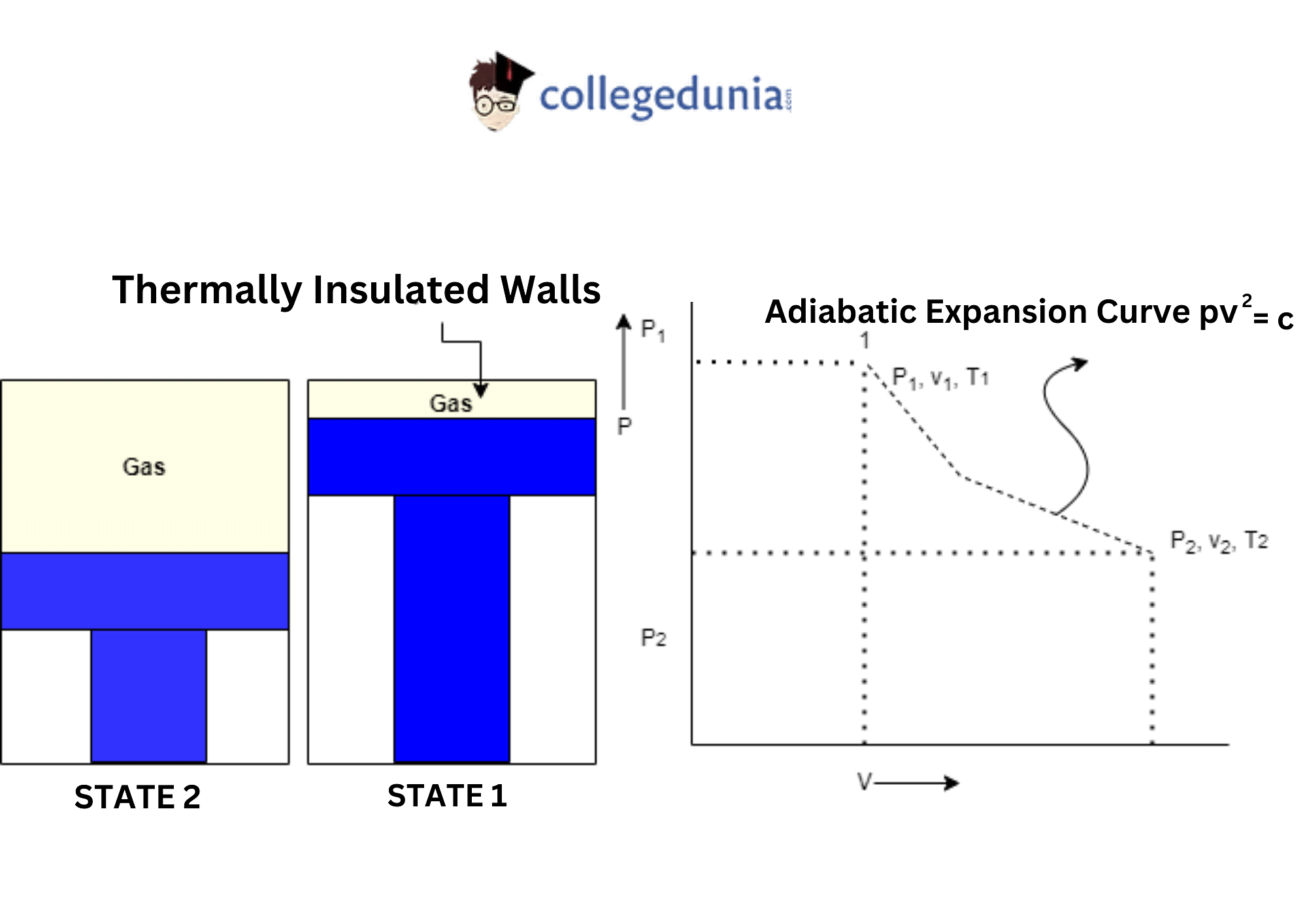
Adiabatic process
Adiabatic process can be either reversible or irreversible. It also requires to follow a few conditions in order to take place:
- The system should be insulated from the surrounding.
- The process should be hastily carried out such that there is a sufficient amount of time for heat transfer to occur.
Read More:
Adiabatic Process Formula
[Click Here for Sample Questions]
Adiabatic process formula can be represented by:
| PVγ = Constant |
Herein,
- P = Pressure of the system
- V = Volume of the system
- γ = Adiabatic index (ratio of heat capacity with a constant pressure of Cp to heat capacity at constant volume Cv)
Adiabatic Index
Adiabatic index, also called heat capacity ratio, can be expressed as the ratio of heat capacity at constant pressure Cp to heat capacity at a constant volume, i.e., Cv. Adiabatic Index is also referred to as Isentropic Expansion Factor. It is denoted by ɣ.
\(\begin{array}{l}\gamma =\frac{C_{p}}{C_{v}}=\frac{c_{p}}{c_{v}}\end{array}\)
Here,
- C = Heat capacity
- c = Specific heat capacity
The adiabatic index finds its application in reversible thermodynamic processes which involves ideal gases. The speed of sound also depends on the adiabatic index.
Read More: Wien’s Displacement Law
Adiabatic Process Derivation
[Click Here for Previous Year Questions]
Adiabatic process can be derived from the first law of thermodynamics which explains the change in internal energy dU to the amount of work W done by the system, alongside the heat dQ added to it.
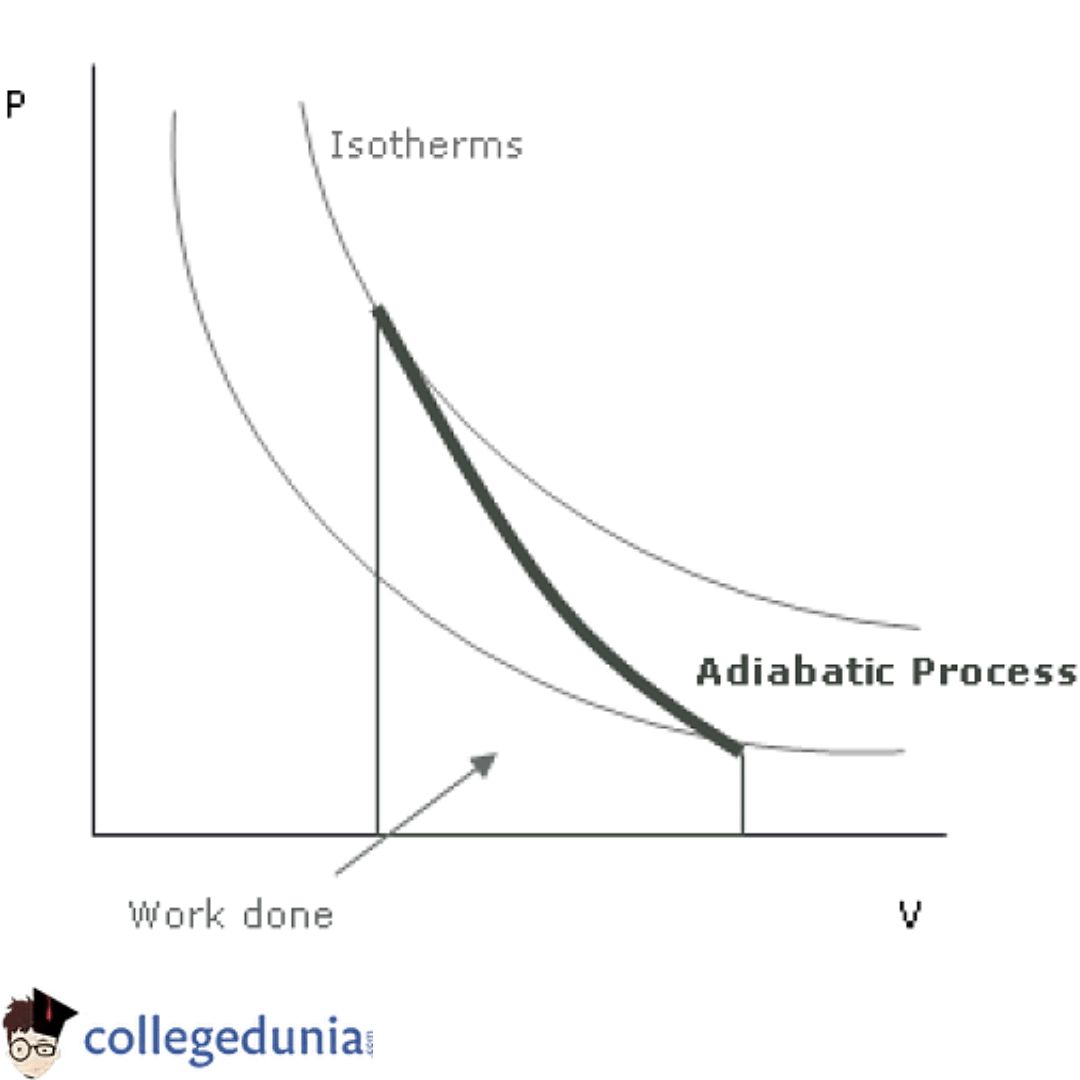
Adiabatic Process Graph
Thus, it can be said, dU = dQ – dW
dQ = 0 (as known)
Therefore, 0 = dQ = dU + dW
\(\therefore\) Work done dW for volume V change by dV is expressed as PdV.
The first term here relates to specific heat (i.e., heat added change per unit temperature, per mole of a substance). The added heat increases the internal energy U such that it fulfills the definition of specific heat (constant volume). It can be shown by:
⇒\( \begin{array}{l}C_{v}=\frac{dU}{dT}\frac{1}{n}\end{array}\) (\(\because\) n = number of moles)
Thus, 0 = nCvdT + PdV … (1)
Now, for ideal gas, we can claim:
⇒ nRT = PV … (2)
Hence, nRdT = PdV + VdP … (3)
Now, after combining both values (1) and (2),
⇒\(\begin{array}{l}-PdV=nC_{v}dT=\frac{C_{v}}{R}(PdV+VdP)\end{array}\)
⇒\(\begin{array}{l}0=(1+\frac{C_{v}}{R})PdV+\frac{C_{v}}{R}VdP\end{array} \)
⇒ \(\begin{array}{l}0=\frac{R+C_{v}}{C_{v}}(\frac{dV}{V})+\frac{dP}{P}\end{array}\)
Now, after heat is added with constant pressure Cp
⇒ Cp + Cv = R
Thus, \(\begin{array}{l}0=\gamma (\frac{dV}{V})+\frac{dP}{P}\end{array}\)
Herein, specific heat is expressed as:
\(\rightarrow\)\(\begin{array}{l}\gamma\equiv \frac{C_{p}}{C_{v}}\end{array}\)
Now, as per calculus, we can say,
⇒ \(d(lnx)=\frac{dx}{x}\)
⇒ \(\begin{array}{l}0=\gamma d(lnV)+d(lnP)\end{array}\)
⇒ \(\begin{array}{l}0=d(\gamma lnV+lnP)=d(lnPV^{\gamma })\end{array}\)
⇒ \(PV^{\gamma }=constant\)
Also Check: Hydrostatic Paradox
Adiabatic Process Examples
[Click Here for Sample Questions]
There are several examples of Adiabatic Process. Some of them include:
- Turbine that uses heat to generate work
- Release of air from pneumatic tire
- Adiabatic Efficiency can be applied to nozzles, turbines and compressors
- Oscillating pendulum in a vertical plane
Read Also:
Previous Year Questions
- For a gas …
- If enthalpies of formation for … [NEET 1995]
- The shown p- V diagram represents the thermodynamic cycle … [JEE Mains 2013]
- Consider a spherical shell of radius … [JEE Mains 2015]
- Consider an ideal gas confined in an isolated closed chamber … [JEE Mains 2015]
- If the heat of 110J is added to a gaseous system …
- A perfect gas is found to obey the relation …
- A cyclic process is shown in the figure …
- A Carnot engine whose sink is at … [NEET 2006]
- The molar specific heat at constant pressure of an ideal gas … [NEET 2006]
- For a gas undergoing an adiabatic process …
- Heat is supplied to a diatomic gas at constant pressure …
- In an isothermal process, there is …
Things to Remember
- Adiabatic process can be explained as thermodynamic process where no amount of heat energy is conveyed across a system’s boundary.
- Adiabatic Process formula is PVγ = Constant.
- The system, in an adiabatic process, should always be insulated from the surrounding.
- The process in adiabatic process should be quickly carried out such that there is a sufficient amount of time for the heat transfer to take place.
- One of the major examples of Adiabatic process is the release of air from pneumatic tire.
Sample Questions
Ques. A man pumps air inside a tire of a bicycle using a hand pump. The air within the pump is a thermodynamic system with Volume V at atmospheric pressure of P. The room temperature here is about 30°C. Assuming that the nozzle of the tire is blocked and you start pushing the pump to ⅕ of volume V, then evaluate the final temperature of the air in the pump. (3 marks)
Ans. The air will not flow since the tire is blocked. Thus, it can be considered as an Adiabatic Process.
Ti Vi (r -1) = Tf Vf (r - 1)
Ti = 30°C = (273 + 30) K
= 303 K
Vi = V.
Thus, Vf = V/5
Tf = Ti \(\times\) (Vi / Vf)(r – 1)
= 303 K \(\times\) 5(1.4 -1)
= 303 K \(\times\) 50.4
= 303 \(\times\) 1.90365
Tf = 576.81 K
Since the temperature T is at its peak, touching the nozzle would be considered dangerous.
Ques. Define Adiabatic Process. (1 mark)
Ans. The adiabatic process can be explained as a thermodynamic process wherein no amount of heat energy is transmitted across a system’s boundary.
Ques. Define Adiabatic Expansion. (2 marks)
Ans. Adiabatic expansion typically has no heat interaction of the system with its given surroundings. Also, the amount of work done by the system is at the expense of its internal energy.
Ques. Assuming that a cylinder explodes which contained gas at high pressure, then the gas undergoes what? (1 mark)
Ans. Considering a cylinder which contained gas at high pressure explodes, then the gas will experience irreversible adiabatic change and further fall in temperature.
Ques. What is Adiabatic Index? (1 mark)
Ans. Adiabatic Index can be defined as the ratio of heat capacity with a constant pressure of Cp to heat capacity at constant volume Cv.
Ques. Which quantity is seen to remain constant in an adiabatic process? (1 mark)
Ans. The total heat of the system remains constant in an Adiabatic process.
Ques. There are two cylinders, A and B, that are of equivalent size (both fitted with piston). The cylinders are filled with equal amount of ideal gases at room temperature. As per the data, the piston is free to move in cylinder A, whereas in B, it is fixed. Assuming that some amount of heat is added to cylinder A, it further rises by 30 K. Determine Cylinder B’s rising temperature of the gas. (3 marks)
Ans. For the gas in cylinder A,
⇒ Q (heat) = n x CpdT1,
Cylinder B = n x CvdT2
Thus, \(dT_2 = \frac{C_p}{C_v} \times dT_1\)
= \(\frac{7}{5} \times 30\)
dT2 = 42 K
Thus, it can be said that in, dT2 = 42 K is the Rise in temperature in cylinder B
Also Read:



Comments