



Content Curator
Fruits are rich in various minerals and vitamins. They serve numerous health benefits- be it better immunity, glowing skin, healthy hair, or overall good health- and different fruits come to our rescue for each of these concerns.
- Thus, fruits are an integral part of a balanced diet for humans.
- Fruits are a characteristic feature of flowering plants (angiosperms), as the maturation of one or more flowers results in fruit formation.
- Fruits develop from ripened or matured ovaries of the flowers.
- Usually, this happens after fertilization. However, some fruits are formed without fertilization.
- These are called parthenocarpic fruits.
- The seeds and epicarp are the main parts of the fruit.
| Table of Content |
Key Terms: Fruits, Fertilization, Angiosperms, Epicarp, Mesocarp, Endocarp, Parthenocarpic fruits, Apocarpous, Seeds, Flowering plant, Pericarp, Endosperm
What is a Fruit?
[Click Here for Sample Questions]
Fruit is a pulpy or dry ripening ovary of a flowering plant, surrounded by one or more seeds.- Fruits include apricots, bananas, grapes, corn grain, bean pods, tomatoes, cucumbers, acorns, and almonds.
- Fruit farming is the process of cultivating and treating fruits.
- Fruit processing is used to prepare fruits and improve their nutrient composition.
- Many animals are attracted to pulpy fruits with high sugar content, and these animals then disperse the seeds of fruits to other locations.
- Non-fleshy fruits use various methods for seed dispersal.
- Some plants can produce fruits without fertilization.
- This process is known as parthenocarpy, and the fruits are seedless.
- During ovary development, the wall thickens and differentiates into three distinct layers.
Also Read:
| Related Articles | ||
|---|---|---|
| Plasmodium Life Cycle | Lizard and Moth Life Cycle | Silkworm Life Cycle |
| Taxonomic Hierarchy of Plants and Animals | Two Kingdom Classification | Reproductive Health |
How are Fruits Formed?
[Click Here for Sample Questions]
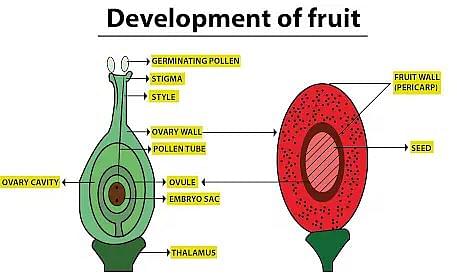
The seed-bearing structure of angiosperms (flowering plants) is known as fruit. It is formed when the ovaries mature or are ripe. The process of fruit formation, which is a result of the maturation of one or more flowers, involves the following steps.
- Pollination, i.e., the movement of pollen from the stamens to the stigma of the flowers results in the formation of a tube through the stigma that passes into the ovary and to the ovule.
- Also, two sperms are transferred to the megagametophyte from the pollen.
- One of the two sperms fertilizes the egg within the megagametophyte and zygote formation takes place.
- The second sperm enters the central cell and forms the endosperm mother cell. This completes the double fertilization process.
- Further, the zygote forms the embryos of the seed while the endosperm mother cell produces the endosperm, which provides nutrition for the embryo.
- As the seeds develop into ovules, the ovary begins to ripen and the ovary wall (pericarp) may become fleshy or a hard outer covering.
What are the Different Parts of a Fruit?
[Click Here for Sample Questions]
The fruit primarily has 2 parts. These are
- Pericarp
- Seeds
The pericarp may differentiate into other layers i.e. the epicarp (exocarp), mesocarp, and endocarp, while the seed comprises endosperm, embryo, and the seed coat.

Pericarp
The ovary wall of the flower on maturation forms the pericarp. The pericarp is often edible It may be fleshy like that in fruits such as Guava or mango or hard like that in nuts such as Walnuts.
The fleshy pericarp can be differentiated into distinct layers namely:
- Epicarp: it is the outermost layer. It forms the peel.
- Mesocarp: it is the middle, fleshy, and edible part.
- Endocarp: it is the innermost layer or the rough textured part portion where the seed is enclosed.
Seeds
The ripened ovules form the seeds. A seed comprises the following:
- Seed coat: it is the outermost covering of the seed. Its function is to protect the seed.
- Endosperm: it is the layer after the seed coat. Its function is to provide nutrition to the embryo.
- Embryo: it is the innermost part of the seed, formed by the fertilization of the male and the female gametes.
What are the Different Types of Fruits?
[Click Here for Sample Questions]
Fruits can be classified into various types based on factors such as:
- Mode of Development or Type of Ovaries
- Number of flowers and ovaries involved
- Based on whether the fruit is formed from the ovaries or not
Mode of Development or Type of Ovaries
According to the mode of development or type of ovaries, fruits are classified as
- Apocarpous: Fruit development occurs from a single flower with one or more separate carpels.
- Syncarpous: Fruit development occurs from a single gynoecium with two or more carpels that are fused together.
Number of flowers and ovaries involved
According to the number of flowers and ovaries involved, fruits are classified as
Simple Fruits
These develop from a single matured ovary in a single flower. For example, Apple, Banana, Cherry, Tomato, Plum, Pear.
Simple fruits can further be classified as:
- Drupes: They have a very hard seed enclosed inside the fruit. Hence, they are also called stone fruits since they contain a very hard seed inside the simple fruits. For e.g., Peach, Plum, Mango, Coconut.
- Berries: They are fleshy and juicy fruits with one or more seeds. For e.g., Grapes and blueberries.
- Pomes: These are fruits that bloom from the trees. They develop from the fleshy thalamus. For e.g., Papaya, Apple.
- Pepo: These are similar to berries but have a hard rind and numerous flattened seeds. For e.g., Watermelon, Cucumber, Squash, Pumpkin.
- Hesperidium: These are fleshy fruits, similar to berries but have a leathery rind and parchment-like partitions. Fruits of this type are typical fruits of the citrus family (Rutaceae). For e.g., Lemon, Grapefruit, Orange.
Aggregate Fruits
These are fruits that develop from a number of matured ovaries in a single flower. The individual ovaries are known as “fruitlets”, and the fruitlets are collectively known as “etaerio”. For e.g., Strawberry and raspberry.
Compound Fruits (Multiple Fruits)
These fruits develop from a cluster of flowers or inflorescence. A single fruit develops on the maturing of an inflorescence/cluster. For e.g., Pineapple and mulberry.
Based on whether the fruit is formed from the ovaries or not
Based on whether the fruit is formed from the ovaries or not, fruits are classified as
- True fruits: These are fruits that develop from the ovaries of the flower. For e.g., Mango.
- False fruits: These are fruits in which other parts of the flower, such as the thalamus and petals take part in the fruit formation. For e.g., Apple.

Things to Remember
- Fruit is a pulpy or dry ripening ovary of a flowering plant, surrounded by one or more seeds.
- Fruits include apricots, bananas, grapes, corn grain, bean pods, tomatoes, cucumbers, acorns, and almonds.
- The fruit primarily has 2 parts, Pericarp and Seeds.
- Fruits are characteristic of angiosperms, where the ovaries develop into fruits and the ovules develop into seeds inside the fruit.
- In gymnosperms, the ovules develop into seeds and are not enclosed inside fruits.
- The pericarp in Mango is well-differentiated into a thin outer epicarp, a middle fleshy mesocarp that is edible, and a hard inner endocarp.
- The mesocarp of coconut is fibrous.
- Parthenocarpic fruits are those which are formed without the fertilization of the ovaries.
- Tomato, Orange, Melon, and Banana are some examples of true fruits.
- Pineapple, Strawberry, and Cashew are some examples of false fruits.
Also Read:
| Related Articles | ||
|---|---|---|
| Mitochondria | Cell biology | Plasma Membrane |
| Plasma Membrane | Binomial Nomenclature | Taxonomy |
Sample Questions
Ques. What is a Fruit? (2 Marks)
Ans.
Fruits are seed-producing structures. It grows from a mature ovary. They include high levels of vitamins, minerals, and fiber. Humans consume fruits such as grapes, bananas, papaya, and watermelon. They are the primary source of a balanced diet.Ques. How are fruits formed in flower? (3 Marks)
Ans. Formation of fruits
- Plants fertilize or reproduce sexually, producing seeds and fruits.
- The production of fruits in flowers begins when pollen reaches the stigma, followed by fertilization.
- Fruit formation occurs after fertilization; the ovary undergoes changes to form the fruit.
- Following fertilization, the ovules develop into seeds.
Ques. Under which sub-division fruits and flowers are formed? (1 Mark)
Ans.
Only the angiosperms of the plant kingdom produce flowers and fruits. This is why they are often referred to as flowering plants.Ques. Name the type of fruit that is formed from a cluster of flowers. (2 Marks)
Ans.
The inflorescence or cluster of flowers produces multiple fruits, often known as collective fruit.Ques. Using a well-labeled diagram explain the various parts of a fruit. (5 Marks)
Ans. The fruit primarily has 2 parts- the pericarp and the seeds. The pericarp may differentiate into other layers- the epicarp (exocarp), mesocarp, and endocarp, while the seed comprises endosperm, embryo, and the seed coat.
Pericarp:
The ovary wall of the flower on maturation forms the pericarp, which is often edible It may be fleshy like that in fruits such as Guava or mango, or hard like that in nuts such as Walnuts.
The fleshy pericarp can be differentiated into distinct layers namely:
- Epicarp- It is the outermost layer. It forms the peel.
- Mesocarp- It is the middle, fleshy, and edible part.
- Endocarp- It is the innermost layer or the rough textured part portion where the seed is enclosed.
Seeds:
The ripened ovules form the seeds. A seed comprises the following:
- Seed coat- it is the outermost covering of the seed. Its function is to protect the seed.
- Endosperm- it is the layer after the seed coat. Its function is to provide nutrition to the embryo.
- Embryo- it is the innermost part of the seed, formed by the fertilization of the male and the female gametes.
Ques. Explain the process of fruit formation in flowering plants. (5 Marks)
Ans. The process of fruit formation is a result of the maturation of one or more flowers. The process involves the following steps:
- Pollination: the pollen from the stamens is transported to the stigma of the flowers. This results in the formation of a tube through the stigma that passes into the ovary and to the ovule.
- Two sperms are transferred to the megagametophyte from the pollen.
- One of the two sperms fertilizes the egg within the megagametophyte and zygote formation takes place.
- The second sperm enters the central cell and forms the endosperm mother cell. This completes the double fertilization process.
- Further, the zygote forms the embryos of the seed while the endosperm mother cell produces the endosperm, which provides nutrition for the embryo.
- As the seeds develop into ovules, the ovary begins to ripen and the ovary wall (pericarp) may become fleshy or a hard outer covering. The fleshy pericarp can also be differentiated into epicarp, mesocarp, and endocarp.
Ques. Define with examples a) True fruits b) False fruits c) Parthenocarpic fruits. (3 Marks)
Ans. a) True fruits: These are fruits that develop from the ovaries of the flower. For e.g., Mango, Banana.
b) False fruits: These are fruits in which other parts of the flower, such as the thalamus and petals take part in the fruit formation. For e.g., Apple, Strawberry.
c) Parthenocarpic fruits: Fruits are those which are formed without the fertilization of the ovaries. For e.g., Banana and cucumber.
Ques. What are simple fruits? Explain the types of simple fruits with examples. (5 Marks)
Ans. Simple Fruits develop from a single matured ovary in a single flower. For example, Apples and bananas. Simple fruits can further be classified as:
- Drupes: They have a very hard seed enclosed inside the fruit. Hence, they are also called stone fruits since they contain a very hard seed inside the simple fruits. For e.g., Mango, Coconut.
- Berries: They are fleshy and juicy fruits with one or more seeds. For e.g., Grapes and blueberries.
- Pomes: They develop from the fleshy thalamus. For e.g., Papaya, Apple.
- Pepo: These are similar to berries but have a hard rind and numerous flattened seeds. For e.g., Watermelon, Pumpkin.
- Hesperidium: These are fleshy fruits, similar to berries but have a leathery rind and parchment-like partitions. Fruits of this type are typical fruits of the citrus family (Rutaceae). For e.g., Lemon, Orange.
Ques. What are seeds comprised of in fruit? (3 Marks)
Ans. The ripened ovules form the seeds. A seed comprises the following:
- Seed coat- it is the outermost covering of the seed. Its function is to protect the seed.
- Endosperm- it is the layer after the seed coat. Its function is to provide nutrition to the embryo.
- Embryo- it is the innermost part of the seed, formed by the fertilization of the male and the female gametes.
Ques. How are fruits formed? (4 Marks)
Ans. The seed-bearing structure of angiosperms (flowering plants) is known as fruit. It is formed when the ovaries mature or are ripe. The process of fruit formation, which is a result of the maturation of one or more flowers, involves the following steps.
- Pollination, i.e., the movement of pollen from the stamens to the stigma of the flowers results in the formation of a tube through the stigma that passes into the ovary and to the ovule.
- Also, two sperms are transferred to the megagametophyte from the pollen.
- One of the two sperms fertilizes the egg within the megagametophyte and zygote formation takes place.
- The second sperm enters the central cell and forms the endosperm mother cell. This completes the double fertilization process.
For Latest Updates on Upcoming Board Exams, Click Here: https://t.me/class_10_12_board_updates
Check-Out:



Comments