



Content Writer
Galvanic Cell is a type of electrochemical cell that converts the chemical energy obtained from a redox reaction into electrical energy.
- The electric current generated in the cell is due to an oxidation-reduction reaction.
- Galvanic Cell is also known as a voltaic cell.
- Within the cell, ions are discharged at both anode and cathode.
- An external source of current starts the redox reactions.
- During the reaction, there is a continuous flow of electrons in a conductor.
- The salt bridge maintains the neutrality of the solution.
- Luigi Galvani and Alessandro Volta developed the galvanic cell.
- Galvanic cells are most commonly used in batteries.
Read More: Quantitative Aspects of Electrolysis
| Table of Content |
Key Terms: Galvanic Cell, Redox Reaction, Oxidation, Reduction, Electrical Energy, Salt Bridge, Ions, Current
Principle of Galvanic Cell
[Click Here for Sample Questions]
The principle of galvanic cells is based on the Gibbs free energy of spontaneous redox reaction carried out in the voltaic cell. The cell consists of two-half cells and a salt bridge.
- The two-half cells are connected with a voltmeter to generate the required voltage.
- Each of the cells consists of metallic electrodes dipped in an electrolyte solution.
Galvanic Cell Diagram
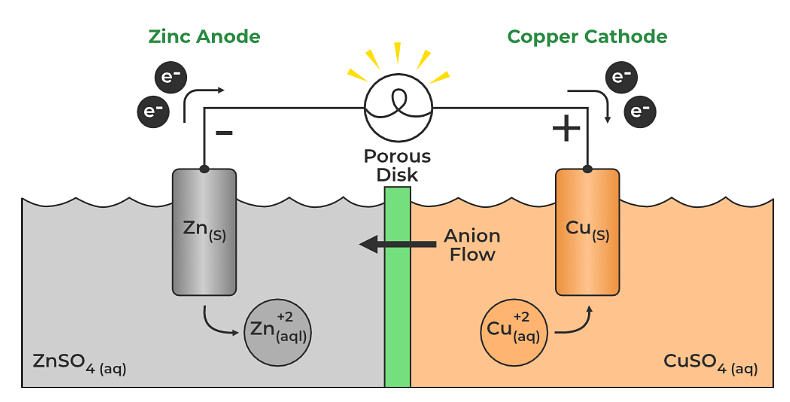
Galvanic Cell Diagram representing Zinc at anode and copper at cathode
Read More: Chemical Reactions
Types of Galvanic Cell
[Click Here for Previous Year Questions]
Galvanic Cell are divided into broad categories, which are as follows:
- Primary Galvanic Cell: It is a type of galvanic cell that undergoes an irreversible reaction, which once used cannot be reused again. They are also known as use-and-throw cells.
- Secondary Galvanic Cell: It is a type of cell which can work as a galvanic cell and an electrolytic cell. They are also known as rechargeable batteries.
Read More:
| Related Articles | ||
|---|---|---|
| Ammonium Nitrate | Difference Between Cell and Battery | Standard Hydrogen Electrode |
| Fuel Cells | Standard Electrode Potential | Cell Potential |
Formulas and Reaction of Galvanic Cell
[Click Here for Sample Questions]
A Galvanic Cell is a type of electrochemical cell that will generate current through the redox reaction taking place inside the cell. The cell is made up of two-half cells that contain metal in two different oxidation states.
- Consider that the electrode of one half-cell is made of metal X.
- The electrode of one half-cell is made of metal Y.
- N is a metal cation that consists of charge imbalance due to the loss of "n" electrons
The reaction involved in the galvanic cell is as follows:
Mn+ (oxidised species) + ne− ⇌ M (reduced species)
An+ + ne− ⇌ A
Bm+ + me− ⇌ B
The final reaction is given as:
m A + n Bm+ ⇌ n B + m An+
Read More: Synthetic Polymers
Parts of Galvanic Cell
[Click Here for Previous Year Questions]
The various parts used in the galvanic cell are as follows:
- Anode: The place where the oxidation of electrons takes place is an anode.
- Cathode: The place where the reduction of electrons takes place is the cathode.
- Salt-Bridge: It is a long tube filled with electrolytes and used to complete the circuit of the galvanic cell.
- External-Circuit: The external circuit is responsible for the flow of electrons between the electrodes of the circuit.
Read More: Magnesium bromide formula
Construction of Galvanic Cell
[Click Here for Sample Questions]
The construction of a galvanic cell is as follows:
- Galvanic Cells are constructed using two-half cell electrodes at which oxidation reaction takes place.
- The two half-cells are filled with two different kinds of electrolytic solution.
- Cells are connected with the help of a salt bridge to a wire, switch and voltmeter.
- In a galvanic cell, the anode acts as the negative electrode and the cathode acts as the positive electrode.

Galvanic Cell
Read More: Hydrochloric acid (HCl)
Working of Galvanic Cell
[Click Here for Previous Year Questions]
The galvanic cell undergoes a chemical reaction that will generate the required amount of energy at the end of the process. The cell consists of two half-cells that consist of an electrode dipped in an electrolyte solution.
- When an electrode is exposed to an electrolyte solution, the atoms will generate ions in the electrolyte.
- This process will leave behind electrons at the electrode, thus making it negatively charged.
- At the same time, metal ions are deposited in the electrode, making it positively charged.
- A potential difference is generated between the electrode and electrolyte when the reaction reaches equilibrium.
- The electrode at which reduction takes place is called the cathode, and the electrode at which oxidation takes place is called the anode.
- The accumulation of electrons generates a negative potential.
- The potential difference generated between two electrodes is called cell potential.
- When the device switch is turned on, the electron will flow from the negative electrode to the positive electrode due to the potential difference.

Galvanic Cell
Read More: Copper i chloride formula
Uses of Galvanic Cell
[Click Here for Sample Questions]
The various uses of galvanic cells are as follows:
- Galvanic Cells are used as a source of energy in batteries.
- These cells are used in portable vacuum cleaners and AM/FM digital tuners.
- It is also used in the preparation of heart peacemakers.
- Galvanic Cells are used to control the acidity of water.
Read More: Magnesium oxide formula
Example of Galvanic Cell
[Click Here for Previous Year Questions]
The working of the galvanic cell can be explained with the help of a chemical reaction between zinc and copper.
- In the process, the zinc electrode is dipped into a zinc sulphate solution.
- The copper electrode is dipped into a copper sulphate solution.
- When an electric current is passed through the circuit, the zinc electrode undergoes an oxidation reaction.
The chemical reaction taking place at the anode by the zinc electrode is as follows:
Zn → Zn2+ + 2e–
- The electron generated at the oxidation half-cell will reach the reduction half-cell.
- The electrons are taken up by copper ions and deposited on the copper rod.
The chemical reaction taking place at the cathode by the copper electrode is as follows:
Cu2+ + 2e– → Cu
The complete equation is as follows: Zn(s) + Cu2+(aq)+ → Zn2+(aq)+ Cu(s)

Galvanic Cell Construction
Read More:
| Related Articles | ||
|---|---|---|
| Balanced Chemical Equations | Types of Chemical Reactions | Barium chloride |
| Displacement Reaction | Using a chemical balance | Rancidity |
Things to Remember
- A galvanic cell or a voltaic cell converts chemical energy into electrical energy.
- The electrons within the cell undergo oxidation-reduction reactions simultaneously.
- It is of two types, namely primary and secondary galvanic cells.
- Within the cell, oxidation takes place at the anode, and reduction takes place at the cathode.
- When no current is drawn from the cell, then it is called the electromotive force of the galvanic cell.
Previous Year Questions
- Extraction of metal from the ore cassiterite involves...[JEE Advanced 2011]
- Commonly used vectors for human genome sequencing are...[NEET UG 2014]
- Interfascicular cambium and cork cambium are formed due to..
- Pneumotaxic centre is present in...[UP CPMT 2007]
- Reaction of HBr with propene in the presence of peroxide gives….[NEET UG 2004]
- Assuming the expression for the pressure exerted by the gas on the walls of the container, it can be shown that pressure is...[MHT CET 2016]
- Which among the following is the strongest acid?...[TS EAMCET 2017]
- Isopropyl alcohol on oxidation forms..
- A vector is not changed if..
- Which of the following arrangements does not represent the correct order of the property stated against it?...[JEE Main 2013]
- The major product of the following reaction is...[JEE Main 2019]
- Major product of the following reaction is..[JEE Main 2023]
- The percentage of nitrogen in urea is about..
- The electric field at a point is
- Which of the following statements is true?..[JKCET 2006]
Sample Questions
Ques. What is the difference between a galvanic cell and an electrolytic cell? (4 marks)
Ans. The difference between the galvanic cell and electrolytic cell are as follows:
| Galvanic Cell | Electrolytic Cell |
|---|---|
| Galvanic Cells are used to convert chemical energy into electrical energy. | Electrolytic Cells are used to convert electrical energy into chemical energy. |
| Oxidation and reduction reactions take place simultaneously. | Oxidation and reduction reactions do not take place simultaneously. |
| It is carried out with the help of salt bridges. | It does not require a salt bridge. |
| The chemical reaction in galvanic cells is spontaneous in nature. | The chemical reaction in electrolytic cells is non-spontaneous in nature. |
Ques. What reactions are involved when zinc and copper electrodes undergo oxidation-reduction in the galvanic cell? (2 marks)
Ans. The reactions involved when zinc and copper electrodes undergo oxidation-reduction in the galvanic cell are as follows:
- Zn → Zn2+ + 2e–
- Cu2+ + 2e– → Cu
Ques. What are the types of galvanic cells? (2 marks)
Ans. There are two types of galvanic cells, which are as follows:
- Primary Galvanic Cell: It is a type of use and throw cell which can be used once the battery gets discharged. These types of cells undergo an irreversible reaction.
- Secondary Galvanic Cell: It is a type of rechargeable battery that can work as a galvanic cell and an electrolytic cell simultaneously.
Ques. What is a galvanic cell? (2 marks)
Ans. Galvanic Cell is a type of cell in which chemical energy released during the redox reaction is converted into electrical energy. The cell is connected to an external source or circuit, which will initiate the required redox reaction. It is also popular with the name voltaic cell.
Ques. Why is cathode positive in the case of galvanic cells? (2 marks)
Ans. In the galvanic cell, anode oxidation of electrons takes place. As a result, it acts as a negative electrode. The electrons of oxidation are also left at the anode, which makes the cathode a neutral electrode. As a result, the cathode acts positively in the case of galvanic cells.
Ques. What is the difference between the cathode and anode? (4 marks)
Ans. The difference between the cathode and anode are as follows:
| Cathode | Anode |
|---|---|
| At the cathode, reduction reactions take place. | At the anode, oxidation reactions take place. |
| Electrons move outside the cathode. | Electrons move inside the anode. |
| It is the negative side of the cell. | It is the positive side of the cells. |
| The charge is negative in the case of electrolytic cells. | The charge is positive in an electrolytic cell. |
Ques. What are the uses of galvanic cells? (3 marks)
Ans. The different types of uses of galvanic cell in real life is as follows:
- It is used in medical devices such as heart pacemakers.
- Galvanic cells are used in lithium iodide batteries.
- It is used in the cells of lead storage batteries used at home.
- Galvanic Cells are used in various types of fuel cells.
Ques. What parts are used in the preparation of galvanic cells? (4 marks)
Ans. The parts used in the preparation of galvanic cells are as follows:
- Anode - where oxidation of electrons takes place.
- Cathode - where the reduction of electrons takes place.
- Salt-Bridge: Long tube used to complete the circuit.
- External-Circuit: Responsible for the flow of electrons between the electrodes.
Ques. What is an electrochemical cell? (3 marks)
Ans. An electrochemical cell is a cell that is responsible for generating electrical energy from required chemical reactions taking place inside a cell. In this type of cell, the anode acts as the negative terminal and the cathode acts as the positive terminal. It is of two types, namely galvanic cells and electrolytic cells.
Ques. Who invented the galvanic cell and on which principle the working of galvanic cells is based? (2 marks)
Ans. Luigi Galvani and Alessandro Volta invented the galvanic cell and it is based on the principle of Gibbs free energy of spontaneous redox reaction carried out in the voltaic cell.
Ques. What are the key features of galvanic cells? (3 marks)
Ans. The key features of galvanic cells are as follows:
- A Galvanic cell is a type of spontaneous reaction.
- It generates an electric current at the end result.
- In this type of cell, current flows through a wire.
- In galvanic cells, ions flow with the help of salt bridges.
Ques. What is a salt bridge? (2 marks)
Ans. Salt Bridge, also known as ion bridge, is a device that is used to act as a bridge between oxidation and reduction reactions in the galvanic cell. It is responsible for maintaining the electrical neutrality within the solution.
For Latest Updates on Upcoming Board Exams, Click Here: https://t.me/class_10_12_board_updates
Check-Out:



Comments