



Education Journalist | Study Abroad Lead
Cells and Batteries are one of the most crucial inventions that has made the existence of humans a lot simple and easier. They are used in the majority of the portable digital gadgets that we use nowadays. Apart from that, we can’t consider a world without batteries and cells. The cell is an electrochemical device used to power a wide array of devices that use electrical energy to perform various functions. Battery, in contrast to a cell, contains multiple cells combined together for more power output and backup. A battery is a collection of one or more cells. It releases power by way of chemical reactions and through electrical reactions. It mostly has two terminals, positive and negative. Cells and batteries are crucial additives in cars, trucks, and ships. Though cell and batteries are the terms that are used interchangeably, however, there are many differences between cell and battery in terms of how they are made and their functionalities.
| Table of Contents |
Key Terms: Cell, Battery, Electricity, Electric Circuit, Chemical Energy, Cathode, Anode, Electric Current, Electrodes, Electric Strength
What Is A Cell?
[Click Here for Sample Questions]
An electric cell can be defined as a device that converts chemical energy into electrical energy. The chemical cell converts the force produced through a chemical kind of reaction right into an electric strength.
The chemical cell, through the manner of chemical kinds of reaction, may be divided into an anode and cathode. An anode is a location wherein oxidation occurs and the electrode via which electricity flows out of the cell. Conversely, a cathode is where reduction occurs and the electrode via which current flows into the cell.

Structure of a Cell
Also Read:
| Related Articles | ||
|---|---|---|
| Nonelectrolyte | Standard Hydrogen Electrode | Cadmium Sulfate Formula |
| Cell Potential | Battery Definition | Fuel Cell |
What Is A Battery?
[Click Here for Sample Questions]
A battery contains a number of special substances, known as electrodes, which might be usually made from carbon. One electrode is the anode and one is the cathode. Batteries come in all shapes and sizes, each with its own specific materials, design, purpose and size. The battery’s electrochemical tool is to store and provide electric power by transforming chemical energy into an electrical force that could be used through a tool.
When a battery generates electricity it automatically generates two partial reactions. The cathode gains electrons from the anode and anions move toward the cathode while cations move toward the anode. This process creates an electrical current because of the flow of electrons through one or more conductors. The transfer of energy and matter in a battery is known as an exchange reaction.

Structure of a Battery
Difference Between Cell And Battery
[Click Here for Sample Questions]
Though cells and batteries are often confused with each other, there are numerous differences between cells and batteries. The biggest difference that lies between the two is that a cell tends to generate energy by converting the resources available, whereas a battery generally stores energy.
Tabulated below are some of the major differences between cells and batteries:
| Cell | Battery |
|---|---|
| A cell can be described as a single unit device that converts chemical energy into electric energy. | A battery is a device consisting of one or more electrochemical cells with an external connection for powering electrical devices. |
| It consists of an outer case (called container) made up of plastic or hard rubber, a liquid solution called an electrolyte and two metals contacts known as electrodes. | When a battery is supplying electric power, its positive terminal is the cathode and its negative terminal is the anode. |
| Some common examples of cells are reserve, wet and dry and some more. | A battery is either a primary battery meaning that it is non-rechargeable or it can be a secondary battery which means that it is rechargeable. |
| A cell is usually light and compact as it has a single unit. | Normal batteries are bulky because they need to include several cells to give the power it needs. |
| Cell supplies power for a shorter period of time; does not retain energy like a battery. | A battery can supply power for long durations. Rechargeable batteries can be more efficient than disposable batteries. |
| Cell lose their charge over time, even if they are not in use. | The battery holds its charge for a longer period of time. |
| A cell is a secondary generator. | A battery is a primary generator. |
| Electrons are received by the cell from an external generator and stores for later use. | The potential is stored by the battery to generate electrical energy through chemical energy. |
| The cell has one or more electrolytic cells. | Batteries have a single electrolytic cell. |
| Cells are limited by the number of charges they can handle. | Stacks are limited by their sizes. |
| Mainly, a cell is used for lighter tasks mostly that require less energy. It is used in lamps, clocks, and laptop computers for example. | Batteries are used in a wide variety of technological gadgets such as mobiles, laptops, inverters/ UPS systems and even in automobiles. |
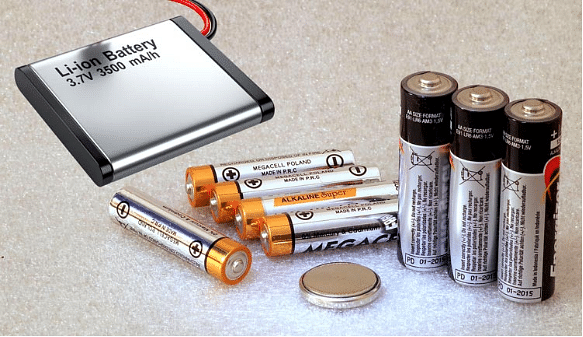
Cell vs Battery
Things To Remember
- The primary difference between a cell and a battery is the amount of energy that they hold. Generally, cells are used to power individual devices whereas batteries are used to power larger devices.
- A battery already has electrical energy in it when you buy it, unlike a cell which just contains chemicals inside it and needs to be charged up before use.
- This is because a battery is always charged from the factory or from an outlet, whereas a cell doesn't come with electricity already in it.
- The cell is a device that uses chemical energy to generate electrical energy that powers devices in our day to day lives.
- On the other hand, the battery is a device that has already stored electrical energy and is ready to power devices according to the need of the consumer
- Cells and batteries are used in the products we use every day.
- Batteries are portable modules that usually contain two or more cells. Although they are often used to power small devices, they also play an important part in larger applications such as motor vehicles and large electronic devices.
Also Read:
Sample Questions
Ques. What is a Cell? (3 Marks)
Ans. A cell is a device that uses chemical energy to generate electrical energy that powers devices in our day to day lives. On the other hand, the battery is a device that has already stored electrical energy and is ready to power devices according to the need of the consumer.
A cell is an electrochemical device used to power a wide array of devices that use electrical energy to perform various functions. Battery, in contrast to a cell, contains multiple cells combined together for more power output and backup.
Ques. What is a battery? (3 Marks)
Ans. Batteries are portable modules that usually contain two or more cells. Although they are often used to power small devices, they also play an important part in larger applications such as motor vehicles and large electronic devices.
Batteries typically include all of the connections that are required to utilize the cell potential and convert it into a usable form, such as voltage. Aside from small devices, batteries can be found in such devices as cars, boats, planes and even spacecraft. At the moment, lithium-ion batteries are some of the most common types of batteries used in electronics."
Ques. Distinguish between electric cells and batteries? (5 Marks)
Ans. Some major points of difference between cells and batteries are as follows:
- A cell is a single unit device that converts electrical energy to chemical energy. A battery is a collection of different cells that convert chemical energy to electrical energy.
- The main difference between a cell and a battery is the kind of components they have inside. The bottom line is that: while a cell uses a few cells, the battery uses many cells.
- A cell generates current using electrochemical reactions while a battery usually consists of two cells, generating current using galvanic reactions.
- A cell is a device that is capable of converting chemical energy into electricity and consists of two elements, the anode, and the cathode, that is immersed in an electrolyte solution. A battery is a combination of cells connected to each other that convert chemical energy into electrical energy.
- Cells are single units, and batteries are multiples of cells.
Ques. What are the advantages of fuel cells? (3 Marks)
Ans. Fuel cells produce electricity from fuel that is stored outside the cell. This allows for the constant flowing of electricity as long as fuel is constantly fed into the cell. Also, since there are no moving parts, these have a high rate of reliability and are more convenient to use.
These are silent in operation and hence find use as an alternative technology wherever noise pollution is to be minimized. They have no moving parts and do not require frequent servicing, so they are very convenient and highly reliable. Fuel cells are exciting because they contain a chemical reaction that creates electrical energy. Fuel cells are pollution-free. Fuel cells can safely operate in extreme conditions. Fuel cells have very low maintenance and servicing costs.
Ques. What are the similarities between cell and battery? (5 Marks)
Ans. Batteries and cells are very similar, to the point that a cell could be used as a battery if it were used in a closed circuit. Batteries are typically just a series of individual cells wired in such a way that they behave like a single cell. Although many different types of batteries exist—chemical combinations, temperatures, physical configurations and so on—most have some common properties when compared to cells.
- A battery is similar to a cell but on a grander scale (because a battery is composed of multiple cells). A battery poses the same basic features and pros/cons as its smaller counterpart, with just bigger dimensions. It also shares the same disadvantage about running down and needing a replacement.
- Cells and batteries are similar electrochemical devices that supply electrical energy. However, batteries are typically composed of multiple cells to provide a greater current capacity or voltage.
- A battery is a collection of cells. Electrochemical cells use spontaneous chemical reactions to produce electricity, which can then be used for various applications. Batteries do this more directly by providing terminals for an external circuit to connect to.
Ques. State differences between primary and secondary battery. (5 Marks)
Ans. The differences between primary and secondary batteries are as follows:
- Primary batteries, also known as primary cells are stand-alone power sources with a limited life that must be replaced once exhausted. Primary cells are used extensively in portable or remote powering devices due to an inherent advantage.
- The secondary battery can be electrically recharged after use to its original pre-discharge condition by passing a current through the circuit in the opposite direction to the current during discharge.
- Secondary batteries provide the advantage of saving money and resources over single-use primary batteries. It also has less environmental impact than disposable batteries, which are discarded when they are exhausted.
- In primary batteries, the chemicals cannot be reversed by applying an external electric current so the chemical reaction is irreversible. In secondary batteries, chemical changes are reversible through an external electrical current. Very often a secondary battery can be recharged many times, and it is called the rechargeable battery.
Ques. What is the name of the cell that is a device to convert the chemical energy of hydrogen gas into electrical energy? (3 Marks)
Ans. A fuel cell is a device that converts the chemical energy of hydrogen gas into electrical energy. This is done through a chemical reaction (without combustion) between two substances, hydrogen and oxygen. A fuel cell can generate electricity continuously for as long as these substances are supplied. Fuel cells are different from batteries in that they consume reactants, which must be replenished.
Ques. Why a dry cell has been termed so? (3 Marks)
Ans. The name "dry cell" is given to this cell because its electrolyte is a paste rather than a liquid. The dry cell uses an electrolyte paste made of ammonium chloride and zinc chloride in the top layer, and manganese dioxide and carbon powder in the bottom layer. A dry cell is a type of battery that contains a paste electrolyte rather than a water-based liquid. This allows the battery to be used in many positions. Dry cells can be used in flashlights, radios and other portable electronics.
Ques. What is Anode and Cathode in a battery? (3 Marks)
Ans. The anode is the electrode at which oxidation (loss of electrons) occurs in a galvanic cell or another electrochemical device. Until the invention of the battery, this was also called the "negative pole". The direction of conventional (electron) current is opposite to that of electron flow.
The cathode is the electrode that accumulates a negative charge which in a battery is represented by the metal plate connected to the negative end of the battery. It is called the carbon pole or the positive pole, while the anode is called the zinc pole or the negative pole.
For Latest Updates on Upcoming Board Exams, Click Here: https://t.me/class_10_12_board_updates
Check-Out:



Comments