



Content Curator
Ganongs Potometer is a device used to measure the water uptake in transpiration. The transpiration rate is calculated by taking the gap included by using the air bubble in a fixed time period. Several readings of the time taken are noted and repeated by adjusting the air bubble to zero reading. The average of those readings gives transpiration rate. Ganong’s potometer is made up of a glass cylinder with a wide mouth and a glass tube bent twice.
| Table of Content |
Also read: Transportation in Plants
Key Terms: Ganong’s Potometer, Transpiration, Twig, Beaker, Bubble, Readings
Design Principle of Ganongs Potometer
[Click Here for Sample Questions]
The Design Principle of Ganong’s Potometer is as follows:
- Reservoir- A tap is attached to a funnel. The bubbles are adjusted by rotating the tap on the reservoir. (Syringes can also be used in some designs.)
- Capillary Tube’s Length- The capillary is injected with a bubble. The bubble starts moving when the plants absorb the water. The amount of water is calculated by spotting the regular markings on the tube.
- Tube for Handling Leafy Shoot- There should always be water with the leafy shoot, and no air should come in contact with the surface of the water, as evaporation can cause interference.
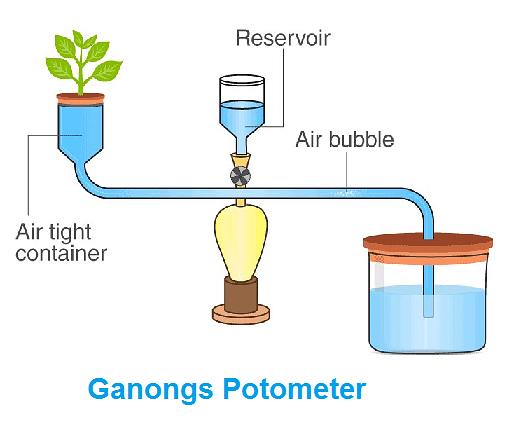
Fig. Ganongs Potometer
Procedure of Measuring Water Uptake
[Click Here for Sample Questions]
The rate of transpiration with the help of Ganongs’s Potometer can be calculated in the following ways:
- Directly– If the weight of Ganong’s potometer is measured after some time. Any loss is assumed to be because of Transpiration.
- Indirectly– If the water level drops are measured in the graduated tube it is calculated after some time.
- An apparatus is mounted on a flat surface under bright sunlight and is filled with coloured water. A few drops of Eosin oil is poured into the coloured water.
- A freshly cut twig is placed to the mouth of the glass cylinder with the help of a single-holed rubber cork.
- A single air bubble is kept at zero reading, before the experiment, in the horizontal glass rod’s capillary tube.
- The horizontal rod’s bent side is shifted from the beaker. This will help a couple of air bubbles to stay in the capillary tube. Only a single air bubble should be kept at the zero reading.
- For this variation, cork is removed from the reservoir to allow water to flow through the horizontal rod.
- Water makes the air bubbles move out through the nozzle. As the moisture is transpired by the leafy shoot’s aerial regions, a pull by transpiration is done to compensate for the moisture’s loss.
- Due to this force, the air bubble moves towards the freshly cut twig.
- The amount of water absorption may be calculated by measuring the distance travelled via the air bubble in a positive time frame and numerous measurements are recorded through adjusting the air bubble to zero reading.
- Average of these measurements will give transpiration’s rate. Water saved within the reservoir is necessary to adjust the air bubble to zero reading and restart the experiment.
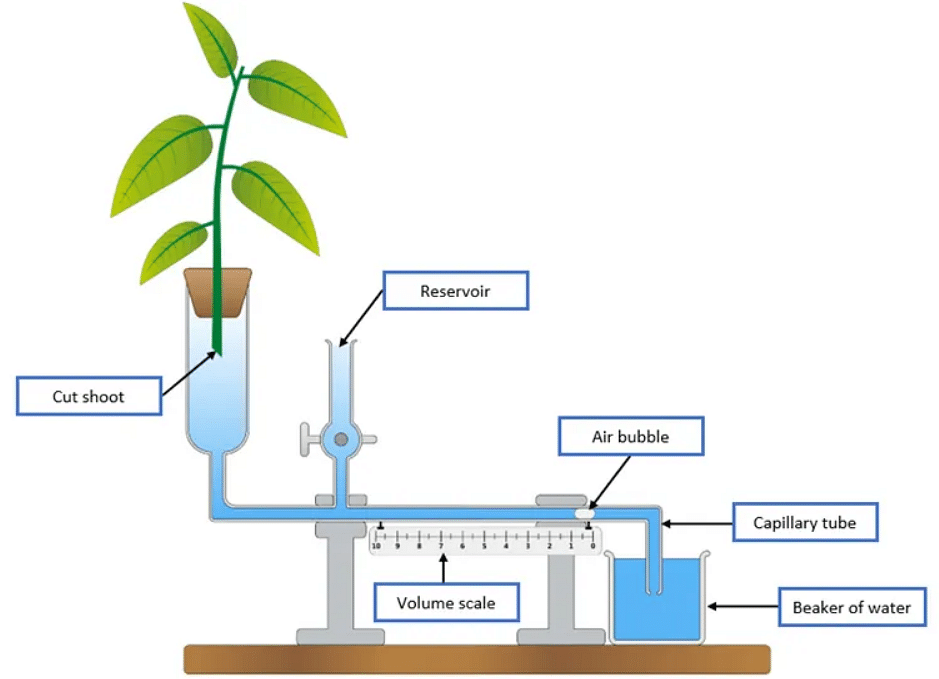
Fig. Water Uptake Measurement Procedure
Limitations of Ganongs Potometer
[Click Here for Sample Questions]
- The newly cut twig might not have a long shelf life..
- The injection of the air bubble into the horizontal rod is not easy and takes time.
- It does not calculate the rate with accuracy as the entire water absorbed by the plants is not used in transpiration.
- A little change in the temperature can inflict problems on the air bubble’s position.
Necessary Precautions
[Click Here for Sample Questions]
The precautions that must be taken before using Ganong’s potometer are as follows:
- When a freshly cut twig is immediately placed underwater, a tiny portion needs to be cut underwater. This will help to block the entrance of the air into the xylem vessels.
- The potometer's state must not be changed while the experiment goes on, doing so will let external factors like temperature or pressure affect the water absorption.
- Any water leakage should be avoided by tightening everything.
Also Read:
Things to Remember
- Ganong’s Potometer is a device used to measure the water uptake in transpiration.
- The transpiration charge is calculated with the aid of taking the gap blanketed by using the usage of the air bubble in a certain term.
- Ganong’s potometer is made up of a tumbler cylinder with a large mouth and a tumbler tube bent two times.
- A horizontal glass bar consistent with a reservoir inserted with a capillary tube and a pitcher cylinder with an extensive beginning is constant to the gadget’s the front cease, on the equal time as a holed-rubber cork is fixed on the glass cylinder’s establishing.
Sample Questions
Ques. What is Ganong’s Potometer? (4 Marks)
Ans. A device used to measure the water uptake in transpiration is known as Ganong’s Potometer or a transpirometer. The transpiration rate can be measured in a laboratory with the help of this device. Ganong’s potometer is made up of a glass cylinder with a wide mouth and a glass tube bent twice.
A horizontal glass bar fixed with a reservoir gets inserted with a capillary tube and a glass cylinder with a wide opening is fixed to the apparatus’s front end, while a holed-rubber cork is fixed on the glass cylinder’s opening.
The experiment begins by cutting a twig and placing it in the cork’s hole. As the horizontal bar has reading marks on it so we can take readings accordingly. Its ending is with a nozzle opening and is bent.
The bent end that was inserted in the horizontal bar gets a beaker with coloured water placed under it and a reservoir is connected to the to store water in the horizontal bar. A flat surface is used for the entire setup.
Ques. What is the principle of the Design of Ganong’s Potometer? (3 Marks)
Ans.
- Reservoir– A tap is attached to a funnel. The bubbles are adjusted by rotating the tap on the reservoir. (Syringes can also be used in some designs.)
- Capillary Tube’s Length- The capillary is injected with a bubble. The bubble starts moving when the plants absorb the water. The amount of water is calculated by spotting the regular markings on the tube.
- The Tube for Handling the Leafy Shoot- There should always be water with the leafy shoot, and no air should come in contact with the surface of the water, as evaporation can cause interference.
Ques. What are the two methods of measuring Water Intake? (3 Marks)
Ans. The rate of transpiration with the help of Ganongs’s Potometer can be calculated in the following ways:
- Directly: If the weight of Ganong’s potometer is measured after some time. Any loss is assumed to be because of Transpiration.
- Indirectly: If the water level drops are measured in the graduated tube it is calculated after some time.
Ques What are the limitations of Ganong’s Potometer? (3 Marks)
Ans. Limitations of using Ganongs Potometer are listed below:
- The newly cut twig may not live for a long period.
- The injection of the air bubble into the horizontal rod is not easy and takes time.
- It does not calculate the rate with accuracy as the entire water absorbed by the plants is not used in transpiration.
- A little change in the temperature can inflict problems on the air bubble’s position.
Ques. What are the necessary precautions to be taken during the experiment? (3 Marks)
Ans. The important precautions that are considered before starting the experiment are:
- When a freshly cut twig is immediately placed underwater, a tiny portion needs to be cut underwater. This will help to block the entrance of the air into the xylem vessels.
- The potometer's state must not be changed while the experiment goes on, doing so will let external factors like temperature or pressure control the water absorption.
- Any water leakage should be avoided by tightening everything.
Ques. How is the amount of water absorption calculated? (3 Marks)
Ans. The amount of water absorption may be calculated with the aid of measuring the distance travelled via the air bubble in a positive time frame and numerous measurements are recorded with the aid of adjusting the air bubble to the zero reading once more.
The average of these measurements will give us transpiration’s rate. The water saved within the reservoir is necessary to adjust the air bubble to zero reading and restart the experiment.
Ques. How many bubbles are kept in the experiment and how? (2 Marks)
Ans. A single air bubble is kept at zero reading, before the experiment, in the horizontal glass rod’s capillary tube. The horizontal rod’s bent side is shifted from the beaker. This will help a couple of air bubbles to stay in the capillary tube. Only a single air bubble should be kept at the zero reading.
Check-Out:



Comments