



Education Content Expert
Ganymede is the largest moon in the solar system. It is one of Jupiter's many natural satellites. Compared to Mercury and Pluto, Ganymede is substantially smaller. There are three primary layers of Ganymede:
- Top spherical outer covering of ice.
- A spherical mantle made up of rocks.
- A metallic core (center) made of iron.
The visible surface of Ganymede is on the top of the spherical ice shell with irregular lumps beneath it. According to the Hubble Space Telescope, there is solid evidence that Ganymede has a saltwater ocean under its surface.
| Table of Content |
Key Terms: Ganymede, Moon, Jupiter, Solar System, Mercury, Natural Satellite, Sun, Pluto, Solar, Planet
Ganymede Moon
[Click Here for Sample Questions]
Ganymede is a satellite of Jupiter and is the largest and most massive moon in the Solar System.
- Ganymede is the ninth-largest object in the Solar System.
- It is about 4.5 billion years old, which is almost the same age as Jupiter.
- It would easily be classified as a planet if it was orbiting the sun rather than Jupiter.
- Ganymede has a salty ocean underneath its icy surface.
- It is the third-farthest Galilean satellite from Jupiter, orbiting at a distance of 665,000 miles (1,070,000 kilometers).

Ganymede
Read More:
| Relevant Concepts | ||
|---|---|---|
| Dark Side of the Moon | Why Doesn't the Moon Fall into the Earth? | Value of g on Moon |
| Difference between Stars and Planets | Dwarf Planets | Motion of Celestial Bodies In Space |
Discovery of Ganymede
[Click Here for Sample Questions]
The first human to observe Ganymede was Galileo Galilei on January 7, 1610. It was given the name "Ganymede" after the prince from Greek mythology.
- The first spacecraft to closely examine it was Pioneer 10.
- Later, Voyagers 1 and 2 determined its precise size and other parameters.
- Ganymede's magnetic field and subsurface ocean were found by Galileo.
- The ESA's JUICE (Jupiter Icy Moon Explorer) mission is most likely to circle Ganymede by the third quarter of 2032.
Origin and Evolution of Ganymede
[Click Here for Sample Questions]
It is believed that the accretion in the subnebula of Jupiter led to the formation of Ganymede.
- It was a gas and dust disc that encircled the newborn Jupiter.
- Ganymede's accretion took just around 10,000 years.
- The amount of gas in the subnebula directly affected the accretion process.
- It's possible that Ganymede originated more closely to its parent planet.
- It was therefore significantly closer to the subnebula's denser region.
- This gave enough resources for a quicker accretion.
- The evacuation of recreational heat may have been impeded by the substantially speedier formation.
- The separation of the ice and rocks was most likely caused by this event.
- There were no distinct layers like on Ganymede's internal structure because there was a clear loss of recreational heat during its formation.
Structure of Ganymede
[Click Here for Sample Questions]
A metallic iron core, a spherical shell of rock (the mantle), and a top layer primarily made of ice make up the three primary layers of Ganymede.
- Under Ganymede's ice surface, researchers found strange lumps.
- These amorphous masses might represent rock formations sustained for billions of years by Ganymede's ice cover.
- According to computer simulations, Ganymede may have seas and ice piled on top of one another like a club sandwich.
- In the 1970s, researchers originally hypothesized Ganymede may have a subterranean ocean.
- The magnetic field of Ganymede was detected in 1996 by the Galileo spacecraft, providing proof for the hypothesis.
- In 1996, the Galileo spacecraft found Ganymede's magnetic field, providing proof for the hypothesis.
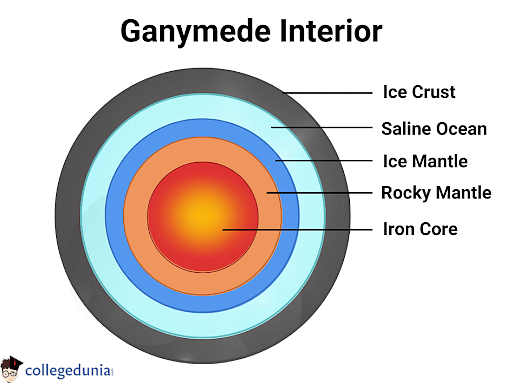
Structure of Ganymede
Read More: Halley's Comet
Exterior of Ganymede
[Click Here for Sample Questions]
Images from the spacecraft reveals two different types of topography on Ganymede's surface.
- The moon's surface is made up of two types of terrain.
- First is heavily cratered dark sections covering 40% of the area and the second one is bright grooved terrain covering 60% of it.
- These two types of terrain combine to create fascinating patterns on the moon.
- Under Ganymede's frozen surface, irregular bumps were found in 2004 by scientists.
- The uneven masses might represent rock structures sustained for billions of years by Ganymede's ice shell.
- This indicates that the ice is likely robust enough to prevent such rock piles from sinking to the bottom of the ice, at least close to the surface.
- The presence of granite strewn near the ice's base may possibly be responsible for this peculiarity.
Size and Distance of Ganymede
[Click Here for Sample Questions]
With a radius of 2,631 kilometers, Ganymede is the biggest naturally occurring satellite in the solar system.
- It is even bigger than Pluto and Mercury, as was previously mentioned.
- One orbit of Jupiter by the ice moon takes seven earth days to complete.
- Ganymede orbits the sun once every 12 years together with Jupiter.
Ganymede Environment
[Click Here for Sample Questions]
Researchers have discovered evidence of a thin oxygen atmosphere on Ganymede using the Hubble Space Telescope.
- The oxygen, according to the scientists, is coming from the frozen surface of Ganymede.
- With daylight surface temperatures ranging from -297 to -171 degrees Fahrenheit, Ganymede is far colder than Earth (90 to 160 Kelvin).
- The quantity of sunlight that Jupiter and its moons get is less than 1/30th that of the Earth.
- Ganymede lacks a substantial atmosphere to retain heat.
Check More:
| Related Topics | ||
|---|---|---|
| Life Cycle of Stars | Why do stars twinkle? | Neptune |
| Galaxies | Difference between Asteroids and Comets | Difference Between Asteroids and Meteoroids |
Ganymede and Life
[Click Here for Sample Questions]
According to scientists, the interplay between rock and water is what allowed life to evolve. A computer-generated internal model of Ganymede suggests in 2014 that it could be able to sustain the emergence of simple life forms. The model showed how salt water may be in contact with the stony surface of the moon.
On the other hand, other scientists are skeptical of Ganymede's capacity to support life. There are still enough internal characteristics that are very conducive to the emergence of life even in the absence of a thick atmosphere.
Things to Remember
- Ganymede is the largest moon of Jupiter and the Solar System.
- It is the biggest naturally occurring satellite in the solar system.
- Ganymede was first viewed by Galileo Galilei, a notable Italian astronomer.
- It is believed to be created by accretion in the subnebula of Jupiter.
- It is composed of three main layers which are a metallic core of iron, a spherical outer coating of ice, and a mantle of rock.
- Water and silicate rock are the two elements that make up the majority of Ganymede.
Sample Questions
Ques. Which moon is the largest in the Solar System? (1 Mark)
Ans. The largest moon in the Solar System is Ganymede.
Ques. What prospects exist for life in Ganymede? (1 Mark)
Ans. In the year 2014. a computer-generated internal model of Ganymede suggested that it could be able to sustain the emergence of simple life forms.
Ques. What planets have a smaller diameter than Ganymede? (1 Mark)
Ans. Pluto and Mercury have a smaller diameter than Ganymede.
Ques. What is Magnetosphere? (2 Marks)
Ans. Magnetosphere is an area of charged particles that surrounds numerous planets. It had never been observed surrounding a moon until the Galileo spacecraft, the first to orbit Jupiter, made the important discovery that Ganymede has its own magnetosphere. Galileo even recorded the static and whistling generated by Ganymede's magnetosphere.
Ques. What satellite made the magnetic field of Ganymede known? (1 Mark)
Ans. The magnetic field of Ganymede was found by the Galileo spacecraft.
Ques. Who was the initial person to notice Ganymede? (1 Mark)
Ans. The first human to view the Ganymede was Galileo Galilei (January 7, 1610).
Ques. What are Ganymede's primary layers? (2 Marks)
Ans. Ganymede is composed of three main layers- a metallic core formed of iron, a spherical outer coating of ice, and a mantle of rock (center). The top of the ice shell's spherical shape is where the surface of Ganymede is visible.
Ques. What satellite made the magnetic field of Ganymede known? (1 Mark)
Ans. The magnetic field of Ganymede was found by the Galileo spacecraft.
Ques. What are the two primary landforms of Ganymede? (2 Marks)
Ans. Dark and bright parts make up the outer surface of Ganymede into two different sorts of topography. Cross-cuts of ridges and grooves are seen throughout the light zones. Craters, which make up roughly one-third of the darker areas, are abundant.
Ques. Which spacecraft made the initial close observations of Ganymede? (1 Mark)
Ans. The first spacecraft to closely study Ganymede was Pioneer 10.
Ques. What is the composition of Ganymede? (2 Marks)
Ans. A metallic iron core, a spherical shell of rock (the mantle), and a spherical shell primarily made of ice make up Ganymede's three primary layers. The ice shell's very top is where the surface of Ganymede is. Under Ganymede's ice surface, strange irregular lumps are found. These amorphous masses might represent rock formations sustained for billions of years by Ganymede's ice cover.
Ques. Why orbit the planets in the same direction? (1 Mark)
Ans. Each planet and other celestial bodies that are formed from the interstellar cloud carried a portion of the system's original angular momentum. The dust and gas clouds were compressed by gravity, which improved angular momentum conservation. The cloud was compressed into a simple disc by it.
As a result, all of the planets that were created inside this disc circle the sun in roughly the same orbital plane, the same spin direction, and the same orbital inclination.
Ques. Why don't planets twinkle? (3 Marks)
Ans. Due to the following factors, planets do not twinkle like stars in the sky:
- Compared to the stars, they are located closer to our planet. The planets appear to be considerably larger than the stars because they are so close, and the light they emit only experiences a slight change in atmospheric refraction.
- Light is not generated by planets on their own. Instead, they depend on the stars and reflect the light that is sent to them.
- The shift is insufficient as the planets move closer, and the sparkling effect is eliminated.
Check-Out:



Comments