



Education Content Expert
Glassware is a variety of objects or containers made from glass. Glassware includes bowls, drinking containers, serving dishes, vases, and ornaments. Glass is an organic substance that typically has a translucent or transparent appearance. It is a transparent solid material. It is widely utilized in many different industries, including laboratories, as decorative and domestic goods, and for technological purposes. It is non-crystalline and amorphous. Scientifically speaking, glass refers to any non-crystalline solid that experiences a phase transformation when heated toward the liquid state. Glass is produced from sand that is opaque but entirely transparent.
| Table of Content |
Key Terms: Glassware, Glass, Amorphous Solid, Annealing, Containers, Float Glass Process, Glassblowing, Laboratory Glassware
What is Glassware?
[Click Here for Sample Questions]
Glassware is one of the most versatile and oldest human-created tools by man. Glassware is an object or container made from glass. Glassware is completely transparent, however, it is manufactured from opaque sand. It is widely employed in many different industries, including household goods, labs, technology, and decor.
- Glass lacks a distinct chemical formula.
- Raw ingredients that are plentiful and natural are melted at extremely high temperatures to create glass.
- Sand, limestone, and sodium carbonate are the three basic components used to make commercial glasses.
- Glassware is produced using two main techniques namely the Float Glass Process and Glassblowing.
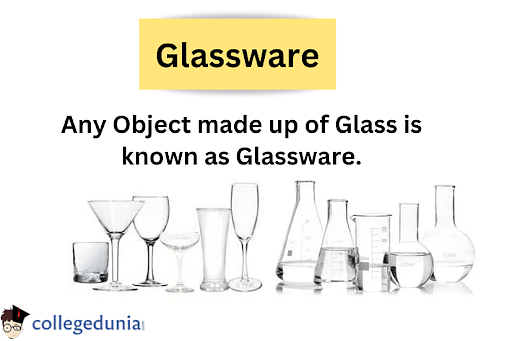
Glassware
Read More:
How is Glass Made?
[Click Here for Sample Questions]
The conventional method of preparing glass involves the sand being heated to extreme temperatures and allowed to cool down. It is then shaped into any form by either blowing or pouring into pre-designed moulds. Additives can be added during this process to improve the quality of glass and enhance the glass's appearance with different colors.
The production of glass involves several techniques which are:
- Float Glass Process: In this process, the glass is laid on the surface of molten metal. It is used to create flat windows.
- Manual Glass Blowing: This process is used to manufacture custom glass objects and art objects.
- Glass Containers: In this process, the glass is made in three different stages namely the melting of raw materials, blowing or pouring a glass in container moulds, and cooling with finishing touches.

Production of Glass
Float Glass Process
[Click Here for Sample Questions]
A sheet of glass created by floating molten gases on a bed of molten metal is employed in this method. Tin is typically used for this technique, but other low melting point metals like lead have also been employed in the past. This technique preserves the sheet's consistent thickness while producing extremely flat surfaces. The Pilkington process is another name for this procedure.
- Melting And Refining: Fine materials are combined to create a batch that flows smoothly to the float bath after flowing onto molten gases at 1500°C in the melter for up to 50 hours without bubbles.
- Float Bath: At a temperature of 1200°C, glass from the melter flows easily over a spout to the mirror-like surface of tin, leaving the float bath ribbon at 600°C.
- Coating: It causes significant changes in optical properties and can be used with high-tech temperature technology on the glass cooling ribbon.
- Annealing: The ribbon undergoes heat treatment in a furnace known as a Lehr to relieve stress.
- Inspection: The float method is renowned for producing flat glass. But every step is inspected to guarantee high quality.
- Cutting to Order: The square meter is the unit of sale. Diamond wheels cut the ribbon to size and remove any strained edges.
Glassblowing
[Click Here for Sample Questions]
It is a method of shaping glass that people have employed throughout history. It entails using a blowpipe to inflate molten glass to create a sort of glass bubble that may be shaped into different glassware for functional uses. The process of making glass products by blowing glass is:
- Step 1: Melting
- Step 2: Rolling
- Step 3: Adding Color and then Re-rolling
- Step 4: Removing
- Step 5: Cooling
Properties of Glass
[Click Here for Sample Questions]
The important properties of glass are as follows:
- Glass is employed in numerous kinds of glass processes because polycrystalline materials do not transmit visible light but glass does.
- The fact that glass reflects or scatters light, often known as diffuse reflection, is another crucial property of glass.
- Light is reflected, transmitted, and refracted by glass.
- Glass can have these properties improved by cutting and polishing.
- Prisms, optical lenses, and exquisite glassware all employ glass.
- Silicate glasses are utilized as window panes because of their ability to be optically transparent.
Read More:
| Related Topics | ||
|---|---|---|
| Melting and Boiling Point | Difference Between Heat and Temperature | Stress Formula |
| Laws of Reflection | Difference between Reflection and Refraction | Thermal Expansion |
Applications of Glassware
[Click Here for Sample Questions]
The general uses of glassware are as follows:
- Windows and doors
- In tableware (cups, bowls, plates)
- Insulation
- Interior design and furniture element
- In automotive-like aircraft, ships, etc.
- X-ray and gamma rays radiation.

Applications of Glassware
Glassware Used in Kitchen
- Glassware used in the kitchen is typically made up of borosil or pyrex glass.
- These glasses are used in the kitchen because they do not crack on heating or cooling because of their low coefficient of expansion.
- Such kinds of glassware are very thin and hence, inner and outer surfaces expand equally.
Glassware Used in Labs
- Lab Glasswares are pieces of glassware used for scientific reasons, such as in chemical and biology labs.
- For these uses, borosilicate or soda-lime glass is typically utilized.
- Silica and boron oxide are the key ingredients in borosilicate glasses, which increases this substance's dimensional stability.
- As a result, Pyrex, also known as sodium borosilicate glass, is used for cooking glass, automotive headlamps, and other items.
- The high refractive index of lead-oxide glass improves the aesthetic appeal of glassware.
- Its high density and hence high electron density are the causes of its high refractive index.
- Additionally, it is highly elastic, which aids in the formation of "rings" in the glassware.
Things to Remember
- Glassware is defined as any object or item made up of glass.
- Glass is a non-crystalline, transparent amorphous solid with widespread practical, technological, and decorative use.
- Glassware is produced using two techniques which are Float Glass Process and Glassblowing.
- The float glass process is used to produce sheet glass.
- The glassblowing process produces bottles and other containers.
- Glassware is widely used in the kitchen and laboratories in daily life.
Sample Questions
Ques. What is Glassware? Give examples. (2 Marks)
Ans. Glassware is used to refer to items that are made up of glass. The term glassware refers to any object or container made from glass. A wide variety of glassware of different sizes and shapes is available around us. Wine and beer glasses, glass containers, dishes, bowls, etc. are some examples of glassware that are used in our daily lives.
Ques. What is Glass? (3 Marks)
Ans. Glass is an amorphous solid. Glass is a durable, non-crystalline, brittle material used to build windows, drinking glasses, and other items. It is a non-crystalline solid that experiences a phase transformation when heated toward the liquid state. Most frequently, it is created by the quick cooling of the molten form. Some glasses, such as volcanic glass, are made spontaneously. It is produced by melting an abundant supply of all-natural raw materials at extremely high temperatures to create a new substance.
Ques. How do you clean and store glassware? (3 Marks)
Ans. Hand washing glasses in hot water with a small bit of dish soap like SUNLIGHT is the best method for cleaning them. To avoid scratching the surface of your glassware when drying it, use a soft, lint-free cloth. Also, always read the cleaning product's instructions before using it.
Ques. Explain the importance of Glassware in laboratories. (3 Marks)
Ans. Glassware is used widely as a laboratory apparatus. Glassware offers a wide range of containment and transport functions for solutions and liquids used in laboratories. The laboratory glassware is manufactured with borosilicate glass, a particularly durable glass that can be safely used to hold chemicals being heated over a flame and to contain acidic or corrosive chemicals. An important thing to note here is that all laboratory glassware should be cleaned immediately following use to prevent chemical residue from congealing or hardening.
Ques. What are the precautions taken while handling glassware? (5 Marks)
Ans. The precautions that must be taken while handling glassware are:
- Always check the glass for faults before using it. If flaws are found, glass should be taken out of service.
- When choosing glassware, consider whether it can withstand the chemicals or process.
- The risk of injury and accident can be decreased with proper glassware handling.
- Put hot glassware away from cold or wet surfaces as the shift in temperature could cause it to shatter.
- When washing glassware, safety goggles and strong, chemical- and slip-resistant gloves should be worn.
- After use, wash your glasses as soon as you can. It will be more challenging to clean the longer it is kept unclean. Allow more difficult-to-clean equipment to soak in soapy water if necessary.
Ques. How to polish Glassware quickly? (3 Marks)
Ans. The steps to polish glassware quickly are:
- First, fill a plastic container tub with hot water.
- Add a tablespoon of a generous splash of white vinegar to the container.
- Now, dunk the top of the glass into the water, swishing it all over the surfaces.
- You can hold the glass by its base such that fingerprints do not get on the stem and then use the free portion of the towel to gently dry the bulb of the glass.
- Flip the glass and put its bottom foot into the water, by holding the glass with its stem with a towel.
- Lastly, dry the bottom foot with the towel.
In this manner, the glassware is polished easily and quickly.
Ques. What are the steps in maintaining glassware? (3 Marks)
Ans. The following things one should keep in mind while maintaining glassware:
- Before using new glasses, always wash them.
- Hand wash each glass separately.
- To lessen the possibility of mechanical stress, avoid soaking with other glasses.
- Use a non-abrasive sponge or use a cloth with warm water and an appropriate detergent.
Ques. Why is it important to use the correct glassware in the lab? (2 Marks)
Ans. Glass has additional benefits for use in laboratories, such as its transparency and dimensional stability even at very high temperatures. Other benefits include the availability of a wide range of laboratory equipment sizes and the simplicity of cleaning glass.
Ques. What are the various types of glass? (3 Marks)
Ans. Glass is available in a variety of types which are as follows:
- Float Glass
- Toughened Glass
- Tinted Glass
- Low E Glass
- Coated Glass
- Obscured Glass
- Laminated Glass
- Mirrored Glass
Ques. What are the common glassware in laboratories? (3 Marks)
Ans. The common types of glassware used in laboratories include beakers, flasks, pipettes, and test tubes. All of these glasswares have their own unique form and purpose in labs. Given below are various types of glassware in labs:
- Beakers
- Erlenmeyer Flasks
- Test Tubes
- Pipettes
- Florence Flasks, or Boiling Flasks
- Volumetric Flasks
Check-Out:



Comments