



Content Curator
Laws of reflection is when light rays fall on a smooth surface, the angle of reflection becomes equivalent to the angle of incidence, and the incident ray, reflected ray, and the normal to the surface are all located in the same plane. The law of reflection formula is θi = θr. Light can be defined as a form of energy that can undergo various phenomena, such as:
- Refraction
- Reflection
- Diffraction
- Interference
The laws of reflection can illustrate the images which are produced by plane mirrors and curved mirrors. Thus, the reflection of light can be defined as the process via which light rays fall on the surface and are immediately bounced back.
Read More: Image Formation by Lenses
| Table of Content |
Key Terms: Laws of Reflection, Incident Ray, Refracted Ray, Reflected Ray, Light, Angle of Incidence, Angle of Reflection, Mirrors, Diffraction, Interference
Reflection of Light
[Click Here for Previous Year Questions]
Reflection of light refers to the reflecting back of light rays when they strike an object's surface. Reflection of light can be portrayed as:
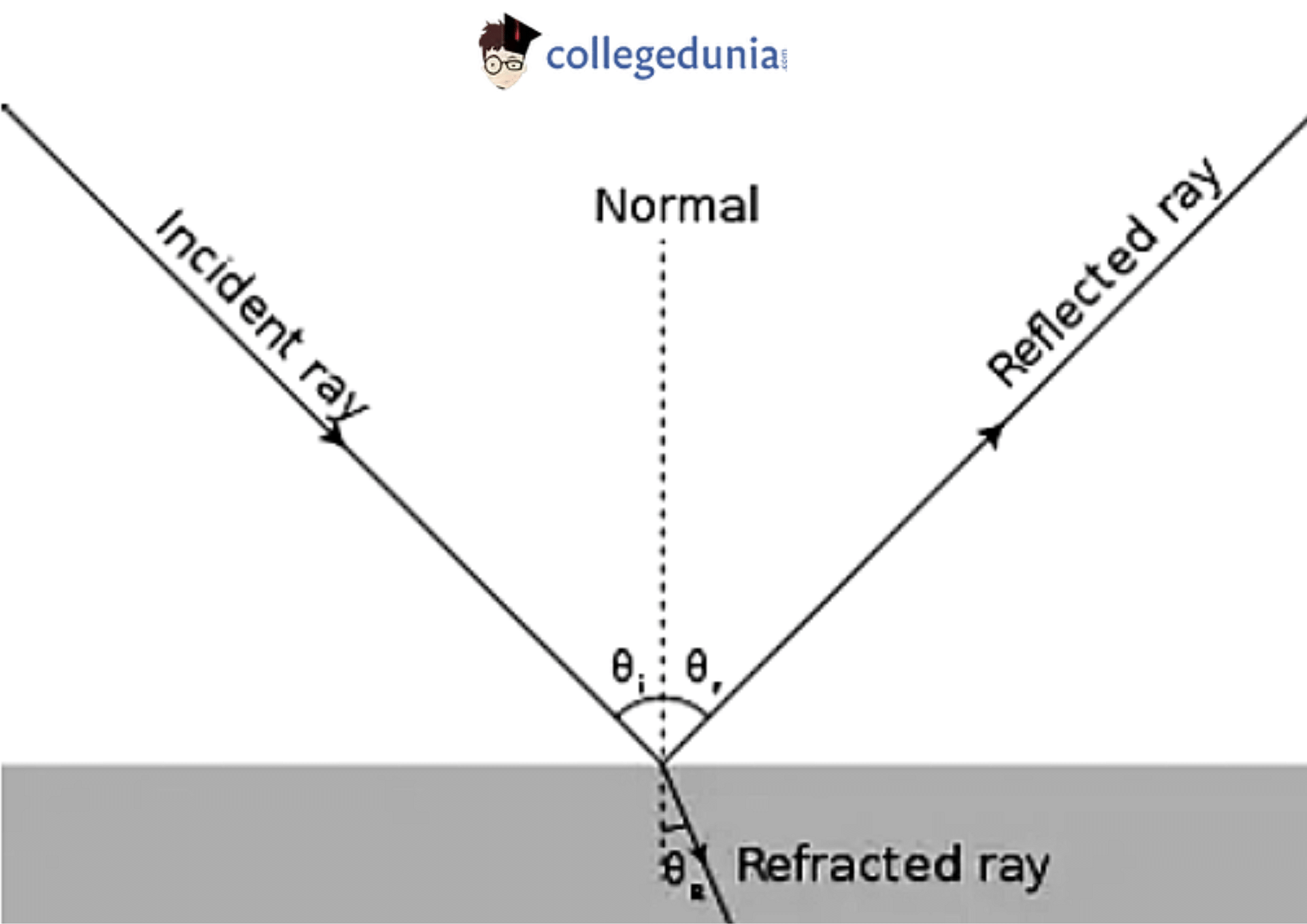
Incident Ray
The incident ray is the light ray that strikes an object. An incident ray can be defined as a ray of light which is seen to strike a surface. The angle that the incident ray forms with normal at the point of incidence is known as the angle of incidence.
Reflected Ray
A reflected ray refers to a ray of light that is reflected off a surface. It can be defined as a ray of light which is thrown back from a non-absorbing surface. The ray of light which is seen to bounce back from a surface is generally called a Reflected ray.
Normal
When a line forms a 90o angle with the line of the mirror at the point where the incident ray collides with the mirror, it is said to be normal to the reflecting surface.
Angle of Incidence
The angle of incidence is the angle that’s formed at the point of incidence between the normal and the incident ray. It is symbolized as θi. The angle of incidence is generally measured from the normal (0°) to the given ray of light.
Angle of Reflection
The angle of reflection is the angle formed by the reflected beam and the normal. It is symbolized as θr. The late of reflection claims that the angle of reflection is equivalent to the angle of incidence, i.e., \(\theta\)r = \(\theta\)i
| Concept Related Topics | ||
|---|---|---|
| Reflection of Light by Spherical Mirrors | Reflection on a Plane Mirror | The Refractive Index |
| Refraction at Spherical Surfaces and By Lenses | Snell’s Law | Concave Lens |
Types of Reflection
The various types of reflection can be shown as:
Regular or Specular Reflection
This form of reflection is produced by flat mirrors with a smooth surface. The image formed is clear and sharp. All the light falling on the surface is reflected equally in a uniform manner.
Irregular or Diffused Reflection
When light reflects in an irregular pattern from a rough surface, it is known as irregular or diffused reflection. This leads to a loss in the quality of the reflection and the brightness.
Mixed Reflection
When a single source of light is reflected multiple numbers of times. This phenomenon is possible until the light’s intensity becomes way too low for us to see.

Differences between Regular and Irregular Reflection
The differences between Regular and Irregular Reflection are tabulated below:
| Regular Reflection | Irregular Reflection |
|---|---|
| Regular Reflection takes place when the reflected rays from a smooth surface become parallel to the parallel incident rays. | Irregular Reflection takes place when the parallel incident rays and the reflected rays are not parallel to one another. |
| It only takes place on smooth surfaces such as a mirror, shiny silver spoon, and more. | It takes place on a rough surface such as wood, door, book, and more. |
| The image, in this case, is formed and can be seen. | It helps to see images. No images, in this case, can be seen. |
Laws of Reflection
[Click Here for Sample Questions]
Law of Reflection can be expressed as:
“When light rays hit a smooth surface, the angle of reflection is said to be equal to the angle of incidence. The incident, reflected and the normal ray to the surface lies on the same plane.”
Law 1: According to the first law of reflection of light, the angle of reflection (r) is always equal to the angle of incidence (i). If the incident ray strikes the plane mirror at a 90° angle, the reflected ray will follow the same path.
Law of Reflection Formula
The formula of Law of Reflection is:
| θi = θr |
Here,
- θi = Angle of incidence
- θr = Angle of reflection
Law 2: The reflected ray is always in the same plane as the incident ray, the normal to the surface at the point of contact of the incident ray.
Angle of Incidence and Angle of Reflection
The angle of incidence and the angle of reflection can be calculated by stretching a normal line perpendicular to the respective reflecting surface.

Angle of Incidence and Reflection
Solved Examples Related to Laws of ReflectionQues. A ray of light has been incident on a plane mirror at angle 30° with the mirror surface. Determine its angle of reflection. [2 marks] Ans. Angle of incidence is calculated between the incident ray and the normal, thus the angle of incidence here is not 60° Therefore, as per the Law of Reflection, \(\therefore\) θi = θr Thus, Angle of Reflection = 60° Ques. A light ray, at an angle 54° hits a reflective plane surface. Thus, Calculate the following: [4 marks]
Ans:
Ques. Define Angle of Reflection. [1 mark] Ans. The angle of reflection (that is, 0r) of a ray can be defined as the angle which is measured from the reflected ray to the normal surface. |
Read More: Difference between Reflection and Refraction
Reflection by Spherical Mirrors
[Click Here for Sample Questions]
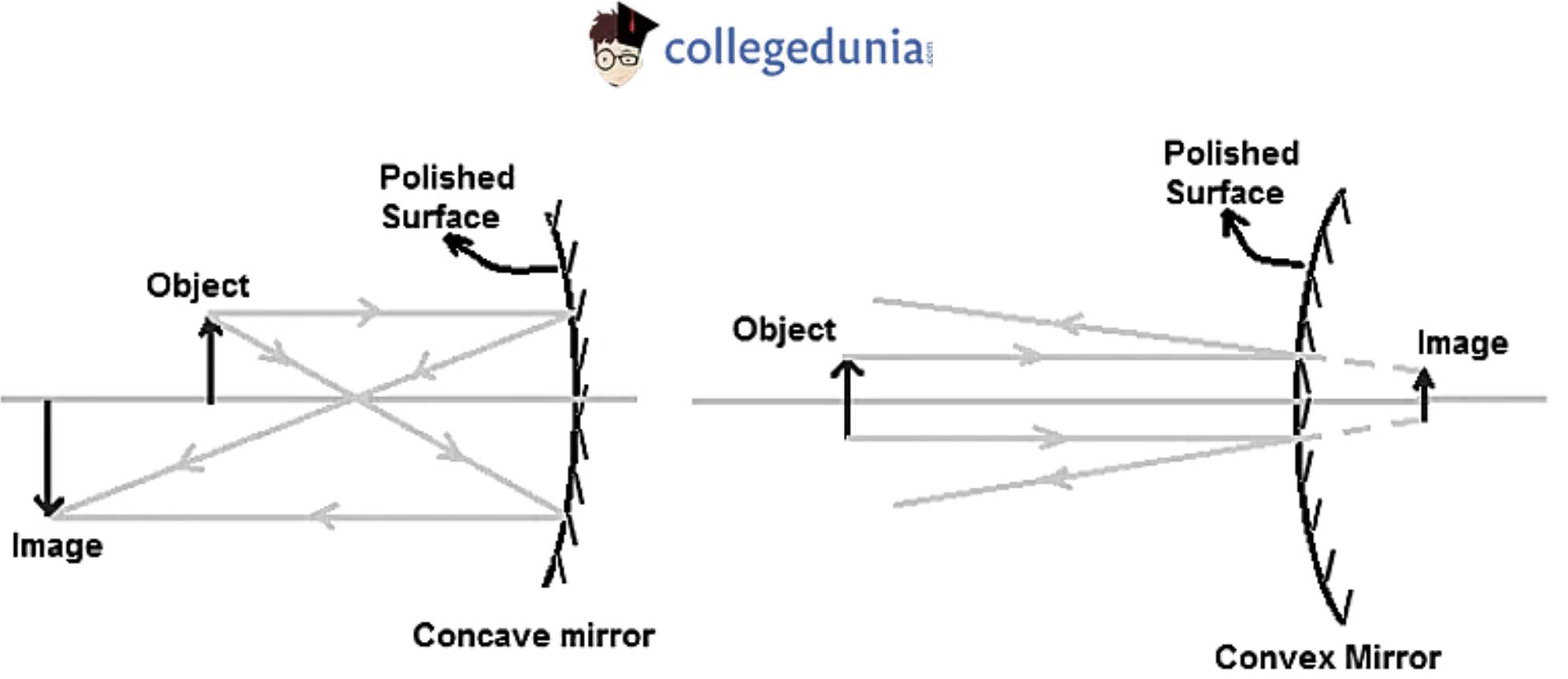
Spherical mirrors come with a shape of a piece which is cut out from a spherical surface. Spherical mirrors are a type of mirror that has a reflecting surface part of a hollow sphere of glass. Spherical mirrors are of two types:
- Concave mirrors
- Convex mirrors
Concave Mirrors
If the object is beyond the focus, concave mirrors produce genuine, inverted pictures. If the object is placed at a distance less than the focal length from the mirror's pole, concave mirrors produce a virtual, erect, expanded image.
Applications of concave mirrors:
Some of the major applications of Concave mirrors are:
- To create powerful parallel beams of light, concave mirrors are employed in torches, searchlights, and vehicle headlights.
- Shaving mirrors with concave surfaces are used to see a larger image of the face.
- Concave mirrors are used by dentists to see larger images of their patient's teeth.
- Solar furnaces use large concave mirrors to focus sunlight and generate heat.
Convex Mirrors
Convex mirrors always produce a virtual, erect, and reduced picture of the item behind them.
Applications of convex mirrors:
Some of the major applications of Convex mirrors are:
- In cars, the convex mirror is used as a side-view mirror to provide a smaller perspective of vehicles approaching from behind.
- They're employed in stores, supermarkets, and any other location where robbers need to be detected.
- Convex mirrors are used to make eyewear lenses.
- Magnifying glasses and telescopes both use convex mirrors.
- Because they can reflect light across a large area, convex mirrors are used to reflect street light.
- To avoid collisions, convex mirrors are placed at street corners.
Read More: Light – Reflection and Refraction
Total Internal Reflection
[Click Here for Sample Questions]
The Total Internal Reflection is the phenomenon where light is reflected back into the denser medium when it crosses from a denser medium to a lighter media at an angle greater than the critical angle required for refraction.
- Optical fibers make use of this phenomenon. With the use of total internal reflection, light pulse sequences are employed to convey data via an optical fiber network.
- To image organs inside the human body, medical tools such as endoscopes use the phenomenon of total internal reflection of light through an optical fiber bundle.

Uses of Laws of ReflectionThere are several uses of laws of reflection. Some include:
|
Previous Year Questions
- A spherical surface of radius of curvature R, separates air … [NEET 1998]
- If in the following figure, height of object is H1=+2.5cm, then height of…? [DUET 2007]
- A lens of large focal length and large aperture is best suited as an objective … [NEET 2021]
- A container is filled with water (μ = 1.33) up to a height of 33.25 cm. A concave mirror is placed…? [JEE 2005]
- A student performed the experiment of determination of focal length of a concave mirror by…? [KEAM 2009]
- A concave mirror is placed on a horizontal table with its axis directed vertically upwards…? [JEE 1998]
- A convex lens ′A′ of focal length 20cm and a concave lens ′B′ of focal length…? [JIPMER 2021]
- Two thin biconvex lenses have focal lengths f1 and f2. A third thin … [KCET 2021]
- A thin convex lens is made of two materials with refractive indices n1 and n2, as shown…? [JEE 2019]
- Colour of light having maximum speed … [KCET 1997]
- The focal length of a spherical mirror made of steel is 150cm. If the temperature of the mirror…? [AP EAPCET 2009]
- A concave lens of glass, refractive index 1.5 has both surfaces of same radius of curvature…? [JEE 1999]
- Two plano-concave lenses (1 and 2) of glass of refractive index 1.5 have radii of curvature…? [BITSAT 2017]
- A convex lens of glass is immersed in water compared to its power in air, its power…? [CBSE 2017]
Things to remember
- Reflection refers to reflecting back on light rays when they strike an object's surface.
- First Law of Reflection: According to the first law of reflection of light, the angle of reflection (r) is always equal to the angle of incidence (i). If the incident ray strikes the plane mirror at a 90o angle, the reflected ray will follow the same path. θi = θr (Where, θi: Angle of incidence θr: Angle of reflection.)
- Second Law of Reflection: The reflected ray is always in the same plane as the incident ray, the normal to the surface at the point of contact of the incident ray.
- Total Internal Reflection is the phenomenon where light is reflected back into the denser medium when it crosses from a denser to a lighter media at an angle greater than the critical angle. They are used in optical fibres.
Read More:
Sample Question
Ques. Explain how multiple images are formed with an example. Justify your answer. (2 marks)
Ans. If you want to view several images of yourself, you'll need to use multiple mirrors at various angles. Numerous reflections are a phenomenon in which you can perceive multiple pictures because the image from one mirror serves as an object for the second mirror. The angle at which the second mirror is positioned determines the number of visible pictures. The number of pictures created can be calculated using the formula below.
Total number of images = (360o/ angle of placement) - 1
If you place a candle between two parallel mirrors that are 40 cm apart, the number of pictures of candles between the mirrors is unlimited. Because the angle is assumed to be 0°, hence there’s an endless number of images.
Ques. Does diffuse reflection type obey the law of reflection? (2 marks)
Ans. It certainly does. We consider several rays during diffused reflection which become unparalleled following reflection.
You can observe the angle of incidence=angle of reflection if you consider a single ray and draw a normal for that ray only. This technique can be repeated for each ray separately.
Ques. State the second law of reflection. (1 mark)
Ans. The reflected ray is always in the same plane as the incident ray, the normal to the surface at the point of contact of the incident ray.
Ques. Do curved mirrors also follow the law of reflection? How? (2 marks)
Ans. Yes. Imagine a very small flat piece of the mirror at each point on the curved mirror that is perpendicular to the surface. Light rays bounce off that flat surface with a reflection angle equal to the incidence angle. The following piece is angled slightly differently, but its angle of reflection is still equal to the angle of incidence with regard to that local tangent.
Ques. When a light ray strikes a reflective plane surface at 56 degrees angle with the surface. Find out:
(1) Angle of incidence
(2) Angle of reflection
(3) Angle made by the surface and the reflected ray.
(4) Angle made by the incident and the reflected rays. (5 marks)
Ans.
- Angle of incidence, i = 90 – 56 = 34o
- Angle of reflection, r = i = 34o (by the law of reflection)
- Angle made by the surface and the reflected ray = 90 – r = 90 – 34 = 56o
- i + r = 34 + 34 = 68o
Ques. What is the second law of reflection? (1 mark)
Ans. The second law of reflection defines that the incident ray, reflected ray, the normal to surface at the point of incidence are all located in the same plane.
Ques. What do you mean by Angle of Incidence? (1 mark)
Ans. The angle of incidence can be defined as the angle which is formed at the point of incidence between the normal and the incident ray. It is denoted as θi. The angle of incidence can be measured from the normal (0°) to the given ray of light.
Ques. What are the uses of Reflection? (3 marks)
Ans. Some of the many uses of reflection are:
- Reflection can be utilised in periscopes, which is an instrument that was typically used to view advancing enemies on the battlefield from a safe position.
- Reflection facilities in medical diagnosis and optical communications.
- Light and Sound are concepts that both follow the law of reflection (being waves).
Read More:



Comments