



Content Curator
Bending a Glass Tube Experiment provides insights into the nature of glass and its inherent qualities. Glass is a versatile material that may be used for both decoration and as a transparent barrier that allows for reasonably safe observation. While many different varieties of glass may be made, we'll be working with the most common and widely used glass, which is extremely bendable when heated. Glass is an amorphous, crystalline substance that requires knowledge of how to bend it properly with the Bunsen burner without obstructing it or shattering it accidentally. The experiment will go as follows.
| Table of Content |
Key Terms: Crystalline Solid, Amorphous Solid, Bunsen Burner, Pippet, Test Tube, Ependroff
Aim
[Click Here for Sample Questions]
To learn, understand, and commit to memorizing the simple process of the bending of a glass tube experiment.
Materials Required
[Click Here for Sample Questions]
- 20-25 cm long Soda-glass tube
- Bunsen Burner
Experiment
[Click Here for Sample Questions]
- Over the bunsen burner, place the heating tubing.
- The tube begins to bend owing to its bulk.
- Make sure the bend and the glass's ends are all in the same plane (coplanar)
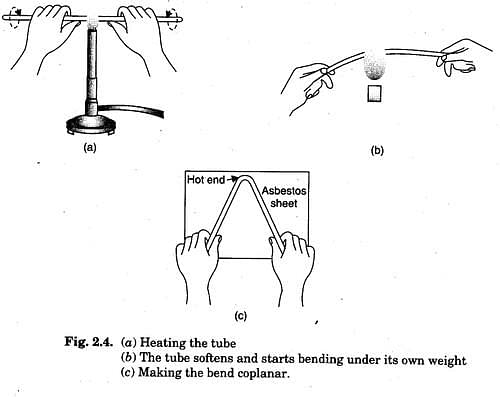
Bending a Glass Tube Experiment
Procedure
[Click Here for Sample Questions]
- Hold the tube horizontally with both hands in the bunsen burner's flame.
- Get to the point where you can bend the glass with a flame.
- While heating, keep turning the glass tube with your thumbs and fingers to ensure that it is evenly heated and softened.
- Choose the direction in which you wish to bend the glass tube.
- Maintain the glass tube in the flame until it turns red hot.
- Apply slight pressure to the softened (red hot) glass tube and bend the glass tube to the desired angle.
- When the proper angle has been achieved and the glass tube has been bent, remove it from the flame.
- Place it on a glazed tile to cool.
- A glass tube may be bent at various angles.
Precautions
[Click Here for Sample Questions]
- Keep fingers at least 4-5 cm away from the Bunsen burner flame and the point of bending of the soda-glass tube when doing the bending of a glass tube experiment.
- The glass tube should be maintained as far away from the face as possible, as well as from the body.
- It's important not to try to bend the glass tube with force before it's red hot and pliable enough to bend; doing so risks breaking the glass and injuring yourself.
Conclusion
[Click Here for Sample Questions]
At room temperature, the glass tube is exceedingly fragile and is known to shatter readily. However, one may deduce that an amorphous crystalline solid, such as glass, has unique qualities that allow it to bend when subjected to tremendous heat. Because of how flexible glass is and how it can be bent to the correct direction if heat is applied properly, the bending of a glass tube experiment can infer that materials like glass have a broad number of applications.
Things to Remember
- Use the apparatus properly and maintain a proper distance with the bunsen burner.
- Amorphous solids are similar to liquids in that they lack an ordered structure or a three-dimensional arrangement of atoms or ions.
- Transparency, heat resistance, pressure and breakage resistance, and chemical resistance are all characteristics of glass.
- Crystalline substances have sharp melting points, well-defined edges, faces, and diffract x-rays.
- Amorphous solids feature uneven or curved surfaces, lack well-resolved x-ray diffraction patterns, and melt at a wide temperature range.
Sample Questions
Ques. Why Can We Not Bend the Glass Before it's Ready? (2 Marks)
Ans. Because glass is a solid, brittle, amorphous crystalline substance, it cannot be twisted without shattering in its natural condition. Glass bends at temperatures well below its melting point (at which time it flows like a liquid), but any attempts to bend it before it has completely softened may result in an incorrect bend or even fracture. Because this procedure employs a fragile soda-glass tube, it's critical to bend the glass gently and with as little force as possible. The red-hot section of the glass will be flexible enough to bend to the appropriate form after it has softened enough.
Ques. What Happens If Red Hot Glass is Placed in Water Instead of a Glazed Tile? (2 Marks)
Ans. It's best to let the glass cool gently on its own once it's been heated to a red-hot temperature. Attempting to speed up the process with water might cause it to shatter and, in rare circumstances, explode. As a result, it is not advised to allow any type of moisture to come into contact with the glass while it is cooling on a glazed tile. Glass expands significantly when heated, therefore cooling it rapidly in this state creates non-uniform contraction at the molecular level, which causes it to shatter.
Ques. What are the Industrial Applications of Bent Glass? (2 Marks)
Ans. While glass blowing is mostly used for decorative purposes, bending glass is an essential component of any enterprise that produces glass vessels and tubes for practical use. Even in the lab, most glassware apparatus, such as distillation tubes and U-shaped tubes, are made by carefully using the bending glass method. Because glass cannot be bent or shaped under normal circumstances, the notion of applying heat is widely used, allowing for the fabrication and manipulation of glass into nearly any form or size.
Ques. What is the Composition of Glass? Can Any Soda Glass Apparatus be Heated and Bent? (3 Marks)
Ans. Traditionally, glass was made up of the following compound
4SiO2, Na2SiO3, CaSiO3
Other types of glass, on the other hand, may not have the same composition. Glasses with various compositions and additions will have unique features that will allow them to be used in other sectors. Even soda-glass that has previously been shaped into an instrument should not be heated and bent again. This is because, after the glass's bonds are fixed into form, warming them in an attempt to reconfigure them is ill-advised and almost always ends in breakage and, in the worst-case scenario, damage.
Ques. Why does the glass tube need to be rotated uniformly while heating? (3 Marks)
Ans. While heating, rotate the glass tube uniformly to ensure that all sides of the tube get an equal amount of heat. When the heat is distributed evenly throughout the tube, it will aid in the tube's shaping. If you try to bend the glass with force without first heating it, it may shatter suddenly.
The heat softens the characteristics of glass, allowing it to bend and assume shape. As a result, if certain portions get more heat than others, the form will be distorted, and there will be a risk of shattered glass.
Ques. What is the temperature that makes a glass break? (2 Marks)
Ans. Refrigeration or a warm temperature does not affect glass. When the temperature rises over 300 degrees Fahrenheit, however, the thermal fluctuation causes the glass to shatter. Because glass is a poor heat conductor, fast temperature fluctuations generate tension and fractures in the glass, resulting in shattering or breaking. When the glass is heated to 500 degrees Fahrenheit, it transforms from a solid to a plastic condition.
Ques. If the glass breaks at a high temperature then what are shatterproof glasses? (3 Marks)
Ans. A glass normally breaks when it reaches a temperature of more than 500 degrees Fahrenheit. The phrase shatterproof glasses has gained popularity as a result of innovations and commercialization. It is a glass that has been subjected to the tempering process, which involves heating the object to a temperature around 600 degrees Celsius and then cooling it rapidly. This procedure creates a regulated increase in tension inside the item.
However, the name is not entirely true because the glass can still shatter after a sudden incident, but the shattering occurs into extremely minute particles that can not do significant injury.
Ques. What are some of the applications of Bent glass? (2 Marks)
Ans. In the industrial sector, bent glass has a wide range of applications. Bend glass is primarily used in the glass manufacturing sectors for the fabrication of glass vessels and tubes, as well as the creation of light and associated goods. It's also employed in the creation of ornaments. And, more particularly, all of the laboratories from the conventional period used bent glass.
Ques. Why does the hot water cause the glass to break? (2 Marks)
Ans. The quick shift in temperature caused by the hot water puts internal stress on the material, not the water itself, which causes the glass to break. Because glass is a poor conductor of heat, the high temperature causes stress and strain. The simple thing to remember is that glass shatters when it reaches a high temperature.
Also read:



Comments