



Content Curator
Glycerin is also known as 1,2,3 – Propanetriol, glycerine or glycerol. Glycerin is the common name for glycerol. It is an organic alcohol. It contains a mixture of sugar and alcohol. Glycerin has wide end applications in almost every industry. Usually, alcohols do not mix in water but float in it whereas Glycerin is miscible in water. It is known for its antimicrobial and antiviral properties. Glycerin has a chemical formula of C3H8O3.
Read More: Concepts in Chemistry
| Table of Content |
Key Terms: Glycerin, moisture, soap production, specific gravity, thermal conductivity, hydrogen bonds, alcohols, ethers, fats, organic compounds, lipids, viscosity
Glycerin
[Click Here for Sample Questions]
Glycerin is a by-product of soap production. It is humectant meaning it helps skin and hair retain moisture. It is ideal for water-based formulations as it readily dissolves in water. It is also used as a preservative for preserving delicate items. Glycerin is a simple polyol – having simple hydroxyl groups in its chemical structure. It is a sugar alcohol. It has a high viscosity and has greater resistance and opposition to flow against the surface. It is odourless and colourless. It is sweet to taste and is non-toxic.
IUPAC name – Propane – 1,2,3 - triol
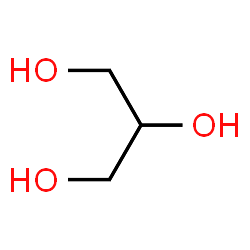
Glycerine
Glycerin can be obtained from synthetic, animal and vegetable sources. The vegetable glycerin is indirectly obtained from palm trees and soybeans. They are further used in industrial processes. Glycerin can be obtained from animal tallow (animal fat). The petroleum-based oils are derived from synthetic sources. Propylene can also be used to produce glycerine synthetically. It is insoluble in ether, chloroform, and in volatile oils.
Read more:
Structure of Glycerin
[Click Here for Sample Questions]
Chemically Glycerin is written as C3H8O3. The three carbon atoms are attached to three hydroxyl molecules. The rest of the carbon valency is occupied by hydrogen. Glycerin is known for its intermolecular hydrogen bonds.
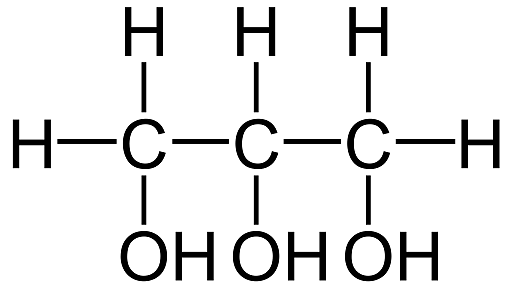
Glycerin Structure
Read More:
Properties of Glycerin
[Click Here for Sample Questions]
Some of the important properties of Glycerin are tabulated below.
| Chemical formula | C3H8O3 |
| Molecular weight | 92.09 g/mol |
| Density | 1.261 g/cm3 |
| Boiling Point | 2900 C |
| Melting Point | 18.20 C |
| Thermal Conductivity | 0.2860 W/m.K |
| Specific Heat | 2.386 kJ/kg.K |
| CAS Numbers | 56 – 81 – 5 |
| Composition | 99.7% Glycerol and water |
It is hygroscopic: Glycerin has great affinity with water, and its hygroscopic nature is quite helpful in retaining moisture in the skin/hair.
It is emollient: Glycerin not only attracts water but also holds all the moisture by forming a protective layer over our skin. This property helps glycerin to be widely used in the beauty industry.
Temperature: Since its freezing temperature is precisely 18.170 C, glycerin is in liquid state at normal room temperature. This makes it easy to store it as it does not require any special device for storage. It is rare to find glycerine in its crystallized state.
Viscosity: Glycerin is highly viscous, meaning the liquid is thick. At room temperature, it is 103 times thicker than water. This causes it to supercool easily. The highly branched intermolecular hydrogen bonds of glycerin also enhance its supercooling ability.
Thermal Conductivity: Thermal conductivity is a transport property characteristic of each material, which indicates the rate at which a given material can transport energy under certain conditions of geometry and temperature. Low temperatures decrease thermal conductivity. The greater amount of glycerin in the solution of glycerin + water leads to a decrease in thermal activity.
Hydrogen Bonding: Glycerin is full of hydrogen bonding. Under increased pressure, one can observe that the number of hydrogen bonds has increased making glycerin denser leading to crystallization.
Lubricant: Glycerin has the natural ability to be highly viscous and to remain fluid at low temperatures. This directly enhances its lubricant property without any need for modification in its properties.
Read More:
Uses of Glycerin
[Click Here for Sample Questions]
- Glycerin is used as a sweetener in food, as a sugar substitute, it adds on to calories entering our body.
- It is used to create and preserve botanical extracts. Eg – rosemary, lavender extract, etc.
- Used in pharmaceuticals and is a key ingredient in e-cigarettes.
- Used as a chemical intermediary to create other chemicals.
- Many of our daily personal care products as well as cosmetic products contain glycerin. Eg – hand sanitizers, shea body butters, body scrubs, face masks, itch relief serum, nail polish, lip balms, etc.

Uses of Glycerin
- Used in the paper and printing industry.
- It promotes the restoration of the skin’s pH level, reduces scarring.
- It is a quick solution for mouth ulcers or painful mucoceles
- Used in nail hardeners
- Used as a thickening agent in liqueurs.
- Used in the treatment of increased eye pressure.
- Used in toothpaste production
- Used in explosives, eg – dynamite
- Used in wound-care materials, to treat burns (except third-degree burns), due to its antiviral and antimicrobial properties.
Read more:
Things to Remember
[Click Here for Sample Questions]
- Glycerin is also known as 1,2,3 – Propanetriol, glycerine or glycerol.
- Glycerin is an organic alcohol.
- Glycerin is a byproduct of the production of soap.
- In the early 1920s, glycerin was widely used as an antifreeze for car engines.
- Glycerin and other glycols can be considered as fairly weak preservatives as they have the property to render some organic molecules inert.
- Glycerin does not provide broad-spectrum coverage against mold, bacteria, fungi, etc.
- Glycerin is also naturally produced in the body.
Read More:
Sample Questions
Ques. What happens when you apply Glycerin on dry skin? [2 marks]
Ans. Dry skin lacks moisture. Glycerin is an excellent ‘moisture-locker’ due to its hygroscopic and emollient nature. It gets absorbed into the skin and stops water from evaporating from your skin. It forms a protective layer around your skin giving it a smooth texture. The moisture now present in your skin keeps it soft and hydrated and thus healthy. Regular use of glycerin promotes the growth of new skin cells and helps in getting rid of dead skin cells.
Ques. What are the side effects of using glycerin? [2 marks]
Ans. If ingested beyond a particular amount as per age limit, it may cause
- Cramping
- Rectal pain
- Excessive bowel activity
- Glycerin allergy
- Rectal irritation
Vegetable glycerin may cause
- Dizziness
- Vomiting
- Headaches
- Gas and diarrhea
- Excessive thirst
- Nausea
Ques. What are the types of Glycerin and where are they found? [2 marks]
Ans. Glycerin can be obtained from three sources - synthetic, animal and vegetable sources. The vegetable glycerin is indirectly obtained from palm trees and soybeans. Glycerin can be obtained from animal tallow (animal fat). Petroleum-based oils are derived from synthetic sources. Propylene can also be used to produce glycerine synthetically.
Ques. Why is glycerin used in the printing and paper industry? [2 marks]
Ans. Due to its viscous nature and ability to be neutral, it is used as emulsifiers/ plasticizers in watercolour, glues, printing inks, cement, gouache paints, etc. It is used in the manufacturing of paper as it helps the paper to retain its moisture thus increasing its softening property. It effectively avoids shrinkage. It doesn’t interrupt the paper’s biodegradable ability. Its non-toxic ability makes it more apt for usage in the paper industry as papers are also used to pack foods, sanitary products, etc.
Ques. Enlist the differences between glycerol and fatty acids [2 marks]
Ans.
| Glycerol | Fatty Acids |
|---|---|
| Glycerol is a viscous, colourless substance and is a component of lipid | Fatty acids are a component of carboxylic acid |
| Glycerol’s variants are yet not found | Fatty acids have two variants – saturated fats and unsaturated fats |
| It contains three carbon molecules | It may contain 10-30 carbon molecules |
| It contains three hydroxyl groups | It contains a carboxylic group |
Ques. List out the everyday uses of Glycerin [3 marks]
Ans. Glycerin is used in -
- Medicines/drugs: Anaesthetics, capsules, cough remedies, gargles, suppositories, etc
- Food: cakes, soft drinks, cheese, candies, dry food, meat, etc
- Cosmetics: lipstick, lip balms, toothpaste, lotions, moisturizers, deodorants, mascara, etc
- Tobaccos
- Automotive enamels
- Paper production
- House paints
- Rubber production
- Textiles
Ques. What is the alcohol family in organic compounds? [2 marks]
Ans. Alcohol compounds are those organic compounds which have one or more hydroxyl group (-OH) attached to the carbon atom of an alkyl group that is a hydrocarbon chain. They are organic derivatives of water H2O. An alcohol group is formed when one of the hydrogen atoms is replaced by a bond shared by a carbon in a hydrocarbon chain. The hydrocarbon chain is represented by R. Thus the alcohol family is represented by R – OH.
Ques. Describe the difference between glycerol and glycerin [2 marks]
Ans.
| Glycerol | Glycerin |
|---|---|
| It is in its pure form. | It is 95% of glycerol while the rest of it is water. |
| It is for internal use, consumption. | It is for external use, applying |
| This is used in the medicine industry | This is used in the cosmetic/beauty industry |
| Its side effects include headache, nausea, etc | Its side effects include rashes, skin redness, etc |
Ques. Explain Glycerol uptake and utilization in human body [3 marks]
Ans. The major glycerol uptake in the human body is carried out by the liver. It is located where fatty acid reesterification occurs. The human body, in order to store long-chain saturated fatty acids, palmitic acid, oleic acid, polyunsaturated fatty acid, linoleic acid, etc uses glycerol. The body breaks the fatty acid down to attach it to the glycerol which is naturally produced in the body. The body performs a dehydration process that is the removal of H2O molecules to give a triglyceride. The body removes hydrogen from the OH group of the glycerol and removes an OH group from the fatty acid and thus attaches them to give a triglyceride. Triglycerides are stored as fat deposition.
Ques. Distinguish between lipids and fats [2 marks]
Ans.
| Lipids | Fats |
|---|---|
| They serve as a structural component and an energy molecule in the body | They serve as an energy source |
| They have three types – triglycerides, steroids, and phospholipids | They have two types – saturated and trans fats |
| They form a diverse group of molecules found in the body | They are a type of lipid |
| Some lipids are liquids while others are solid | Fats are solid substances. |
Read more:



Comments