



Content Curator
Heat rate is the total amount of energy that is essential to produce one kilowatt-hour (kWh) of electricity using a power plant. In other words, it can also be defined as the rate of input energy that is required in order to generate a unit of power.
- The unit of heat rate is BTU/KWh.
- The unit for energy input is BTU (British thermal units) and the output electrical energy is kilowatt-hour KWh.
- It's calculated by multiplying the energy output of the fuel used to generate electricity by the quantity of electrical energy produced.
- Heat rate is a common terminology that is used in power stations to indicate the effective efficiency of the power plants.
Check also: Heat Formula
| Table of Contents |
Click Here for Class 12 Physics NCERT Solutions
What is Heat Rate Formula?
[Click Here for Sample Questions]
Heat rate is the rate of input which is vital for generating unit power. Heat rates are commonly expressed in BTU per net KWh generated. The net generation of the energy is fundamentally the amount of electricity which is used to power the transmission line which is ultimately connected to the power plant.

Heat Rate Graph and Fuel-Cost Graph
- The heat rate can additionally be described as the ratio of heat inputs to electrical output.
- It can also be concluded that the lower the heat rate, the higher will be the efficiency of the power plant.
- Around 3,412 Btu/hr equals 1 kW.
- The thermodynamic efficiency of a power plant can be easily calculated by dividing 3,412 by the heat rate.
- For instance, a coal power plant with a heat rate of 10,000 Btu/kWh has a thermal efficiency of 3,412/10,000, or 0.3412 (34.12%).
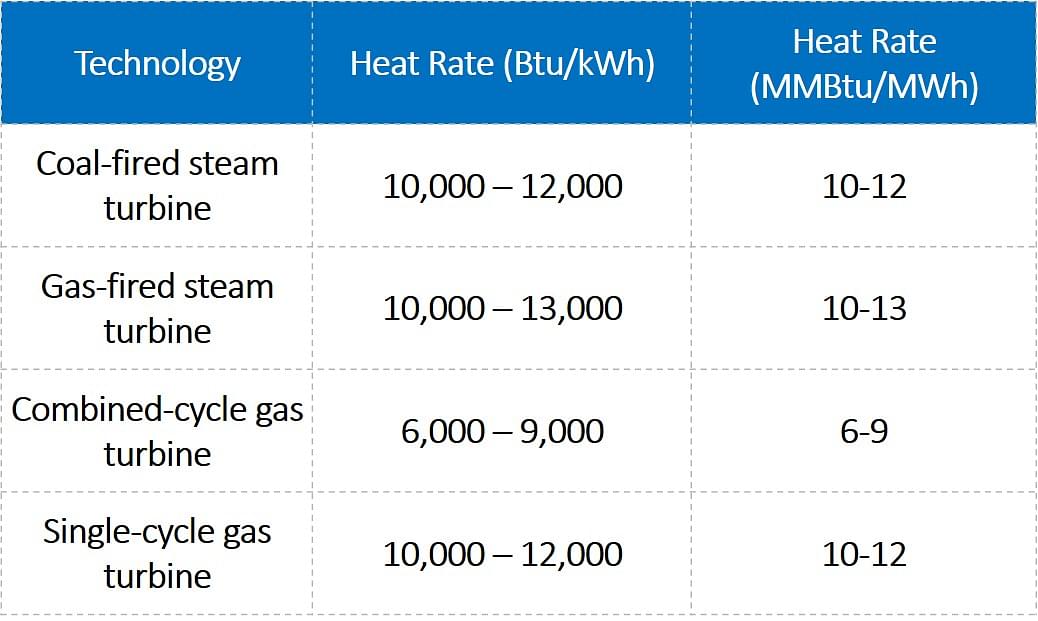
Heat rates of different power plants
- In any thermal generating system, both incoming and outgoing energy, generally exist in the same value or unit.
- Heat amount is directly proportional to the input chemical energy (which is later converted to thermal energy) divided by the released electrical energy.
The formula for heat rate is:
| Rh = Ws × c × ΔT |
Where,
Rh is heat rate in btu /hr,
Ws is steam flow in lb/hr,
c = specific heat capacity in btu/lb ?F,
ΔT is the temperature difference in ?F

Also Read:
What is Total Heat Input?
[Click Here for Sample Questions]
The process of burning fuels such as coal, oil, gas, biomass, etc results in the conversion of the electrical energy contained in these fuels into heat energy.
- This process takes place in boilers in thermal power plants and is referred to as oxidation.
- The heat energy generated is further used to produce a high-temperature stream which is subsequently fed into the turbines.

Conversion of coal to electrical energy
- Here, in the turbines, the heat energy is initially converted into kinetic energy, then mechanical energy and finally into electrical energy in the generator.
Thus,
| Total heat input in the power plant = heat input/power generation |
Also Read:
Things to Remember
[Click Here for Sample Questions]
- The formula for heat rate is Rh = Ws × c × ΔT.
- Heat rate is commonly used in power plants in order to indicate their efficiencies. Hence, the higher the heat rate, the lower the efficiency.
- The unit of the incoming, as well as the outgoing energy, is the same.
- The total heat input in the power plant for releasing electrical energy can also be referred to as electrical power in KwH heat rate.
Previously Asked Questions
- Mass numbers of the elements A,B,C and D … [KCET 2012]
- A radioactive substance contains 10,000 nuclei … [KCET 2007]
- A radioactive substance emits 100 beta particles … [KCET 2013]
- A radioactive sample at any instant has its disintegration rate … [KEAM]
- Two nuclei have their mass numbers in the ratio of 1:3. The ratio of their nuclear densities would be...[KEAM 2008]
- When the number of nucleons in a nuclues increases the binding energy per nucleons?...[NEET 2013]
- For a radioactive material, half-life is 10 minutes. If initially there are 600 number of nuclei ...[NEET 2018]
- A nucleus of uranium decays at rest into nuclei of thorium and helium. Then...[NEET 2015]
- When a uranium isotope … [NEET 2020]
- A and B are the two radioactive elements … [KCET 2013]
- If r1 and r2 are the radii of the atomic nuclei of mass numbers … [KCET 2006]
Sample Questions
Ques 1. Calculate the heat rate if steam enters a turbine at 400oF at atmospheric pressure and leaves the turbine at 200oF. Steam at 200 lb flows through the turbine each hour during normal operation. [3 marks]
Ans. Given parameters are as follows,
Ws = 200 lbs/hr
c = 0.48
Tin = 400oF
Tout = 200oF
ΔT = 400 – 200
ΔT = 200oF
Using the heat rate formula,
Rh = Ws × c ×ΔT
Rh = 200 × 0.48 × 200
Thus, Rh = 19200 btu/hr
Ques 2. If steam enters a turbine at 100oF at atmospheric pressure and leaves the turbine at 50oF. What will be heat rate if the steam at 150 lb flows through the turbine each hour during its normal operation. [3 marks]
Ans. Given parameters are as follows,
Ws = 150 lbs/hr
c = 0.48
Tin = 100oF
Tout = 50oF
ΔT = 100 – 50
ΔT = 50oF
Using the heat formula,
Rh = Ws × c ×ΔT
Rh = 150 × 0.48 × 50
Thus, Rh = 3600 btu/hr
Ques 3.If steam enters a turbine at 600oF at atmospheric pressure and leaves the turbine at 550oF. What will be heat rate if the steam at 700 lb flows through the turbine each hour during its normal operation. [3 marks]
Ans. Given parameters are as follows,
Ws = 700 lbs/hr
c = 0.48
Tin = 600oF
Tout = 550oF
ΔT = 600 – 550
ΔT = 50oF
Using the heat rate formula,
Rh = Ws × c ×ΔT
Rh = 700 × 0.48 × 50
Thus, Rh = 16800 btu/hr
Ques 4.The heat rate is calculated to be 16800 btu/hr. If the steam enters the turbine at 800oF at atmospheric pressure and leaves the turbine at 600oF, what will be the flow of the steam through the turbine each hour during its normal operation? [3 marks]
Ans. Given parameters are as follows,
Ws = ?
c = 0.48
Tin = 800oF
Tout = 600oF
ΔT = 600 – 550
ΔT = 200oF
Using the heat rate formula,
Rh = Ws × c ×ΔT
16800 = Ws × 0.48 × 200
Thus, Ws = 175 lb
Ques 5. The heat rate is calculated to be 36800 btu/hr. If the steam enters the turbine at 700oF at atmospheric pressure and leaves the turbine at 600oF, what will be the flow of the steam through the turbine each hour during its normal operation? [3 marks]
Ans. Given parameters are as follows,
Ws = ?
c = 0.48
Tin = 700oF
Tout = 600oF
ΔT = 700 – 600
ΔT = 100oF
Using the heat rate formula,
Rh = Ws × c ×ΔT
36800 = Ws × 0.48 × 100
Thus, Ws = 766.67 lb
Ques 6.The heat rate is calculated to be 27800 btu/hr. If the steam enters the turbine at 500oF at atmospheric pressure and leaves the turbine at 300oF, what will be the flow of the steam through the turbine each hour during its normal operation? [3 marks]
Ans. Given parameters are as follows,
Ws = ?
c = 0.48
Tin = 500oF
Tout = 300oF
ΔT = 500 – 300
ΔT = 200oF
Using the heat rate formula,
Rh = Ws × c ×ΔT
27800 = Ws × 0.48 × 200
Thus, Ws = 289.58 lb
Ques 7. If steam enters a turbine at 900oF at atmospheric pressure and leaves the turbine at 400oF. What will be the heat rate if the steam at 800 lb flows through the turbine each hour during its normal operation. [3 marks]
Ans. Given parameters are as follows,
Ws = 800
c = 0.48
Tin = 900oF
Tout = 400oF
ΔT = 900 – 400
ΔT = 500oF
Using the heat rate formula,
Rh = Ws × c ×ΔT
Rh = 800 × 0.48 × 500
Thus, Rh = 192000 btu/hr
Ques 8. The steam enters a turbine at 500oF at atmospheric pressure and leaves the turbine at 410oF. What will be heat rate if the steam at 850 lb flows through the turbine each hour during its normal course of operation. [3 marks]
Ans. Given parameters are as follows,
Ws = 850
c = 0.48
Tin = 500oF
Tout = 410oF
ΔT = 500 – 410
ΔT = 90oF
Using the heat rate formula,
Rh = Ws × c ×ΔT
Rh = 850 × 0.48 × 90
Thus, Rh = 36720 btu/hr
Ques 9. What is the total heat rate? [2 marks]
Ans. The heat rate is the total amount of energy required to produce one kilowatt-hour (kWh) of electricity by an electric generator or power plant. It is the input rate that is required for generating unit power. The heat rate can also be defined as the ratio of thermal inputs to electrical output.
Ques 10. An electric heater supplies heat to a system at a rate of 100W. If the system performs work at a rate of 75 joules per second. Find the rate at which the internal energy increases. [2 marks]
Ans. By the law of conservation of energy,
Total energy= Work done + Internal Energy
100= 75 + U = 25 J/s
Hence, Internal energy is increasing at the rate of 25 W
Do Check Out:



Comments