



Content Writer
Henderson-Hasselbalch Equation is a chemical equation that involves the calculation of the pH of a solution. It helps in establishing a relationship between the pH of acids in aqueous solutions and their pKa (acid dissociation constant). Knowing the pH of a solution is very important for many chemical reactions as well as for biological systems.
- The Henderson-Hasselbalch equation gives the approximate pH value of a buffer solution.
- It was discovered by Lawrence Joseph Henderson in 1908.
- The process can be used to determine the pH value of the buffer solution.
- A buffer solution is a concentrated mixture of weak acid and conjugate base and vice versa.
- To calculate the buffer solution value, the value of concentrated acid and conjugate base must be known.
- The second factor used in Henderson-Hasselbalch is the ratio of salt and required acid or base.
Read More: Hydrolysis
| Table of Content |
Key Terms: Henderson-Hasselbalch Equation, pH, Buffer Solution, Acid, Base, Aqueous Solutions, Dissociation Constant, Concentration
Henderson-Hasselbalch Equation
[Click Here for Sample Questions]
In 1908, Lawrence Henderson derived an equation to calculate the pH of a solution. The solution resists changing its pH value on dilution or adding a small volume of acid or alkali.
- The equation was later re-expressed in logarithmic terms by Karl Albert Hasselbalch in 1917.
- The resulting equation was named the Henderson-Hasselbalch Equation and is written as:
pH = pKa + log10 ([A–]/[HA])
- Where, pKa represents the acid dissociation constant,
- [A–] represents the molar concentration of the conjugate base
- HA] represents the molar concentration of the weak acid.
The equation can also be written as-

Read More: Calculating Equilibrium Concentrations
Formula for Henderson-Hasselbalch Equation
[Click Here for Sample Questions]
The Henderson-Hasselbalch equation shows the approximate pH value of a Buffer solution. This equation represents the relationship between the pH or pOH of an aqueous solution and the acid dissociation constant and the ratio of the concentrations of the dissociated chemical species.
- Henderson-Hasselbalch Equation can only be used if the acid dissociation constant is known.
Henderson-Hasselbalch Equation formula is written as follows:
pH=pKa+log10([A−]/[HA])
- Where, pKa represents the acid dissociation constant,
- [A–] represents the molar concentration of the conjugate base
- HA] represents the molar concentration of the weak acid.
Read More: Ionic strength formula
Example of Henderson-Hasselbalch EquationWe can understand the Henderson-Hasselbalch Equation with the help of a real-life situation. Suppose Ravi is a physically fit guy with no major health issues. What do you think will be the pH of a blood sample taken from Ravi's body?
Read More: Classification of Organic Compounds |
Derivation of Henderson-Hasselbalch Equation
[Click Here for Sample Questions]
The ionization constants of strong acids and strong bases can be calculated easily with the direct formula. But it is difficult to find the ionization constants of the weak acids and bases with the same methods as the extent of ionization of these acids and bases are very low. So, in such a situation, Henderson-Hasselbalch Equation is very helpful.
- There are two ways to derive Henderson-Hasselbalch Equation.
- The first derivation of the Henderson-Hasselbalch Equation is for base and the second derivation is for acid.
There are three main assumptions that we have to make before starting the derivation:
- −1 < log ([A−]/[HA]) < 1
- The self-ionization energy of water can be ignored.
- The acid used is monobasic.
Read More: Haloform Mechanism Reaction
Derivation 1
For the derivation of Henderson Hasselbach Equation for acid, take an example of ionization of weak acid HA:
- In general, the equilibrium shown by a weak acid HA is:
HA + H2O ↔ H+ + A-
- The dissociation constant of the reaction is
Ka = [H+] [A−] / [HA]
- Taking the negative logarithm on both sides,
-log Ka = - log[H+] [A−] / [HA]
-log Ka = - log [ H+] - log [A−] / [HA]
- We know that, -log [ H+]= pH and -log Ka = pKa, substituting these in Equation
- We get the following equation,
pKa = pH -log [A−] / [HA]
- After rearranging the equation, we get,
pH = pKa + log [A−] / [HA]
- This is the Henderson Hasselbalch equation for acid.
- Now, if [A−] = [HA]
- We get log [A−] / [HA] = 0
- Therefore, we get pH = pKa, which means that both the species are the same and the acid will be half dissociated.
Read More: Ionization Energy Formula
Derivation 2
For the derivation of Henderson Hasselbalch Equation, take an example of ionization of a base:
B + H2O ↔ OH+ + HB-
- The first step is to use the formula for acid dissociation constant, Ka
Kb = [BH+] [OH−] / [B]
- Taking negative logs on both sides,
-log Kb = −log [BH+] [OH−] / [B]
-log Kb= -log [OH-] - log [BH+] / [B]
- We know that - log [ OH-] = pOH and -log Kb= pKb
- We get the following equation,
pKb= pOH -log [BH+] / [B]
- After rearranging the equation, we get,
pOH = pKb+ log [BH+] / [B]
- This is the Henderson Hasselbalch equation for base.
Read More:
Applications of Henderson Hasselbalch Equation
[Click Here for Sample Questions]
The applications of the Henderson-Hasselbalch Equation are as follows:
- Henderson Hasselbalch Equation provides the formula for pH value in terms of acidity.
- To calculate the pH of the buffer solution made by mixing salt and weak acid/base.
- It is used to calculate the pKa value.
- Henderson Hasselbalch Equation prepares buffer solution of needed pH.
- It is majorly used to calculate the isoelectric point of proteins (the position at which a protein can neither accept nor yield protons).
Read More: Hydrolysis
Limitations of the Henderson-Hasselbalch Equation
[Click Here for Sample Questions]
The limitations of the Henderson-Hasselbalch Equation are as follows:
- The Henderson-Hasselbalch equation doesn’t give accurate values for the strong acids and strong bases.
- It fails to offer accurate pH values for extremely dilute buffer solutions.
Read More: Classification of Oxides
Things to Remember
- Henderson-Hasselbalch Equation is a mathematical expression that is used to calculate the pH of buffer solutions.
- When half of the acid undergoes dissociation, the value of [A]/[HA] changes to 1.
- It represents the pKa of the acid, which is the same as the pH of the solution at this point.
- The formula for Henderson-Hasselbalch Equation is pH = pKa + log10(1) = pKa).
- For every unit change in the pH to pKa ratio, a tenfold change occurs in the ratio of the associated acid to the dissociated acid.
- For example, when the pKa value of the acid is 7 and the pH value of the solution is 6, the value of [A–]/[HA] is 0.1.
- When the pH value of the solution becomes 5, the value of [A–]/[HA] becomes 0.01.
- The value of [A–]/[HA] is dependent on the value of the pH and pKa.
Read More:
Sample Questions
Ques: Give two characteristics of a buffer solution. (2 Marks)
Ans: Two basic characteristics of a buffer solution are:
- Its pH does not change with the addition of a small amount of acid or base.
- Its pH does not change on dilution or standing.
Ques: (a)How does dilution with water affect the pH of a buffer solution?
(b) What is the pH of our blood? Why does it not change in spite of the variety of foods and Spices we eat? (2 Marks)
Ans: (a) Dilution with water of a buffer solution has no effect on the pH of a buffer solution.
(b) The pH of our blood is about 7.4. It remains constant because blood is a buffer.
Ques: Calculate the pH of a buffer solution containing 0.1 moles of acetic acid and 0.15 mole of sodium acetate. The ionization constant for acetic acid is 1.75 × 10⁻⁵. (2 Marks)
Ans: According to Henderson Hasselbalch equation-
pH = pKa + log [Salt] / [Acid]
pH = -log 1.75 x 10⁻⁵ + log 0.15/0.10
pH = -log 1.75 x 10⁻⁵ + log 1.5
pH = 4.9
Ques: A solution is found to contain 0.63 g of nitric acid in 100 mL of the solution. What is the pH of the solution. (2 Marks)
Ans: HNO3 → H+ + NO3 completely
∴ [HNO3] = [H+] as nitric acid is a strong acid.
Cone, of HNO3 = 0.63 g per 100 mL
Strength L-1 = 6.3
[HNO3] = 6.3/63 = 0.1 = 10-1 M
∴ [H+] = 10-1 M
∴ pH = – log 10-1 = 1.
Ques: Why does Buffer Solution Resists Change in pH when small volumes of strong acids or bases are added? (2 Marks)
Ans: Buffer solution resists changes in pH when a small number of strong acids or bases are added because when a strong base is added, the acid available in the buffer solution neutralizes the hydroxide ions (OH-). And When a strong acid is added, the base available in the buffer solution neutralizes the hydronium ions (H3O+).
Ques: What are Acidic Buffers? (2 Marks)
Ans: Acidic Buffer Solutions are used to maintain acidic conditions. It has acidic pH and is made by mixing a weak acid and its salt with a strong base. The pH of these solutions is under seven, these solutions consist of a weak acid and a salt of a weak acid. A mixture of sodium acetate and acetic acid is an example of an Acidic Buffer that has pH value of 4.75.
Ques: What are Alkaline buffers? (2 Marks)
Ans: Alkaline buffer solutions are used to maintain basic environments. It has a basic pH and is made by mixing a weak base and its salt with strong acid. The pH of these solutions is above seven. They contain a weak base and a salt of the weak base. A mixture of ammonium hydroxide and ammonium chloride is an example of such a type of reaction which has a pH value of 9.25.
Ques: How much sodium formate (HCOONa, 68.0069 g/mol) will be needed to add to 400mL of 1.00 M formic acid for a pH 3.500 buffer. Ka = 1.77 x 10⁻⁴ . (3 Marks)
Ans: We know that,
pH = pKa + log [base/acid]
3.500 = 3.752 + log (x / 1) (1 is from the 1.00 M formic acid)
log x = −0.252
x = 0.560 M (molarity of the formate required)
MV = g/molar mass
(0.560 mol/L) (0.400 L) = x / 68.0069 g/mol
So, x = 15.2 g
Ques: What is the pH when 25.0 mL of 0.200 M of CH3COOH has been titrated with 35.0 mL of 0.100 M NaOH? (4 Marks)
Ans: Let’s find the moles of acetic acid and NaOH before mixing:
CH3COOH: (0.200 mol/L) (0.0250 L) = 0.00500 mol
NaOH: (0.100 mol/L) (0.0350 L) = 0.0035 mol
Now we find the moles of acetic acid and sodium acetate after mixing:
CH3COOH: 0.00500 mol − 0.00350 mol = 0.00150 mol
CH3COONa: 0.0035 mol
Using the Henderson-Hasselbalch Equation:
pH = 4.752 + log [(0.00350 mol/0.060 L) / (0.0015 mol/0.060 L)]
pH = 4.752 + log 2.333
pH = 4.752 + 0.368 = 5.120
Ques: The ionization constant of phenol is 1.0 x 10⁻¹⁰. What is the concentration of phenolate ion in 0.05 M solution of phenol? What will be its degree of ionization if the solution is also 0.01 M in sodium phenolate? (4 Marks)
Ans:
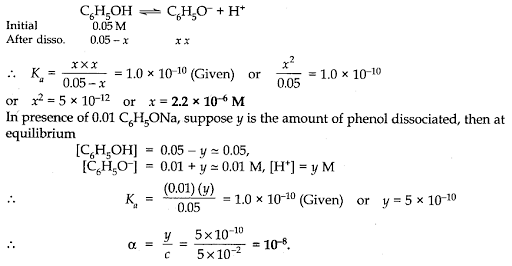
Concentration of Phenolate Ion
Ques: Calculate the pH of a buffer solution containing 0.1 moles of acetic acid and 0.1 mole of sodium acetate. The ionization constant for acetic acid is 1.75 × 10⁻⁵. (2 Marks)
Ans: According to Henderson Hasselbalch equation-
pH = pKa + log [Salt] / [Acid]
pH = -log 1.75 x 10⁻⁵ + log 0.1/0.1
pH = -log 1.75 x 10⁻⁵ + log 1
pH = 2.4
Ques: If [CH3COOH] is equal to the 1.0 mole dm-3 and [CH3COONa] is 0.2 mole dm-3 then find the pH of the buffer solution. (2 Marks)
Ans: pH = 4.74 + log 0.2/1
= 4.74 + log 2/10
= 4.74 + log 0.5
pH = 4.439
Ques: Give a chemical equation for ammonia as weak acid and conjugate base. (2 marks)
Ans: The chemical equation for ammonia where ammonium is weak acid and ammonia is the conjugate base is as follows.

Ques: A buffer solution is made from 0.2M CH3COOH and 0.6M CH3COO–. If the acid dissociation constant of CH3COOH is 1.8*10-5, what is the pH of the buffer solution. (3 marks)
Ans: As per the Henderson-Hasselbalch equation, pH = pKa + log([CH3COO–]/[CH3COOH])
Here, Ka = 1.8*10-5 ⇒ pKa= -log(1.8*10-5) = 4.7 (approx.).
Substituting the values, we get:
pH = 4.7 + log(0.6M /0.2M) = 4.7 + log(3) = 4.7 + 0.477 = 4.477
Therefore, the pH of the solution is 4.477.
Ques: A buffer solution is made from 0.2 M CH3COOH and 0.4 M CH3COO–. If the acid dissociation constant of CH3COOH is 1.8*10-5, what is the pH of the buffer solution. (3 marks)
Ans: As per the Henderson-Hasselbalch equation, pH = pKa + log([CH3COO–]/[CH3COOH])
Here, Ka = 1.8*10-5 ⇒ pKa= -log(1.8*10-5) = 4.7 (approx.).
Substituting the values, we get:
pH = 4.7 + log(0.4M /0.2M) = 4.7 + log(2) = 4.7 + 0.301 = 4.301
Ques: Calculate the pH of a buffer that contains 0.7 M ammonia and 0.6 M ammonium chloride. (pKa = 9.248). (3 marks)
Ans: By using the Henderson Hasselbalch Equation is:
pH = pKa + log [A−] / [HA]
pH = 9.248 + log [0.6 / 0.7]
pH = 9.248 + log 0.857
pH = 9.248 - 0.067
pH = 9.181
For Latest Updates on Upcoming Board Exams, Click Here: https://t.me/class_10_12_board_updates
Check-Out:



Comments