



Education Journalist | Study Abroad Lead
Relationship between Kp and Kc is given by Kp= Kc (RT)Δn , where Kp and Kc are the equilibrium constants for an ideal gaseous mixture. Kp is the equilibrium constant used to measure equilibrium concentrations represented in atmospheric pressure.
When equilibrium concentrations are expressed in molarity, Kc is the equilibrium constant used. The equilibrium constant, denoted as k, is a number that helps to describe the relationship between the reactants and the number of products present at equilibrium for a reversible chemical reaction at a given temperature.
Related Links
- Appearing for JEE Main, Download JEE Mains PYQ for all sabjects
- Appearing for CUET, Download CUET PYQ for all subjects
Read More: Important Questions on Equilibrium
| Table of Content |
Key Terms: Kp, Kc, Equilibrium, Gas Constants, Molarity, Equilibrium Constant, Chemical Reaction, Products, Reactants
Relationship between Kp and Kc
[Click Here for Sample Questions]
Consider a generalised reaction as follows:
A + B ⇆ C + D
From the law of mass action, the rate at which A and B react is directly proportional to A and B.
- Thus the rate of forward reaction = kf AB, where kf is the velocity constant for the forward reaction.
- Similarly if kb is the rate constant for backward reaction then, the rate of backward reaction = kbCD
- At equilibrium, rate of forward reaction is equal to rate of backward reaction
- Therefore, kfAB = kbCD
- Thus, \(\frac{[C][[D]}{[A][B]} = \frac{k_f}{k_b}\)
- At constant temperature, kf abd kb are equal, thus \(\frac{k_f}{k_b}\)= k where k is the equilibrium constant.
Now consider another generalised reaction,
aA + bB ⇆ cC + dD
Here, a moles of reactant A reacts with b moles of reactant B to give c moles of reactant C and d moles of reactant D. This can be understood with an example:
2A (g)+ B (g) ⇆ 2 C (g)
All reactants and product are in gaseous phase. To understand the relation between Kp and Kc, let us first understand what are Kp and Kc.
What is Kp?
Kp is the equilibrium constant determined from the partial pressure of the equation of a reaction. It's a mathematical expression to determine the relation between product and reactant pressures. Although it connects the pressures, it is a unitless number.
We can represent Kp formula as:
Kp = \({{P^2_C}\over P^2_A P_B}\)
What is Kc?
Kc is the equilibrium constant for a reversible reaction, which depicts the ratio of the equilibrium concentrations of products over the concentrations of reactants, where each is raised to the power of their stoichiometric coefficients. The Kc formula can be represented as:
Kc = \([C]^c[D]^d\over[A]^a[B]^b\)
Derivation of Relation between Kp and Kc
[Click Here for Previous Year Questions]
To derive the Kp and Kc relationship, let us suppose there is a reversible reaction,
qQ(g) + rR(g) \(\rightleftharpoons\) sS(g) +tT(g)
Here, q moles of reactant Q reacts with r moles of reactant R to produce s moles of reactant S and t moles of reactant T.
To derive the relation between Kp and Kc for a general equilibrium reaction, we get
Kc = \((S)^s(T)^t \over(Q)^q(R)^r\) -------- 1)
Now we know that Kp formula in terms of partial pressure can be written as:
Kp = \(P(S)^sP(T)^t \over P(Q)^qP(R)^r\) ------- 2)
For an ideal gas, we have
PV = nRT
P = (n/V)RT = CRT
Here, C refers to the concentration
Therefore,
- Pq = [Q]RT
- Pr = [R]RT
- Ps = [S]RT
- Pt = [T]RT
Now, substituting the PQ, PR, Ps, Pt in equation 2
We get,
Kp = \(P(S)^sP(T)^t \over P(Q)^qP(R)^r\)
= \([S]^s(RT)^s[T]^t (RT)^t\over [Q]^q(RT)^q[R]^r(RT)^r\)
= \([S]^s[T]^t (RT)^{t+s}\over [Q]^q[R]^r(RT)^{r+q}\)
= \({[S]^s[T]^t \over [Q]^q[R]^r.} (RT)^{{(t+s)} -{(q+r)}}\)
Kp = \({[S]^s[T]^t \over [Q]^q[R]^r.} (RT)^{\bigtriangleup ng}\)
We, know that Kc = \((S)^s(T)^t \over(Q)^q(R)^r\)
Therefore Kp and Kc relation can be denoted as,
Kp = Kc(RT)\(\bigtriangleup \)n
Where \(\bigtriangleup\)n = no. of moles of gaseous products - no. of moles of gaseous reactants for balanced equations
R = 0.082062 L.atom.K-1 mol-1
To derive the relation between Kp and Kc, when there is no change in the no. of gas molecules, n = 0
Kp = Kc
Hence, generally, the relationship between Kp and Kc can be represented as:
Kp = Kc (RT)\(\bigtriangleup \)n
Kc = Kp (RT)-\(\bigtriangleup \)n
| Concepts Related to Kp and Kc | ||
|---|---|---|
| Solubility Product Constant | Calculating Equilibrium Concentrations | Di Polybasic Acid Base |
| Ionic Equilibrium | Hydrolysis | Potassium thiocyanate |
Factors Affecting Kp and Kc Relation
[Click Here for Sample Questions]
The relation between Kp and Kc changes based on the value of number of moles of the gas molecules involved in the reaction. The three possible scenarios are listed below:
Case 1
When the change in the number of gas molecules is zero, i. e. Δn = 0, then Kp= Kc.
Case 2
When the change in number of gas molecules is positive, i.e. Δn > 0, then Kp > Kc.
Case 3
If the change in the number of moles of the gas molecules is negative, i.e. Δn < 0, then Kp < Kc.
Equilibrium Constant Units
[Click Here for Previous Year Questions]
Consider a generalised equation as follows:
aA + bB ⇆ cC + dD
Unit of Kc
Kc for the above reaction can be expressed as:
\(K_c= \frac{CC^c.CD^d}{CA^a.CB^b}\)
\(= \frac{(Mol L^-1)^{c+d}}{(Mol L^-1)^{a+b}}\)
\(= (Mol L^-1)^{\Delta n}\)
Thus the unit of Kc= Mol/L
Unit of Kp
Kp for the above reaction can be expressed as:
\(K_p= \frac{PC^c.PD^d}{PA^a.PB^b}\)
\(= \frac{(atm)^{c+d}}{(atm)^{a+b}}\)
\(= (atm)^{(c+d)-(a+b)}\)
\(= (atm)^{\Delta n}\)
Thus the unit of Kp is \( (atm)^{\Delta n}\) or \( (bar)^{\Delta n}\)
Gas Equilibrium Constants
[Click Here for Sample Questions]
Kp and Kc are the equilibrium constants of gaseous mixtures. Kc is defined with respect to molar concentrations whereas Kp is defined with respect to the partial pressure of gases that exist inside a closed system. The ways to write gas equilibrium constants are:
- In the equilibrium equations, the arrows point both ways ( \(\rightleftharpoons\) ), left side is associated with the reactants and the right side with the products.
- The products are the ones that lie on the top of the fraction as the numerator.
- The reactants are the ones that lie on the bottom of the fraction as the denominator.
- The concentrations of the reactants and products are always raised to the coefficient power in the balanced chemical equation.
- If any of the products or reactants are solids or liquids, their concentrations are denoted as one as they are pure substances.
- Equilibrium constant, k, is the ratio of product of molar concentrations of products and reactants, raised to the power of its stoichiometric coefficients.
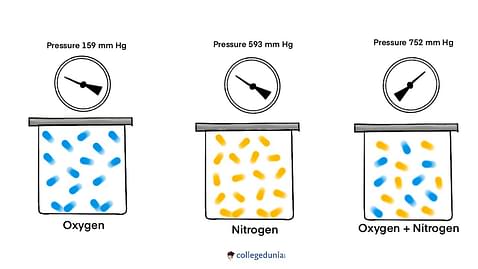
Partial Pressures of Gas Mixtures
Read More: Vapor Pressure
Solved ExampleExample: Calculate Kc and Kp for the given reaction at 295K, if the equilibrium concentrations are [N2O4] = 0.75M and [NO2] = 0.062M, and R = 0.08206 L atm K−1mol−1. Reaction: N2O4 (g) ⇌ 2NO2 (g) Solution: We can get Kc as Kc = \({[NO_2]^2\over[N_2O_4]} = {(0.062)^2\over0.75} = 0.00512 \) Hence, Kc can be represented as 5.12 x 10⁻³ We know that the Kp and Kc relation is Kp = Kc (RT)\(\bigtriangleup \)n Where, “R” represents the universal gas constant; “T” refers to the temperature at which the equilibrium is maintained and Δn is the difference in the number of moles of products and reactants. Δn = No. of moles of products − No. of moles of reactants Applying the above formula, we find Δn is 1. The universal gas constant and temperature of the reaction are already given. Therefore, we can proceed to find the Kp of the reaction. We know that the relation between Kp and Kc is Kp = Kc (RT)\(\bigtriangleup \)n ⇒ 0.00512 × (0.08206 × 295) ⇒Kp = 0.1239 ≈ 0.124 |
Things to Remember
[Click Here for Derivation of Relation Between Kp and Kc]
- Kp is the equilibrium constant in atmospheric pressure determined from the partial pressures of the equation of a reaction.
- Kc is the equilibrium constant, in molarity, which depicts the ratio of the equilibrium concentrations of products over the concentrations of reactants.
- Generally, the relation between Kp and Kc can be represented as:
- Kp = Kc (RT)\(\bigtriangleup \)n
- Kc = Kp(RT)-\(\bigtriangleup \)n
Read More:
Sample Questions
Ques 1. What is the relation between Kp and Kc? (2 marks)
Ans. Kp and Kc are the equilibrium constants of the gaseous mixture in a reversible reaction, and they are directly proportional to each other as shown by the equation
Kp = Kc (RT)\(\bigtriangleup \)n
Ques 2. How do you tell the difference between Kp and Kc? (1 mark)
Ans. The distinction between Kp and Kc is that Kp is the equilibrium constant with respect to atmospheric pressure, whereas Kc is the equilibrium constant with respect to the gaseous mixture's molar concentration.
Ques 3. Let us consider the decomposition of water:
2H2O (l) \(\rightleftharpoons\) 2H2(g) + O2(g)
Assuming that initially there is no oxygen or hydrogen gas present. As the reaction reaches equilibrium, the total pressure increases by 2.10atm. Determine the Kp for the reaction. (5 marks)
Ans. Equation: 2H2O (l) \(\rightleftharpoons\) 2H2(g) + O2(g)
| Initial | NA | 0 atm | 0 atm |
| Change | NA | +2x | +x |
| Equilibrium | NA | 2x | x |
Now, we look at the balanced equation in order to describe how the partial pressures can change when the reaction reaches an equilibrium. Based on the stoichiometric coefficients, if the value of PO2 increases by x, PH2 will change by 2x. The third row sums up the expressions of the first two rows to determine the partial pressures at equilibrium.
From Dalton's law of partial pressure:
Ptotal = PA + PB + PC + …
Hence the total pressure for the reaction is:
Ptotal = PH2 + PO2 = 2x + x = 3x
Now, we have observed total pressure of 2.10 atm, we can solve for the variable x:
Ptotal = 2.10 atm = 3x
x = 0.70 atm
Now, to find the equilibrium partial pressures for the two gases:
PH2 = 2x = 1.40 atm
PO2 = x = 0.70 atm
Now, we can solve for Kp:
Kp = (PH2)2 . (PO2)
= (1.40)2 . (0.70)
Kp = 1.37
Ques 4. We know that the relationship between Kp and Kc is Kp = Kc(RT)\(\bigtriangleup \)n What would be the value of \(\triangle\)n for the reaction NH4C1(s) \(\rightleftharpoons\) NH3(g) + HCl(g)? (3 marks)
Ans. The relationship between Kp and Kc is
Kp = Kc (RT)\(\bigtriangleup \)n
Where \(\bigtriangleup \)n = (number of moles of gaseous products) – (number of moles of gaseous reactants)
For the reaction,
NH4C1 (s) \(\rightleftharpoons\) NH3 (g) + HCl (g)
\(\bigtriangleup \)n = 2 – 0
= 2
Ques 5. The value of Kc for the reaction 302(g) —>2 03(g) is 2.0 x 10-50 at 25°C. If the equilibrium concentration of 02 in the air at 25°C is 1.6 x 10⁻², what is the concentration of O3? (3 marks)
Ans. 3O2- \(\rightleftharpoons\) 2O3 (g)
Kc = [O3]2/[O2]3
or (2.0 x 10-50)
= [O3]2/(1.6 x 10-2)3
Ques 6. Does this Kp/Kc relationship apply only to gaseous mixtures? (1 mark)
Ans. No, it does not. For all reversible processes, such as solid to gas, gas to solid, and so on, the relationship between Kp and Kc holds true.
Ques 7. How do Kp and P relate to each other? (1 mark)
Ans. Kp is the equilibrium constant determined from a reaction equation's partial pressures. It's a mathematical expression for the relationship between product and reactant pressures. Although it connects the pressures, it is a unitless number. While P refers to the pressure.
Ques 8. A sample of HI (g) is placed in a flask at a pressure of 0.2 atm. At equilibrium, the partial pressure of HI (g) is 0.04 atm. Determine the Kp for the given equilibrium? (3 marks) 2HI(g) \(\rightleftharpoons\) H2(g) + l2(g)
Ans. pHI = 0.04 atm,
pH2 = 0.08 atm,
pI2 = 0.08 atm
Kp = \({pH_2 \times pI_2 \over p^2_{HI}}\)
= \({0.08 atm \times 0.08 atm \over 0.04 atm \times 0.04 atm}\)
= 4.0
Ques 9. What is the unit of Kp? (1 mark)
Ans. Kp is usually measured in bar or atm.
Ques 10. What effect does temperature have on Kp? (2 marks)
Ans. When the temperature of the system is changed, the equilibrium constants are altered. At constant temperature, Kc or Kp is constant, but as the temperature changes, they fluctuate. The value of Kp decreases as the temperature rises. Hence, the equilibrium constant values drop with the rising temperatures.
Ques 11. Is Kp affected by volume? (2 marks)
Ans. As both sides of the reaction have the same number of moles, an increase in volume has no effect on the equilibrium, and thus there is no change in the direction. Similarly, there is no effect on the equilibrium when the volume is reduced.
Ques 12. What does it mean if Kc is greater than 1? (2 marks)
Ans. There will be an equilibrium shift in favour of products if Kc exceeds 1, though that doesn't mean that the molar concentration of reactants is negligible.
Ques 13. The reaction between N2 and H2 to form ammonia occurs at a temperature of 5000C. The value for Kc is given as 6 x 10⁻². What will be the value for Kp? (3 marks)
Ans. The relation between Kp and Kc for N2 + 3H2 → 2NH3
Given: T = 500 + 273 = 773 K
Kc = 6 x 10⁻²
\(\bigtriangleup\)n = 2-3-1 = -2
Kp = Kc (RT)\(\bigtriangleup \)n
Putting the values in the equation:
Kp = 6 x 10⁻² (0.0821×773)-2
= 6 x 10⁻² / (63.46)2
= 0.00148×10⁻⁵
Kp = 1.5×10−2 ×10−3
= 1.5×10⁻⁵
Ques 14. Give the relation between Kp and Kc for the reaction: 2NO(g)+CI2 (g) → 2NOCI(g). (3 marks)
Ans. The Kp and Kc relation can be represented as Kp = Kc(RT)\(\bigtriangleup \)n
where \(\bigtriangleup\)n = 2 – 1 – 2
= -1
Kp = Kc [RT]-1
Kp = \({Kc \over RT}\)
Ques 15. If KC > 10x, the products predominate the reactants. What is the value of x? (2 marks)
Ans. If KC > 10x, the products are predominant over the reactants in a chemical reaction as if KC is large the reaction nearly proceeds to completion.
For example: At 300K, H2(g) + Cl2(g) ⇌ 2HCl(g), KC = 4 x 1031.
Ques 16. If reaction quotient of a chemical reaction is 2 and the equilibrium constant is 3, what can be determined by the reaction? (2 marks)
Ans. In a reaction, if the reaction quotient is less than the equilibrium constant, it tends to increase and the reaction will move in the forward direction till it reaches equilibrium.
Ques 17. If the reaction quotient of a reaction is smaller than the equilibrium constant, what can be determined by the reaction? (2 marks)
Ans. If the reaction quotient is less than KC, it tends to increase and the reaction will move in the forward direction, till it reaches the value of the equilibrium constant.
Ques 18. What is the state of KC at equilibrium? (2 marks)
Ans. At equilibrium, the equilibrium constant, depicted by the symbol KC, and the reaction quotient, represented by the symbol QC, is equivalent.
Ques 19. If KC > 10-3 in a chemical reaction, what will happen? (1 mark)
Ans. If KC > 10-3, the reactants are predominant over the products and if if KC > 103, the products are predominant.
Ques 20. What will happen If QC>KC? (2 marks)
Ans. If QC > KC, QC tends to decrease to reach the value of equilibrium constant and the reaction will continue in the opposite direction, where QC is reaction quotient and KC is the equilibrium constant.
Ques 21. What is ideal gas equation? (1 mark)
Ans. Ideal Gas euqation is given by : PV= nRT
Ques 22: Define an ideal gas? (1 mark)
Ans. Ideal gases are defined as a group of randomly propagating point particles which intermix only through elastic collisions.
Ques 23: What are some properties of gases? (2 marks)
Ans. The three important properties of gases are:
- They occuply more volume than solids or liquids due to greater intermolecular distance between the gas particles.
- Gas moleculs are very easy to compress.
- Gas molecules expand to fill spaces around them.
For Latest Updates on Upcoming Board Exams, Click Here: https://t.me/class_10_12_board_updates
Also Check:



Comments