



Education Content Expert
Hygrometer is an instrument used for measuring humidity. It is used to measure the content of humidity in the soil, air, or other confined spaces. The term hygrometer is derived from the Greek word ‘Hygros’, which means moist or wet. Hygrometer is used in meteorological science for measuring the amount of water vapor in the air. Dew-point Hygrometer, Electrical Hygrometer, and Mechanical Hygrometer are the three main types of Hygrometer. It is used by several industries, like manufacturing, construction, agriculture, heating, restoration, and ventilation to keep a check on the humidity level.
| Table of Content |
Key Terms: Hygrometer, Psychrometer, Humidity, Water Vapor, Relative Humidity, Dry and Wet Bulb Hygrometer, Dew-point Hygrometer
What is Hygrometer?
[Click Here for Sample Questions]
A hygrometer is a device that calculates relative humidity.
- It is also known as a psychrometer.
- Hygrometer uses wet and dry bulb thermometers to calculate relative humidity.
- Digital hygrometers are now more widely used than older models.
- Relative humidity is the amount of water vapor in the atmosphere.
- Generally, warm air is substantially more humid than cold air.
- The maximum amount of water that the air can hold falls as the temperature of the atmosphere drops.
- A hygrometer is essential in all settings where humidity is a factor, including manufacturing, healthcare facilities, incubators, agricultural production and storage, humidors, and museums.
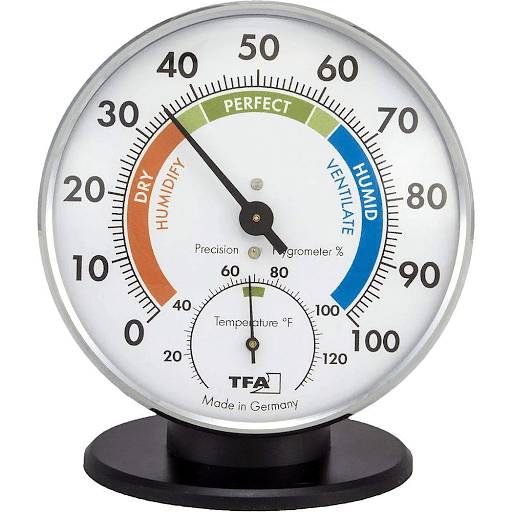
Hygrometer
Read More:
| Relevant Concepts | ||
|---|---|---|
| Unit of Humidity | Absolute Humidity | Temperature Measurement |
| Barometer | Manometer | Low Pressure & High-Pressure System |
Hygrometer Invention
[Click Here for Sample Questions]
Leonardo da Vinci built a crude hygrometer in the year 1480.
- Francesco Folli made tremendous progress and created a useful apparatus model in the 1600s.
- The hygrometer technology had also seen considerable advancements with the inventions of Robert Hooke.
- Johann Heinrich Lambert, a Swiss polymath, created a new comprehensive version in 1755.
- The first hygrometer was created in 1783 by Horace Benedict de Saussure, a Swiss physicist, and geologist who used human hair to determine humidity.
Hygrometer Working Principle
[Click Here for Sample Questions]
Evaporative Cooling is the principle behind the working of hygrometers.
- Water molecules absorb heat from the surface during evaporation, which causes water to become cool when it leaves a surface.
- The wet bulb constantly displays a lower temperature than the dry bulb as a result of this effect.
- The quick cooling effect is seen while bathing operates on the same principles.
- Low humidity and dry air can lead to high evaporation, which lowers the wet-bulb temperature.
- The temperature of the wet bulb lowers less when the humidity level in the air is fairly high because there is less evaporation from the wet bulb.
- The temperature will be the same for both the dry and wet bulbs in the event of 100 percent humidity.
- This is because there is little water evaporation from the wet bulb and no cooling effect results.

Dry and Wet Bulb Hygrometer
Read More: Factors Affecting Evaporation
Types of Hygrometers
[Click Here for Sample Questions]
There are various types of Hygrometers to determine humidity levels. The main types of Hygrometers are as follows:
Mechanical Hygrometer
- Organic materials (thin materials like ox gut, human hair, etc.) expand and contract in response to changes in humidity.
- The mechanical hygrometer's spring moves the needle on the dial as differences in the material are detected.
- As a result, relative humidity can be determined.
- For centuries, these analog gadgets have given reliable readings.
- Since these instruments are analog, it is essential to regularly calibrate them in order to retain the appropriate accuracy.
Electrical Hygrometer
- Electrical hygrometer calculates humidity by analyzing the variation in electrical resistance of a thin layer of a semiconductor device.
- Electrical hygrometers typically fall into one of two categories namely resistive or capacitive.
- Changes in capacitance or resistance are the basis for the calculation of an electrical hygrometer.
- The gadget typically has a sensor to track changes in a semiconductor on-chip layer such as lithium chloride.
Dew-point Hygrometer
- A polished mirror made of metal is typically used as a dew-point hygrometer.
- It is cooled at a fixed pressure and vapor content until moisture just starts to settle on it.
- The metal's dew point is the temperature at which condensation first appears.
Psychrometer
- Wet-bulb and dry-bulb thermometers make up the psychrometer.
- They are used to calculate humidity through evaporation.
- The expanded side of the wet-bulb thermometer is covered with a wet towel.
- Temperature can be changed by turning both thermometers in opposite directions or by blowing air over the bulbs.
- By examining the temperature differential between the wet bulb and the dry bulb, humidity in the air can be calculated.
Uses of Hygrometer
[Click Here for Sample Questions]
A hygrometer is used to determine the amount of moisture in the air or other enclosed spaces.
- It is crucial in the manufacturing sector, medical facilities, historical sites, agricultural businesses, food preservation, meteorology, etc.
- Systems for pharmaceutical manufacture and storage typically use hygrometers.
- Since most pharmaceutical drugs are hygroscopic, changes in humidity may have an impact on their chemical makeup.
- Electrical hygrometers are used in electronics like air conditioners.
- Devices that depend on temperature, pressure, and humidity have humidity sensors, also known as smart hygrometers, as essential components.
Check More:
| Related Topics | ||
|---|---|---|
| Vapour Pressure | Semiconductor Electronics | Water Pressure |
| Difference Between Vapor and Gases | Unit of Capacitance | Difference Between Evaporation and Condensation |
Things to Remember
- Hygrometer is an instrument used in meteorological science to measure humidity.
- The first crude hygrometer was made by renowned inventor Leonardo da Vinci.
- Hygrometers function on the principle of evaporative cooling.
- There are various types of Hygrometers namely Dew-point Hygrometer, Electrical Hygrometer, and Mechanical Hygrometer.
- Each type of hygrometer measures humidity using a particular set of operating principles.
- Hygrometers are used in manufacturing industries, hospitals, agricultural fields, food preservation, meteorology, etc.
Sample Questions
Ques. What is a Hygrometer? (1 Mark)
Ans. A hygrometer, also known as a wet and dry-bulb thermometer, is made up of two calibrated thermometers: one is dry and the other is kept moist with distilled water on a wick or sock.
Ques. What is a hygrometer used primarily for? (2 Marks)
Ans. The applications of a hygrometer are as follows:
- It is used for identifying the moisture in the air.
- It is used to detect the presence of water vapor in a gaseous mixture.
- It is used in a variety of manufacturing procedures and as a method for predicting the weather.
Ques. What distinguishes a hygrometer from a barometer? (1 Mark)
Ans. A barometer is used to measure the atmospheric pressure of the surrounding air, and a hygrometer to measure the atmospheric humidity.
Ques. Who created the hygrometer? (1 Mark)
Ans. In the 1400s, famed inventor Leonardo da Vinci produced the first crude hygrometer.
Ques. How should a Hygrometer be placed for measurements? (2 Marks)
Ans. One should put the hydrometer in a spot where the weather is highly suitable and away from moisture-producing areas like the kitchen or bathroom. The finest option will be the living room. Because of the efficiency and comfort of the heater, humidity levels occasionally may surpass 30% to 50%.
Ques. How do you use a hygrometer to measure humidity? (2 Marks)
Ans. A hair or thread is used by mechanical hygrometers to gauge the relative humidity of the air. The expansion of the hair or thread caused by exposure to water vapor is used to calculate the relative humidity. Sensors are used by electronic hygrometers to determine the relative humidity of the air.
Ques. At what precise moment should the digital hygrometer measurement be read? (2 Marks)
Ans. To get the correct reading, leave the hygrometer in place for close to 8 to 12 hours. The correct computation can only be discovered in this manner. When the value is 75%, you can determine whether the hygrometer is functioning properly.
Ques. What is the hygrometer's working principle? (2 Marks)
Ans. The evaporative cooling phenomenon is how hygrometers operate. Water molecules absorb heat energy from the surface as they evaporate off any surface, which causes the surface to cool. Wet bulbs always display lower temperatures than dry bulbs as a result of this cooling effect.
Ques. What measurement system is used for hygrometers? (1 Mark)
Ans. The amount of humidity or moisture in the air is measured with a hygrometer. The amount of fluid per volume of air is measured in milliliters per cubic centimeter.
Ques. Is a digital hygrometer better than an analog hygrometer? (1 Mark)
Ans. Yes, Digital hygrometers are better than analog hygrometers because they are the most accurate. They provide a reading for temperature as well as humidity.
Check-Out:



Comments