



Education Content Expert
Absolute Humidity is a measure of the actual amount of water vapor or moisture present in the air, regardless of the temperature of the air. It is expressed as grams of water vapor per cubic meter volume of air (g/m3). The higher the amount of water vapor in the air, the higher the absolute humidity would be. The maximum absolute humidity of warm air at 30°C or 86°F is approximately 30 g of water vapor, i.e. 30g/m3. On the other hand, the maximum absolute humidity of cold air at 0°C or 32°F is approximately 5g of water vapor, i.e. 5g/m3. Humidity refers to the amount or concentration of water vapor present in the air. Humidity is one of the factors that affect the changes in the weather and climate.
| Table of Content |
Key Terms: Absolute Humidity, Relative Humidity, Specific Humidity, Humidity, Water Vapor, Air, Atmosphere, Temperature, Moisture
What is Humidity?
[Click Here for Sample Questions]
Humidity is the amount of water vapor or moisture present in the air. The amount of water vapor or moisture in the air varies from one place to another. The concentration of water vapor is increased in the atmosphere through the processes like evaporation. Evaporation is aided by major natural sources of water like the sea, rivers, lakes, and ponds along with the process of boiling water.
- Owing to the concentration of water vapor in the atmosphere, the weather can be classified as sunny, cloudy, rainy, or humid.
- High levels of humidity are seen in the warm air as warm air can hold more water at higher temperatures.
- The more the content of water vapor in the atmosphere, the more latent energy is accessible for the generation of storms.
- Humidity is also defined as the ratio between the vapor pressure (air) to the vapor pressure at saturation.
- Humidity has no official SI Unit. The amount of water vapor that exists in the air is measured using a device called a hygrometer.
- Hygrometer is a device that is designed to calculate the relative humidity in an open or closed area.
Humidity is classified into three major categories which are
- Absolute Humidity
- Relative Humidity
- Specific Humidity
Read More:
| Relevant Concepts | ||
|---|---|---|
| Unit of Humidity | Factor Affecting Evaporation | Heat Index Formula |
| Distinguish between Weather and Climate | Relation Between Pressure and Density | Air Resistance Formula |
What is Absolute Humidity?
[Click Here for Sample Questions]
Absolute Humidity is the exact amount of water vapor or moisture present in the air, irrespective of the air’s temperature.
- If the amount of water vapor is high in the air, the value of absolute humidity will also be high.
- Absolute Humidity is used in measuring the weight of water vapor per unit volume of air.
- The unit of absolute humidity is g/m3 which is expressed as grams of moisture per cubic meter of air.
- A maximum of about 30 grams of water vapor can be present in a cubic meter volume of air with a temperature in the mid-80s.
- The range of absolute humidity starts from near 0 to roughly 30 grams per cubic meter in the atmosphere.
Mathematically, Absolute humidity is represented as:
ΔH = \(\frac{mH_2O}{V_{net}}\)
The value of absolute humidity varies as per the temperature and pressure changes if the volume is not fixed. Absolute humidity is also affected by the water distribution on the Earth along with the seasonal changes. It relatively remains constant as it is the measure of absolute moisture in the air.
How to Measure Absolute Humidity?
[Click Here for Sample Questions]
Absolute Humidity is the density of water vapor in the air (g/m3). In order to measure absolute humidity, one needs to follow the given steps:
- Calculate vapor pressure in millibars using the dewpoint temperature and formula number.
- Multiply the vapor pressure in millibars by 100 to get Pa.
- Once the vapor pressure is obtained in Pa, the gas law can be used to measure water vapor density or absolute humidity) by substituting Rw for R in the gas law formula and using the vapor pressure instead of the total atmospheric pressure used to calculate the density of air.
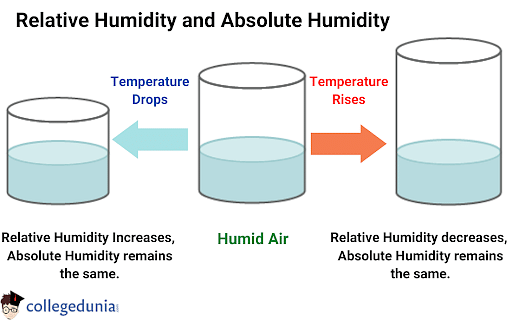
Absolute and Relative Humidity
Read More: Temperature Measurement
What is Relative Humidity?
[Click Here for Sample Questions]
Relative humidity refers to the ratio of the absolute humidity at a particular time to the highest possible humidity, which depends on the current air temperature.
- Relative humidity measures water vapor relative to the temperature of the air.
- Relative humidity is always expressed in percentage.
- The higher percentage of relative humidity means that the mixture of air and water is highly humid.
- It is affected by the temperature and geographical location of a particular region.
- Relative humidity changes when the quantity of water vapor changes.
- The relative humidity is 100% in the rainy season.
The formula for the rainy season is as follows:
\(Relative Humidity = \frac{Actual vapourdensity}{Saturationvapourdensity} \times 100\)What is Specific Humidity?
[Click Here for Sample Questions]
Specific Humidity is the ratio of the mass of water vapor to the total mass of the air parcel.
- It measures the weight of water vapor per unit weight of air.
- The unit of specific humidity is g.kg-1, which is grams of water vapor per kilogram of air.
- Specific humidity remains constant until the moisture in the air is not added or removed.
- It remains constant, even with changes in pressure and temperature.
Also Check:
Things to Remember
- Humidity is defined as the amount of water vapor present in the air.
- There are three major types of humidity namely Absolute Humidity, Specific Humidity, and Relative Humidity.
- Absolute Humidity is the mass of water vapor divided by the mass of dry air in a certain volume of air at a specific temperature.
- The warmer the air would be, the more water the air would be able to absorb.
- Absolute humidity is a measure of water vapor or moisture present in the air, regardless of temperature.
- Absolute humidity is expressed as grams of moisture per cubic meter of air (g/m3).
Sample Questions
Ques. Define humidity. (3 Marks)
Ans. Humidity is defined as the measure of water vapor content in the air or atmosphere. The higher the content of water vapor in the air, the higher will be the humidity. Humidity occurs due to the water evaporating from water bodies like lakes and oceans. When the humidity is high, the air feels extremely muggy or uncomfortable on our skin as the water vapor holds heat in the air. Humidity is much more in hot or warm air.
Ques. What is Absolute Humidity? (3 Marks)
Ans. Absolute humidity is the amount of water content present in the air. It is expressed in either grams per cubic meter or grams per kilogram. Absolute humidity ranges from near zero to roughly 30 grams per cubic meter. Mathematically, it is defined as the mass of the water vapor divided by the volume of the air and water mixture.
Ques. Name the types of humidity. (2 Marks)
Ans. Humidity has been classified into three categories which are:
- Absolute Humidity
- Relative Humidity
- Specific Humidity
Ques. What is Relative Humidity? (3 Marks)
Ans. Relative Humidity is the comparison of the amount of moisture present in the air to the amount of moisture air can hold. The amount of moisture the atmosphere can hold is completely dependent on the temperature.
Relative Humidity = Actual Amount of Water in the Air/Saturated Amount of Moisture in the Air can hold at that Temperature.
Ques. Why does it feel more humid at night? (3 Marks)
Ans. The sun warms up during the day and the warm air absorbs moisture from the grass, the earth, and any bodies of water readily. When things cool down at night, the cooling air might hit the saturation point. Thus, the humidity level is now likely to be close to 100%. In case it reaches 100% and attempts to go higher, fog will be formed. This particular effect is also responsible for rain and snow.
Ques. What is the unit of absolute humidity? (1 Mark)
Ans. The unit of absolute humidity is g/m3.
Ques. How many layers are there in the atmosphere? (3 Marks)
Ans. There are five layers in the atmosphere which are as follows:
- Exosphere
- Thermosphere
- Mesosphere
- Stratosphere
- Troposphere
Ques. Mention any three effects of Humidity. (3 Marks)
Ans. The effects of humidity are as follows:
- Bacteria and viruses spread easily in humid environments because of which people often fall sick, especially from respiratory problems.
- During humidity, higher levels of dust mites and fungi cause allergies among people.
- Humidity leads to a rise in temperature because of which the evaporation rate of sweat from our bodies slows.
Ques. Which instrument is used to measure humidity? (1 Mark)
Ans. Humidity can be measured through a special device called a hygrometer.
Ques. How to calculate absolute humidity? (1 Mark)
Ans. Absolute humidity is calculated by dividing the mass of water contained in the air by the volume occupied by the quantity of air concerned.
Check-More:



Comments