



Content Curator
Water pressure is defined as the force applied perpendicular to the surface of the object per area over which the force is distributed. The gauge pressure is the pressure in relation to the surrounding atmosphere. Pressure is expressed using a variety of units. Pascal is the SI unit of pressure (Pa). Water pressure, on the other hand, is a term used to describe the force of water flowing through a channel or pipe.
| Table of Content |
Key Takeaways: water pressure, force, density of water, fluid, weight, area
Concept of water pressure
[Click Here for Sample Questions]
It is true for both liquids and gases because they are both fluids, yet the pressure in a liquid differs slightly from that of a gas. Because liquids do not fill the full container like gases do, we can clearly see that this is not the case.
This is due to the bonds that exist between the liquid's molecules. When we pour a liquid into a container, gravity pulls it down, so it fills the bottom first. The gravitational force will be the same as our scale reading. It is the weight of the liquid that causes pressure in that liquid.

Also, because of gravity, the pressure in the liquid increases with depth. The bottom liquid must support the weight of all the liquid above it, as well as the weight of air above it. When we swim at the bottom of a pool, we can feel the difference in pressure. The pressure grows as we travel further underwater because there is more and more weight on top of us.
Also Read:
Water Pressure Formula
The formula for calculating water pressure is as follows:
P = ρgh
Where,
P = water pressure in Pa
ρ = density of water in kg.m-3
g = gravitational force in 9.81 m.s-2
h = height in m
Water Pressure Calculation Formula
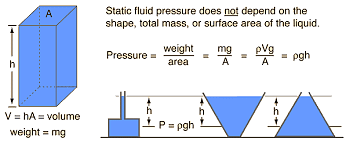
The height of the container is 'h,' and the area is A.
The bottom of the container supports the complete weight of the water in it. The vertical sides, on the other hand, cannot exert an upward force on the fluid since it is not strong enough to withstand a shearing force, which is why the bottom supports everything.
As can be seen, the container's bottom supports the weight of the fluid inside, which is given as:
w = mg
We also know that the pressure is equal to the weight of the fluid mg divided by the area of the container's bottom (here, A is the area of the container's bottom, which is given by:
P = mg/A …(1)
The mass of the fluid is given as:
m= ρV …(2)
The volume of the fluid inside the container is given as:
V= Ah …(3)
Here,
A= cross-sectional area
h= depth
The water pressure calculator by height is obtained by entering the values of (2) and (3) in (1):
P = ρAhg/A
P = ρgh
This equation can be used to compute a fluid's water pressure.
Also Read:
Water Pressure Equation
[Click Here for Sample Questions]
The water pressure equation is valid in a wide range of situations other than those in which it is derived here. If the container were not present, the surrounding fluid would still exert this pressure, causing the fluid to remain static.
As a result, the equation P = ρhg denotes the pressure exerted by the weight of any fluid with an average density ρ of at any depth h below its surface.
The pressure underwater formula still remains true to great depths for liquids that are almost incompressible.
Also Read:
Points to Remember
- Pressure is defined as a force exerted perpendicular to the object's surface.
- Assume that someone is swimming underwater. The deeper the swimmer swims tThe greater the water pressure.
- Because of gravity, the pressure in the liquid increases with depth.
- The density of the liquid also affects the water pressure.
Also Read:
Sample Questions
Ques: A water tank with a 5 m height is filled with water. Compute the pressure at the bottom using the water pressure formula. (3 Marks)
Ans: Given,
Density of water= 1000 kg/m3
g= 10 m/s2
Height = 5 m
The water pressure on the tank will be
P = ρgh
P = 1000 x 5 x 10
P = 50,000 Pa
Ques: A water tank with a 6.2 m height is filled with water. Compute the pressure at the bottom using the water pressure formula. (3 Marks)
Ans: Given,
Density of water= 1000 kg/m3
g= 10 m/s2
Height = 6.2 m
The water pressure on the tank will be
P = ρgh
P = 1000 x 6.2 x 10
P = 62000 Pa
Ques: A water tank with a 0.8 m height is filled with water. Compute the pressure at the bottom using the water pressure formula. (3 Marks)
Ans: Given,
Density of water= 1000 kg/m3
g= 10 m/s2
Height = 0.8 m
The water pressure on the tank will be
P = ρgh
P = 1000 x 0.8 x 10
P = 8000 Pa
Ques: The height of a waterfall is 200 metres. Calculate how much pressure is lost when it reaches the surface. (2 Marks)
Ans: Given:
Density of water, ρ = 1000 kg/m3
g = 9.8 m/s2
h = 200 m
The formula for calculating pressure loss is as follows : 0.4335 ×200 = 86.7 Pa.
Ques: The height of a waterfall is 240 metres. Calculate how much pressure is lost when it reaches the surface. (2 Marks)
Ans: Given:
Density of water, ρ = 1000 kg/m3
g = 9.8 m/s2
h = 240 m
Pressure loss = 0.4335 x h = 0.4335 × 240 = 104.04 Pa.
Ques: The height of a waterfall is 140 metres. Calculate how much pressure is lost when it reaches the surface. (2 Marks)
Ans: Given:
Density of water, ρ = 1000 kg/m3
g = 9.8 m/s2
h = 140 m
Pressure loss = 0.4335 x h = 0.4335 × 140 = 60.69 Pa.
Ques: The height of a waterfall is 40 metres. Calculate how much pressure is lost when it reaches the surface. (2 Marks)
Ans: Given:
Density of water, ρ = 1000 kg/m3
g = 9.8 m/s2
h = 40 m
Pressure loss = 0.4335 x h = 0.4335 × 40 = 17.34 Pa.
Ques: The height of a waterfall is 25 metres. Calculate how much pressure is lost when it reaches the surface. (2 Marks)
Ans: Given:
Density of water, ρ = 1000 kg/m3
g = 9.8 m/s2
h = 25 m
Pressure loss = 0.4335 x h = 0.4335 × 25 = 10.8 Pa.
Also Read:



Comments