



Education Content Expert
Identity Function is a function that gives back the identical value that it received as input. It is also referred to as Identity Relation, Identity Map, or Identity Transformation.
If f is a function, the Identity function is expressed as the following for all values of x.
| f(x) = x |
The function, f : P → P, is defined in terms of relations and functions as
| b = f (a) = a for each a ϵ P |
Where P is the set of real numbers. Here, the function's domain and range are both P, and the plotted graph will show a straight line that goes through the origin.
Key Terms: Identity Function, Functions, Sets, Identity Function Graph, Straight Line, Domain, Range, Real-valued Function
What is Identity Function?
[Click Here for Sample Questions]
Identity Function is a type of function is which in which every element in a set A represents itself as another element, i.e., g(a) = a ∀ a ∈ A.
- It is represented by "I" and has the form g(x) = x.
- As the image of an element in the domain and the output in the range is the same, this function is known as an identity function.
- Thus, an identity function corresponds to each actual number to itself.
- It has the same input and output.
Mathematically, the Identity Function can be expressed as
| f(a) = a ∀ a ∈ R |
Where a refers to the element of set R.
Read More:
Identity Function Example
Consider an example of a function that maps elements of Set A = {1, 2, 3, 4, 5} to itself.
g: A → A such that, g = {(1, 1), (2, 2), (3, 3), (4, 4), (5, 5)}.
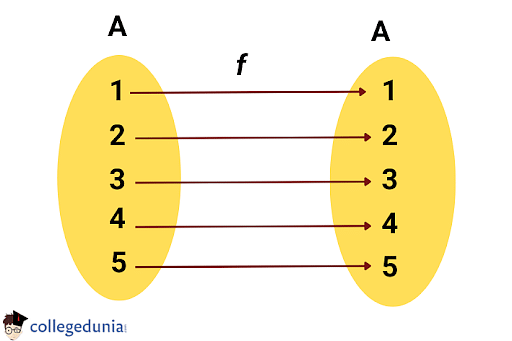
Identity Function
From the given image, it can be seen that function f is an identity function as each element of A is mapped onto itself. The function f is one-one and so on.
Domain, Range and Inverse of Identity Function
[Click Here for Previous Year Questions]
A function that has a real value and can be written as g: R→R so that g(x) = x, for each x∈R, is referred to as an identity function. Here, R is a collection of real numbers and the g function's domain. If the input is √10, the output will also be √10; if the input is 42, the output will also be 42.
- The domain of the identity function g(x) is R.
- The range of the identity function g(x) is also R.
- An identity function's co-domain and range are equal sets.
Properties of Identity Function
[Click Here for Sample Questions]
When the output of a function corresponds exactly to the unmodified arguments, identity functions are used. Identity Function shouldn't be confused with either a null or an empty function.
The important properties of an identity function are
- The identity function is a type of linear and real-valued function.
- The graph of the identity function forms a 45° angle with the x- and y-axis.
- Given that the function is bijective, it is the inverse of itself.
- The graphs of the identity function and its inverse function are identical.
Identity Function Graph
[Click Here for Previous Year Questions]
For the Identity Function Graph, first plot the values of the x-coordinates on the x-axis and the values of the y-coordinates on the y-axis. Identity Function Graph is a straight line through the origin. The domain and range for an identity function are the same.
| x | -2 | -1 | 0 | 1 | 2 |
| f(x) = y | -2 | -1 | 0 | 1 | 2 |
The values are identical for the x-axis and y-axis as seen in the table. So, using these values as the basis, the Identity Function Graph will be plotted.
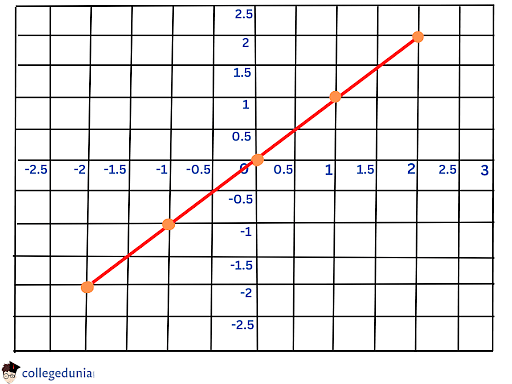
Identity Function Graph
Identity Function Examples
[Click Here for Sample Questions]
Here are some solved examples dealing with Identity Function:
| Example 1: Find x and y if (4x + 3, y) = (3x + 5, – 2). Solution: Since (4x + 3, y) = (3x + 5, – 2), thus, 4x + 3 = 3x + 5 4x - 3x = 5 - 3 x = 2 Now, it can be clearly seen that y = – 2. Thus, x is equal to 2 and y is equal to -2. Example 2: Find x and y if (x – y, x + y) = (6, 10). Solution: The given expression is (x – y, x + y) = (6, 10). x – y = 6 x + y = 10 ∴ 2x = 16 x = 8 Now, substitute the value of x in the expression x – y = 6. 8 – y = 6 ∴ y = 2 Thus, the value of x is 8 and y is 2. |
Check More:
Things to Remember
- Identity Function is a function that returns the value that was used as its argument.
- Mathematically, it is expressed as f(a) = a ∀ a ∈ R, where a is the element of set R.
- The domain and the range of identity functions are the same.
- Identity Function Graph is a straight line that passes through the origin.
- The slope of Identity Function Graph always remains at 1.
- Identity Function’s inverse exists which is also an identity Function because it is injective.
Previous Years’ Questions
- (x−1)(x2 −5x+7)<(x−,1), then x belongs to… (BITSAT - 2007)
- Consider the following lists… (AP EAPCET)
- If f:R→R be defined by f(x)=ex and… (WBJEE - 2018)
- f : R → R and g : [0, ∞) → R is defined by f(x)... (KCET - 2019)
- The domain of the function f(x)... (KEAM)
- The set of zeros of f(x)=0 is a non-empty set, when… (AMUEEE - 2013)
- Let f : R → R be any function. Define g : R → R by…
- Which of the following is not a function…
- A set A has 5 elements. Then the maximum number of relations… (COMEDK UGET - 2007)
- In the group {1,2,3,4,5,6} under multiplication mod… (COMEDK UGET - 2009)
Sample Questions
Ques. Prove that f(2x) = 2x is an Identity Function. (5 Marks)
Ans. Given, f(2x) = 2x
Put the values of x in the given function.
If x = 1, then
f(2(1)) = 2(1) ⇒ f(2) = 2
If x = 2, then
f(2(2)) = 2(2) ⇒ f(4) = 4
If x = 3, then
f(2(3)) = 2(3) ⇒ f(6) = 6
If x = 0, then
f(2(0)) = 2(0) ⇒ f(0) = 0
We can now move on with some negative values of x.
If x =-1, then
f(2(-1)) = 2(-1) ⇒ f(-2) = -2
If x = -2, then
f(2(-2)) = 2(-2) ⇒ f(-4) = -4
If x = -3, then
f(2(-3)) = 2(-3) ⇒ f(-6) = -6
Now, draw a table for all values of x to draw the graph for these values.
| x | -3 | -2 | -1 | 0 | 1 | 2 | 3 |
| y=f(x) | -6 | -4 | -2 | 0 | 2 | 4 | 6 |
Plotting the values, we get

The function f(2x) = 2x plots a straight line, thus, it is an identity function.
Ques. What is an Identity Function? (3 Marks)
Ans. Identity Function is a function in which each element in a set say Set B gives the image of itself as the same element. It means
g (b) = b ∀ b ∈ B
Thus, an Identity Function takes the form g(x) = x and it is denoted by "I". It is called so because the image of an element in the set is identical to the element. It means that the output of an identity function is the same as its input.
Ques. Define the Range of an Identity Function. (2 Marks)
Ans. The domain and the range of an identity function have real numbers. The domain and the range of an identity function are the same. For an identity function f(x) = x, if the input is √4, the output will also be √4. If the
input is 1, the output will also 1.
Ques. If g(y) = (2y+3)/(3y-2).Then prove that g ◦ g is an identity function. (3 Marks)
Ans. Given that, g(y) = (2y+3)/(3y-2)
g ◦ g (y) = g(g(y)) = g((2y+3)/(3y-2))
2[(2y+3)/3y-2] + 3 / 3[(2y+3)/3y-2] + 2
=(4y + 6 + 9y - 6)/(6y + 9 - 6y + 4)
= 13y/13
= y
Hence, g ◦ g (y) = y. Therefore, g ◦ g (y) is an identity function.
Ques. Let A = {1, 2, 3, 4} and B = {5, 7, 9}. Determine
(i) A × B
(ii) B × A
(iii) Is A × B = B × A ?
(iv) Is n (A × B) = n (B × A)? (3 Marks)
Ans. Since A = {1, 2, 3, 4} and B = {5, 7, 9}. Therefore,
(i) A × B = {(1, 5), (1, 7), (1, 9), (2, 5), (2, 7),
(2, 9), (3, 5), (3, 7), (3, 9), (4, 5), (4, 7), (4, 9)}
(ii) B × A = {(5, 1), (5, 2), (5, 3), (5, 4), (7, 1), (7, 2),
(7, 3), (7, 4), (9, 1), (9, 2), (9, 3), (9, 4)}
(iii) No, A × B ≠ B × A. Since A × B and B × A does not have the same
ordered pairs.
(iv) n (A × B) = n (A) × n (B) = 4 × 3 = 12
n (B × A) = n (B) × n (A) = 4 × 3 = 12
Hence n (A × B) = n (B × A)
Ques. State the Value of Identity Function? (2 Marks)
Ans. A function is considered to be an identity function only if it returns the same value of the input as the output. In simpler terms, if g is an identity function, then the equality g(x) = x holds for all x.
Ques. Find the domain for which the functions f (x) = 2x² – 1 and g (x) = 1 – 3x are equal. (3 Marks)
Ans. f (x) = g (x)
⇒ 2x² – 1 = 1 – 3x
⇒ 2x² + 3x – 2 = 0
⇒ 2x² + 4x – x – 2 = 0
⇒ 2x (x + 2) – 1 (x + 2) = 0
⇒ (2x – 1) (x + 2) = 0
This domain for which the function f (x) = g (x) is { 1/2,-2}.
Ques. How does an Identity Function look? (2 Marks)
Ans. In order to graph an identity function, the values of x-coordinates are plotted on the x-axis, and the values of y-coordinates are plotted on the y-axis. Identity functions have the same range and domain, thus, their graph always appears to be a straight line that passes through the origin. Identity Function Graph is a line that is inclined at an angle of 45° to the positive x-axis and passes through the first and the third quadrant.
Ques. What is the Slope of the Identity Function Graph? (2 Marks)
Ans. Identity Function is a linear polynomial function and is defined as g: R → R such that g(x) = x. The domain and the range for an identity function are equal. The slope of an identity function graph is m=1 s it makes an angle of 45° with the positive x-axis.
Ques. What will be the number of elements in the range of an identity function on a set containing 9 elements?
(a) 32
(b) 34
(c) 38
(d) 316 (2 Marks)
Ans. (a) 32
Explanation: If an element is related to itself, then it is referred to as an identity function. It means that g(x) = x. Thus, if a set has 9 elements, then the range of the function will also have 9 = 32 elements.
For Latest Updates on Upcoming Board Exams, Click Here: https://t.me/class_10_12_board_updates
Check-Out:



Comments