



Education Content Expert
Intersection of Sets is an operation on sets that lists the common elements present in two or more sets. A set is a well-defined group of objects in mathematics.
- Set Operations are operations that involve combining different sets in order to create a new set with unique properties.
- Intersection of Sets is the set that includes all the elements that are present in both sets.
- It is denoted by the symbol "∩".
- Intersection A and B (also written as A intersection B) lists all the elements that are shared by two sets A and B and are present in both sets.
Example: Consider Set A = {1,2,3,4,5} and Set B = {3,4,6,8}.
So, A ∩ B = {3,4}
Thus, the Intersection of Set A and Set B is {3,4}.
Read More: NCERT Solutions for Class 11 Maths Sets
Key Terms: Intersection of Sets, Sets, Venn Diagrams, Set Operations, Set Theory, Elements, Union of Sets
What is Intersection of Sets?
[Click Here for Sample Questions]
Intersection of Sets is the set of all elements which are common to all the given sets.
- In set theory, the intersection of sets is defined as the set of all the common elements in Set A and Set B.
- The symbol '∩' denotes the Intersection of Sets.
- For instance, A ∩ B is read as A intersection B.
Example of Intersection of Sets
If B is the set of the first five multiples of 4, and A is the set of even numbers less than 10, then the intersection of these two can be found as follows:
A = {2, 4, 6, 8}
B = {4, 8, 12, 16, 20}
4 and 8 are the elements that both A and B share.
Thus, A ∩ B = {4, 8}
Cardinal Number of Sets
Cardinal Number of a set refers to how many unique elements are present in a finite set. The cardinal number of sets is written as n(A), which can be read as "number of set elements."
For instance,
Set X = {2, 4, 5, 9, 15}
Consequently, Set X's cardinal number is 5. Consequently, it is written as n(x) = 5.
Read More:
Intersection of Sets Symbol
[Click Here for Sample Questions]
The set containing all the components that both A and B share is the intersection of the two sets A and B, which are subsets of the universal set U.
- It is symbolized by the character "∩".
- Intersection of sets A and B is represented by all the elements that are part of both sets.
A Intersection B Formula
The formula for the intersection of sets is given as
A ∩ B = { x : x ∈ A and x ∈ B }
It means x is an element of A ∩ B, if and only if x is an element of both Sets A and B. Therefore, the word “AND” represents the intersection of sets.
Intersection of Sets Venn Diagram
[Click Here for Sample Questions]
Venn diagrams are the pictorial representation of sets in which each set is represented as a circle. They make it simple to understand where sets intersect. Circles that overlap indicate that there is a connection between two or more sets and that they share components. The circles that don't overlap also don't have anything in common.
Consider Set A = {1, 2, 3, 4,} and Set B = {3, 4, 6, 8}.
A ∩ B = {3, 4}
Intersection of Sets Venn Diagram is given as
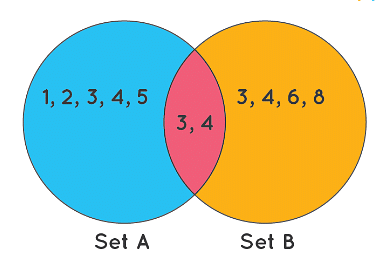
Intersection of Sets Venn Diagram
Intersection of Two Sets
[Click Here for Sample Questions]
- Intersection of Two Sets, say X and Y, is the largest set containing all the elements shared by X and Y.
- Intersection of two sets can be an empty set, meaning that there are no elements in the intersection set, or it can be a set with at least one element.
- If A and B are two sets with the relationship A ∩ B = φ, then A and B are referred to as disjoint sets.
- Therefore, there are no elements at the point where A and B meet.
Intersection of Three Sets
[Click Here for Sample Questions]
If A, B, and C are three sets, then the set of all elements that are shared by A, B, and C is the intersection of these three sets. It can be represented as A ∩ B ∩ C.
Consider three sets,
- A = {6, 8, 10, 12, 14, 16}
- B = {9, 12, 15, 18, 21, 24}
- C = {4, 8, 12, 16, 20, 24, 28}
These three sets can be expressed as intersecting at A ∩ B ∩ C. The only element that connects A, B, and C is 12.
As a result, A ∩ B ∩ C = {12}
Intersection of Sets Properties
[Click Here for Sample Questions]
The following is a list of some properties of the intersection operation:
(I) Commutative Law: A ∩ B = B ∩
Given, A = {1, 2, 3, 4, 5, 6} and B = {2, 3, 5, 7}.
Now, A ∩ B = {1, 2, 3, 4, 5, 6} ∩ {2, 3, 5, 7} = {2, 3, 5}
B ∩ A = {2, 3, 5, 7} ∩ {1, 2, 3, 4, 5, 6} = {2, 3, 5}
As a result, A ∩ B = B ∩ A.
(II) Associative Law: (A ∩ B) ∩ C = A ∩ (B ∩ C)
Given, A = {1, 2, 3, 4}, B = {3, 4, 5, 6}, and C = {5, 6, 7, 8 }.
Now,
A ∩ B = {1, 2, 3, 4} ∩ {3, 4, 5, 6} = {3, 4}
(A ∩ B) ∩ C = {3, 4} ∩ {5, 6, 7, 8} = { } = φ
And
B ∩ C = {3, 4, 5, 6} ∩ {5, 6, 7, 8} = {5, 6}
A ∩ (B ∩ C) = {1, 2, 3, 4} ∩ {5, 6} = { } = φ
As a result, (A ∩ B) ∩ C = A ∩ (B ∩ C)
(III) Law of φ and U: φ ∩ A = φ, U ∩ A = A
Take into account φ = { } and A = 10, 11, 12.
φ ∩ A = { } ∩ {10, 11, 12} = { } = φ
Let A = 4, 8, 12, 16, 20 and U = 2, 4, 6, 8, 10, 12, 14, 16, 18, 20.
U ∩ A = {2, 4, 6, 8, 10, 12, 14, 16, 18, 20} ∩ {4, 8, 12, 16, 20} = {4, 8, 12, 16, 20} = A
(IV) Idempotent Law: A ∩ A = A
Consider: A = {a, b, c, d, e} such that A ∩ A = {a, b, c, d, e} ∩ {a, b, c, d, e} = {a, b, c, d, e} = A
(V) Distributive Law: A ∩ (B U C) = (A ∩ B) U (A ∩ C)
Consider three sets, A = = {2, 4, 6, 8}, B = {2, 3, 5, 7} and C = {3, 4, 5, 6}.
B U C = {2, 3, 5, 7} U {3, 4, 5, 6} = {2, 3, 4, 5, 6, 7}
A ∩ (B U C) = {2, 4, 6, 8} ∩ {2, 3, 4, 5, 6, 7} = {2, 4, 6}
A ∩ B = {2, 4, 6, 8} ∩ {2, 3, 5, 7} = {2}
A ∩ C = {2, 4, 6, 8} ∩ {3, 4, 5, 6} = {4, 6}
(A ∩ B) U (A ∩ C) = {2} U {4, 6} = {2, 4, 6}
Thus, A ∩ (B U C) = (A ∩ B) U (A ∩ C)
Intersection of Sets Examples
[Click Here for Sample Questions]
Here are a few examples on Intersection of Sets for a better understanding of the concept:
| Example: Consider A = { 3, 5, 7, 9, 11}, B = {7, 9, 11, 13}, and C = {11, 13, 15}, find B∩C and A∩B∩C. Solution: Given that
Thus, B ∩ C = {11, 13} A ∩ B ∩ C = {11} |
Union and Intersection of Sets
Union of two sets A and B refer to the set of all those elements which are either in A or in B. On the other hand, the intersection of two sets A and B is the set of all elements which are common. The formulas for the union and intersection of given sets based on the cardinality of sets are as follows:
If A and B are finite sets such that A ∩ B = φ, thus,
n (A ∪ B) = n (A) + n (B).
If A ∩ B ≠ φ, then
n (A ∪ B) = n (A) + n (B) – n (A ∩ B)
Check More:
Things to Remember
- Intersection of Sets is the largest set containing all the elements common in two or more sets.
- If A and B are two sets, then the set of all elements that are shared by sets A and B is the intersection of sets.
- It is denoted by the symbol “∩” and is written as ‘A ∩ B’.
- Intersection of Sets Formula is given as A ∩ B = {x : x ∈ A and x ∈ B}.
- Union of Sets refers to the set of elements that are a part of either of the given sets.
Sample Questions
Ques. If Set A = {a,b,c,d,e,f,g,h,i} and Set B = {a,e,i,o,u}. Determine the intersection of given sets. (3 Marks)
Ans. Given that
- Set A = {a,b,c,d,e,f,g,h,i}
- Set B = {a,e,i,o,u}
Thus, A ∩ B = {a, e, i} (Common Elements of Sets A and B).
Then, n(A ∩ B) = 3
Therefore, n(A ∩ B) = 3.
Ques. Let P = {1, 2, 3, 5, 7, 11}, Q = {first five even natural numbers}. Find the cardinal number of the intersection of sets n(P ∩ Q) as well as the intersection of sets P ∩ Q. (3 Marks)
Ans. Given sets are
P = {1, 2, 3, 5, 7, 11}
Q is the first five even natural numbers, thus, Q = { 2, 4, 6, 8, and 10}.
As a result, P ∩ Q = {2} So,n(P ∩ Q)= 1
Consequently, P ∩ Q = {2} and n(P ∩ Q)= 1.
Ques. Suppose A = {1,3,5,7,9}, B = {0,5,10,15}, and U = {0,1,3,5,7,9,10,11,15,20}. Find (A, B)', A, and B. (3 Marks)
Ans. Given that
- A = {1,3,5,7,9}
- B = {0,5,10,15}
- U = {0,1,3,5,7,9,10,11,15,20}
Then, A ∩ B = {5}
⇒ (A ∩ B)’ = {0,1,3,7,9,10,11,15,20}
Consequently, A ∩ B = {5} and (A ∩ B)’ = {0,1,3,7,9,10,11,15,20
Ques. If A = { 3, 5, 7, 9, 11}, B = {7, 9, 11, 13}, and C = {11, 13, 15}, then find B ∩ C and A ∩ B ∩ C. (3 Marks)
Ans. Given,
- A = { 3, 5, 7, 9, 11}
- B = {7, 9, 11, 13}
- C = {11, 13, 15}
B ∩ C = {11, 13}
A ∩ B ∩ C = {11}
Ques. If Y = (Odd Natural Numbers up to 14) and X = "Multiples of 3 between 1 and 20," Discover the point where the two sets X and Y intersect. (3 Marks)
Ans. Multiples of 3 between 1 and 20 are what X is.
Hence, X = { 3,6,9,12,15,18}
Even natural numbers up to 15 equal Y.
Hence, Y = { 2,4,6,8,10,12,14}
As a result, the largest set that only contains elements that are shared by the two given sets, X and Y, is the intersection of the two.
Consequently, X ∩ Y = { 6, 12 }
Ques. Find the Union and Intersection of two sets P and Q Where Set P = { -29, -45, -10, -30, -3, -39, 24} and Set Q = { -46, 21, -8}. What is the intersection, union, and cardinal number of P and Q? (3 Marks)
Ans. Given Sets are
- P = { -29, -45, -10, -30, -3, -39, 24}
- Q = { -46, 21, -8}
Union = { -10, - 30, - 3, -29, - 45, - 39, 24, - 46, 21,- 8}
Intersection = {}
- P's element count is equal to its cardinal number, which is seven.
- Q's element count is equal to its cardinal number, which is three.
The total number of elements in both sets is equal to 10 when two sets are combined.
A number of elements in the intersection of two sets' cardinal numbers equal 0.
Ques. Let A = {1, 3, 5, 7}, B = {5, 7, 9, 11} and C = {1, 3, 5, 7, 9, 11, 13}. Prove that: (A∩ B) U (A ∩ C) = A ∩ (BU C). (3 Marks)
Ans. Given sets are
- A = {1, 3, 5, 7}
- B = {5, 7, 9, 11}
- C = {1, 3, 5, 7, 9, 11, 13}
B U C = { 5, 7, 9,1, 3,11, 13}
A ∩ (B U C) = { 3, 5,1,7}
Hence, A ∩ B = {5, 7}
A ∩ C = {1, 3, 5, 7}
(A∩B) U (A∩C) = {1, 3, 5, 7} … {Hence proved}
Ques. If P = {Multiples of 3 between 1 and 20} and Q = {Even natural numbers up to 15}, then, find the point where the two sets P and Q intersect. (3 Marks)
Ans. Given that P = {multiples of 3 between 1 and 20}
So, P = {3, 6, 9, 12, 15, 18}
Q is equal to "even natural numbers up to 15"
So, Q = {2, 4, 6, 8, 10, 12, 14}
As a result, P and Q's intersection is the largest set that only includes elements that are shared by P and Q.
Consequently, P ∩ Q = {6, 12}.
Ques. Are A ∩ B and B ∩ A equal? (3 Marks)
Ans. According to the commutative property of the intersection of sets, the order of the operating sets does not affect the resultant set. Thus A ∩ B is equal to B ∩ A.
Consider Sets, P = {a, b, c, d, e}, and Q = {a, e, i}
A ∩ B = {a, e} and B ∩ A = {a.e}
Thus, A ∩ B is equal to B ∩ A.
Ques. What is Complement of Intersection of Sets? (2 Marks)
Ans. Complement of Intersection of Sets is the set of elements that are members of the universal set U but not members of set A ∩ B. In simpler terms, the complement of the intersection of the given sets is the union of the sets excluding their intersection. It is denoted as (A∩B)´.
Check-Out:



Comments